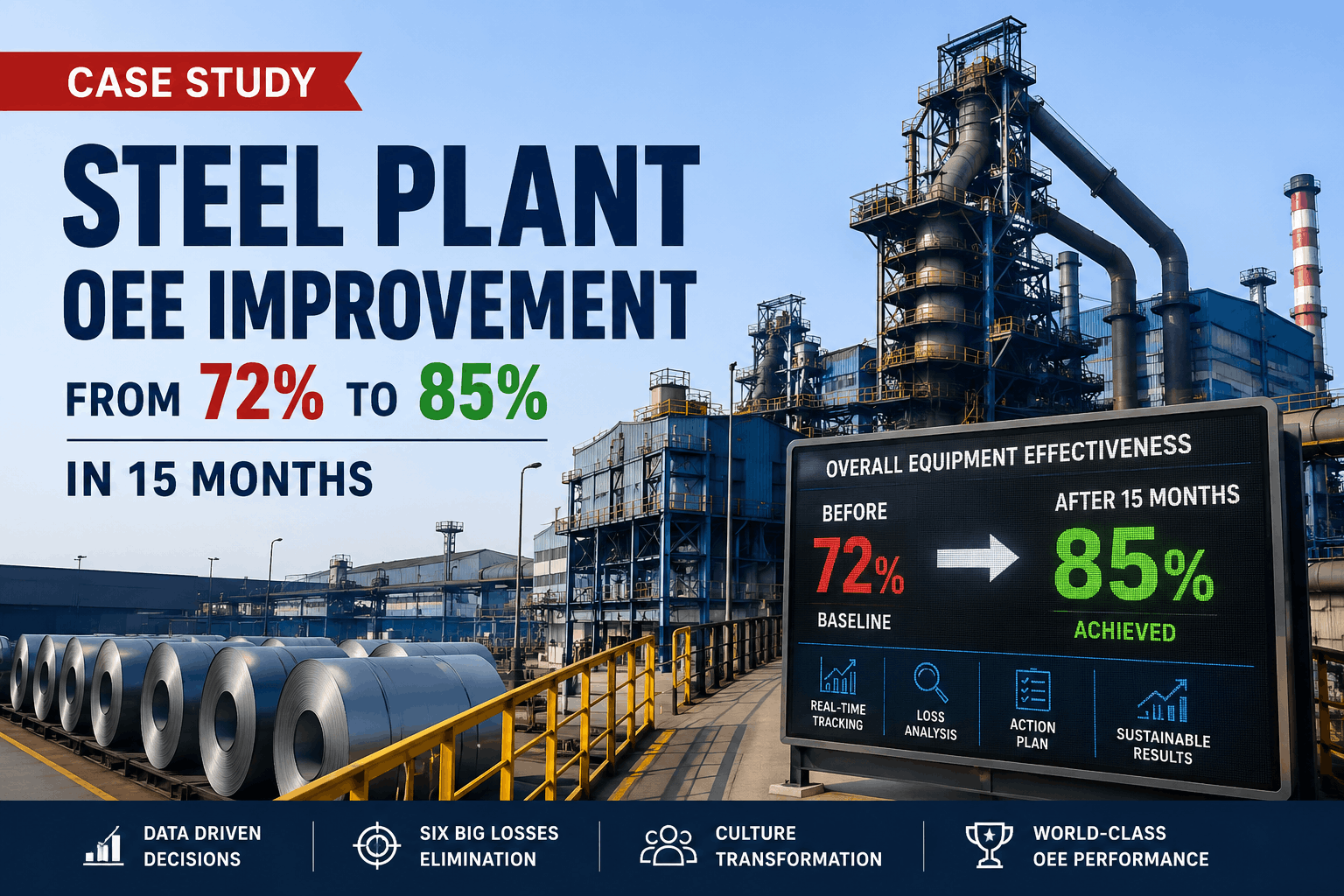
A 2,400 m³ integrated steel mill operated three shifts across its blast furnace, BOF melt shop, caster, and rolling mill — but critical maintenance information was lost between every shift change. Shift logs were handwritten notebooks that were often illegible, incomplete, or misplaced. Pending repairs were communicated verbally and frequently forgotten. Equipment anomalies were documented inconsistently. The result: 40% of pending work orders from the outgoing shift were never actioned by the incoming crew, leading to repeat equipment failures, extended downtime, and frustrated operators. After implementing Oxmaint's digital shift handover system with structured checklists, mandatory fields, photo documentation, and shift sign-off workflows, the mill eliminated shift-related information loss, reduced shift-to-shift task slippage from 40% to 8%, decreased shift-related maintenance delays by 60%, and recovered 22 production days annually worth $1.9M in avoided downtime. Start free — eliminate shift information loss in your steel plant.
Steel Plant Digital Shift Handover Eliminates Information Loss — Shift Delays Down 60%
Case study: integrated steel mill deploys digital shift logbook with structured checklists, mandatory fields, photo documentation, and shift sign-off. Shift-related maintenance delays reduced 60%, task slippage drops from 40% to 8%, 22 production days recovered annually.
The Challenge — Critical Information Lost Between Every Shift
The mill operated 24/7/365 across four production departments: blast furnace, BOF melt shop, six-strand caster, and bar rolling mill. Each department had three shifts (day, evening, night) with 8-12 operators per shift. Shift handover was managed through handwritten notebooks — each shift supervisor maintained a personal logbook. There was no standardized format, no mandatory fields, and no verification that the outgoing shift actually communicated pending issues to the incoming crew. Operators described the process as "we hand off the notebook and hope the next shift reads it." The consequences were severe. Equipment anomalies noted by the night shift were often not seen by the day shift — the notebook was left in a supervisor's office, not passed to the incoming team. Pending repairs identified at 6 AM were still pending at 2 PM because the day shift supervisor never received the information. Safety observations were logged inconsistently, creating liability exposure. The mill tracked shift handover effectiveness through a simple metric: percentage of work orders marked "pending from previous shift" that were actioned within 4 hours of shift start. Baseline: only 60% of pending tasks were actioned — meaning 40% of work identified as urgent by one shift was completely ignored by the next. Book a demo to see how digital shift handover eliminates this gap.
The Solution — Structured Digital Shift Handover with Mandatory Fields
The mill deployed Oxmaint's digital shift logbook across all four production departments. Each shift supervisor and lead operator received a tablet with the Oxmaint mobile app. Shift handover was restructured as a mandatory workflow with five sections: open work orders (pending repairs, status, priority), equipment anomalies (temperature, vibration, pressure observations), safety observations (hazards, near misses), critical spares consumed, and next-shift priorities. All fields were mandatory — incomplete handover could not be submitted. Photo documentation was required for equipment anomalies and safety observations. Digital signatures from both outgoing and incoming shift supervisors were required to close the handover.
The system also included department-specific checklists. Blast furnace operators logged tuyere condition, hot blast stove temperature profiles, and cooling stave flow rates. BOF operators recorded lining erosion observations and lance tip condition. Caster operators tracked mold level fluctuation and SEN condition. Rolling mill operators logged roll vibration, bearing temperature, and strip tracking issues. Each checklist was pre-configured with department-specific fields, eliminating the "blank notebook" problem where critical information was omitted. Start free — deploy digital shift handover with department-specific checklists.
Shift Handover Compliance — How Information Loss Was Eliminated
Shift Handover Compliance Improvement — Task Slippage Reduction (Weekly Average)
Baseline (40% slippage)
Weekly Compliance
Target Achieved (8% slippage)
Task slippage measurement: percentage of work orders marked "pending from previous shift" completed within 4 hours of shift start. Baseline 40% → target 8% achieved within 6 months. 22 production days recovered annually.
Shift Delay Reduction — From 28 Incidents to 9 Per Month
Beyond lost work orders, shift handover failures caused operational delays. When a pending repair wasn't communicated, the incoming shift would discover the issue only when equipment failed or a safety incident occurred — triggering an unplanned outage. The mill tracked "shift-related maintenance delays": any unplanned maintenance activity that could be traced to incomplete or missing shift handover communication. Baseline: 25-30 shift-related delays per month across all four departments. The root causes were consistent: the night shift observed an equipment anomaly but didn't document it; the day shift started operating without knowing the anomaly existed; equipment failed within 2-4 hours; unplanned downtime resulted. After digital shift handover deployment, shift-related delays dropped to 8-10 per month — a 60-68% reduction. The remaining delays were attributed to factors outside shift communication (parts availability, contractor scheduling). The mill calculated that each shift-related delay caused an average of 2.5 hours of unplanned downtime. 20 eliminated delays per month × 2.5 hours = 50 hours of downtime recovered monthly × 12 months = 600 hours annually. At typical mill contribution margin, 600 hours = 22 production days = $1.9M annual value. Start free — calculate your shift-related downtime cost.
Blast Furnace Delays
-68%
12 → 4 per month
Tuyere condition not communicated → hot spot developed → unplanned outage. Digital handover eliminated this chain completely.
BOF Delays
-64%
11 → 4 per month
Lance tip condition missed → suboptimal blowing → reblows required. Digital checklist ensures lance condition is always handed over.
Caster Delays
-71%
7 → 2 per month
Mold level fluctuation observed but not handed over → breakout risk increased. Digital handover eliminates this gap.
Rolling Mill Delays
-55%
9 → 4 per month
Bearing temperature trend not handed over → failure occurred mid-shift. Digital shift log captures temperature trends, not just snapshot.
"
Before Oxmaint, shift handover was chaos. Night shift would leave notes in a logbook, but the day shift supervisor often wouldn't see them until 10 AM — 4 hours into the shift. Equipment anomalies went unaddressed, pending repairs were forgotten, and we had the same problems recurring shift after shift. We tracked it: 40% of pending work orders from the outgoing shift were never actioned. That's not a communication gap — that's a systemic failure. After deploying Oxmaint's digital shift handover, everything changed. Every shift now completes a structured handover with mandatory fields. You cannot skip sections. You cannot submit without photos of equipment anomalies. Both supervisors digitally sign off. Within 3 months, task slippage dropped from 40% to 12%. Within 6 months, we hit 8%. The result: shift-related downtime dropped from 28 incidents per month to 9. We recovered 22 production days annually — $1.9M in avoided downtime. More importantly, our operators now trust that when they hand off a problem, it will be addressed. No more frustration. No more repeat failures. Digital shift handover is the single most impactful operational change we've made in 10 years.
Operations Manager — Integrated Steel Mill, 2,400 m³ BF, BOF, Caster, Rolling Mill
Shift Handover Maturity — Where Does Your Steel Plant Stand?
Shift handover maturity reflects how effectively critical information is transferred between crews. The framework below assesses current state. This mill progressed from Level 2 (inconsistent paper logs, 40% task slippage) to Level 4 (digital structured handover with mandatory fields, 8% task slippage) within 6 months.
Steel Plant Shift Handover Maturity Scoring
Score 5 = fully digital, AI-driven · Score 1 = no formal handover, verbal only
5AI-Driven Predictive Handover · Real-Time Anomaly AlertsShift logs auto-populated from sensor data. AI predicts which anomalies require immediate action. Real-time dashboards show handover status across all shifts. <5% task slippage. Zero shift-related delays.Profile: Maximum information retention. Predictive handover. Continuous improvement loop.
4Digital Structured Handover · Mandatory Fields · Photo DocsMobile-based shift logs with department-specific checklists. All fields mandatory. Photo documentation required. Digital sign-off by both supervisors. This mill achieved Level 4 in 6 months. 8-10% task slippage. 8-10 shift delays/month.Action: Integrate sensor data to auto-populate shift logs. Implement AI anomaly prioritization.
3Standardized Paper Logs · Inconsistent Digital UsePaper shift logs with standard format but incomplete entries. Some digital use but not mandated. Photo documentation rare. 20-30% task slippage. 15-20 shift delays/month.Gap: Digitize all shift logs. Implement mandatory fields. Deploy mobile devices to all shift supervisors.
2Handwritten Logbooks · Inconsistent FormatPersonal notebooks per supervisor. No standard format. Critical information omitted. Photo documentation non-existent. This mill started at Level 2. 40% task slippage. 25-30 shift delays/month.Risk: High information loss. Repeat failures. Immediate digital shift handover deployment required.
1No Formal Shift Handover · Verbal OnlyNo written shift logs. Information passed verbally, often missed or forgotten. 50%+ task slippage. 35+ shift delays/month. High safety risk.Risk: Unacceptable information loss. Immediate digital handover program required.
Technology Integration: Mobile Tables, QR Codes, CMMS Sync
The mill's digital shift handover system leverages three technology layers. Mobile tablets with Oxmaint app enable shift supervisors to complete handovers from anywhere in the plant — no return to office required. QR codes on critical equipment allow operators to scan and log equipment-specific observations directly against the asset record. CMMS sync ensures that any pending work order identified during shift handover is automatically created as a work order in the maintenance system, with priority, assigned technician, and due date based on shift supervisor input. Start free — deploy mobile shift handover across your plant.
Mobile Tables
24
Devices deployed
Each shift supervisor and lead operator equipped with tablet. Handover completed on mobile, not paper. Offline mode for areas without WiFi.
QR Code Scanning
850+
Assets QR tagged
Operators scan QR code on equipment to log observations directly against asset record. Eliminates manual data entry errors.
CMMS Work Order Sync
100%
Pending tasks auto-create WOs
Any pending work order identified during handover automatically creates CMMS work order with priority, technician, due date.
Dashboard Visibility
Real-time
Handover status visible
Supervisors see which shifts have completed handover, which are overdue, and pending tasks requiring action.
Frequently Asked Questions — Digital Shift Handover for Steel Plants
How much time does digital shift handover take per shift?Structured digital handover takes 5-8 minutes per shift — less than paper handover (10-15 minutes) because information is pre-populated from sensor data and checklists are guided. The mill reduced handover time from 12 minutes to 6 minutes average.Start free — time your shift handover improvement.
Does digital shift handover work during network outages?Yes. Oxmaint mobile app works offline — shift logs are saved locally and sync automatically when connectivity is restored. Timestamps reflect when handover was completed, not when sync occurred.
What happens if a shift supervisor forgets to complete handover?Oxmaint sends automated reminders via mobile push and email at 30 and 15 minutes before shift end. If still incomplete at shift change, notification escalates to department manager. This mill achieved 99% on-time handover completion.
Can digital shift handover be customized for different departments?Yes. Each department (BF, BOF, caster, rolling mill) has its own handover template with department-specific fields, checklists, and equipment lists. Templates are fully customizable in Oxmaint without coding.
How does Oxmaint integrate shift handover with maintenance work orders?Any pending repair identified during shift handover can be flagged to auto-create a CMMS work order. The system pre-populates asset ID, issue description, priority level, and attaches any photos from the shift log.
What is the ROI for digital shift handover in a steel plant?This mill achieved $1.9M annual downtime cost avoidance through eliminated shift-related delays. Additional benefits: reduced repeat failures, lower maintenance labor (less rework), and improved operator morale. Typical ROI payback: 3-6 months.
Deploy Digital Shift Handover Across Your Steel Plant — Eliminate Information Loss
Structured shift logs, mandatory fields, photo documentation, sign-off workflows, and CMMS integration — deployed in weeks, not months. Free to start.
Shift Delay Reduction — From 28 Incidents to 9 Per Month
Beyond lost work orders, shift handover failures caused operational delays. When a pending repair wasn't communicated, the incoming shift would discover the issue only when equipment failed or a safety incident occurred — triggering an unplanned outage. The mill tracked "shift-related maintenance delays": any unplanned maintenance activity that could be traced to incomplete or missing shift handover communication. Baseline: 25-30 shift-related delays per month across all four departments. The root causes were consistent: the night shift observed an equipment anomaly but didn't document it; the day shift started operating without knowing the anomaly existed; equipment failed within 2-4 hours; unplanned downtime resulted. After digital shift handover deployment, shift-related delays dropped to 8-10 per month — a 60-68% reduction. The remaining delays were attributed to factors outside shift communication (parts availability, contractor scheduling). The mill calculated that each shift-related delay caused an average of 2.5 hours of unplanned downtime. 20 eliminated delays per month × 2.5 hours = 50 hours of downtime recovered monthly × 12 months = 600 hours annually. At typical mill contribution margin, 600 hours = 22 production days = $1.9M annual value. Start free — calculate your shift-related downtime cost.
Before Oxmaint, shift handover was chaos. Night shift would leave notes in a logbook, but the day shift supervisor often wouldn't see them until 10 AM — 4 hours into the shift. Equipment anomalies went unaddressed, pending repairs were forgotten, and we had the same problems recurring shift after shift. We tracked it: 40% of pending work orders from the outgoing shift were never actioned. That's not a communication gap — that's a systemic failure. After deploying Oxmaint's digital shift handover, everything changed. Every shift now completes a structured handover with mandatory fields. You cannot skip sections. You cannot submit without photos of equipment anomalies. Both supervisors digitally sign off. Within 3 months, task slippage dropped from 40% to 12%. Within 6 months, we hit 8%. The result: shift-related downtime dropped from 28 incidents per month to 9. We recovered 22 production days annually — $1.9M in avoided downtime. More importantly, our operators now trust that when they hand off a problem, it will be addressed. No more frustration. No more repeat failures. Digital shift handover is the single most impactful operational change we've made in 10 years.
Shift Handover Maturity — Where Does Your Steel Plant Stand?
Shift handover maturity reflects how effectively critical information is transferred between crews. The framework below assesses current state. This mill progressed from Level 2 (inconsistent paper logs, 40% task slippage) to Level 4 (digital structured handover with mandatory fields, 8% task slippage) within 6 months.
Technology Integration: Mobile Tables, QR Codes, CMMS Sync
The mill's digital shift handover system leverages three technology layers. Mobile tablets with Oxmaint app enable shift supervisors to complete handovers from anywhere in the plant — no return to office required. QR codes on critical equipment allow operators to scan and log equipment-specific observations directly against the asset record. CMMS sync ensures that any pending work order identified during shift handover is automatically created as a work order in the maintenance system, with priority, assigned technician, and due date based on shift supervisor input. Start free — deploy mobile shift handover across your plant.
Frequently Asked Questions — Digital Shift Handover for Steel Plants
Deploy Digital Shift Handover Across Your Steel Plant — Eliminate Information Loss
Structured shift logs, mandatory fields, photo documentation, sign-off workflows, and CMMS integration — deployed in weeks, not months. Free to start.