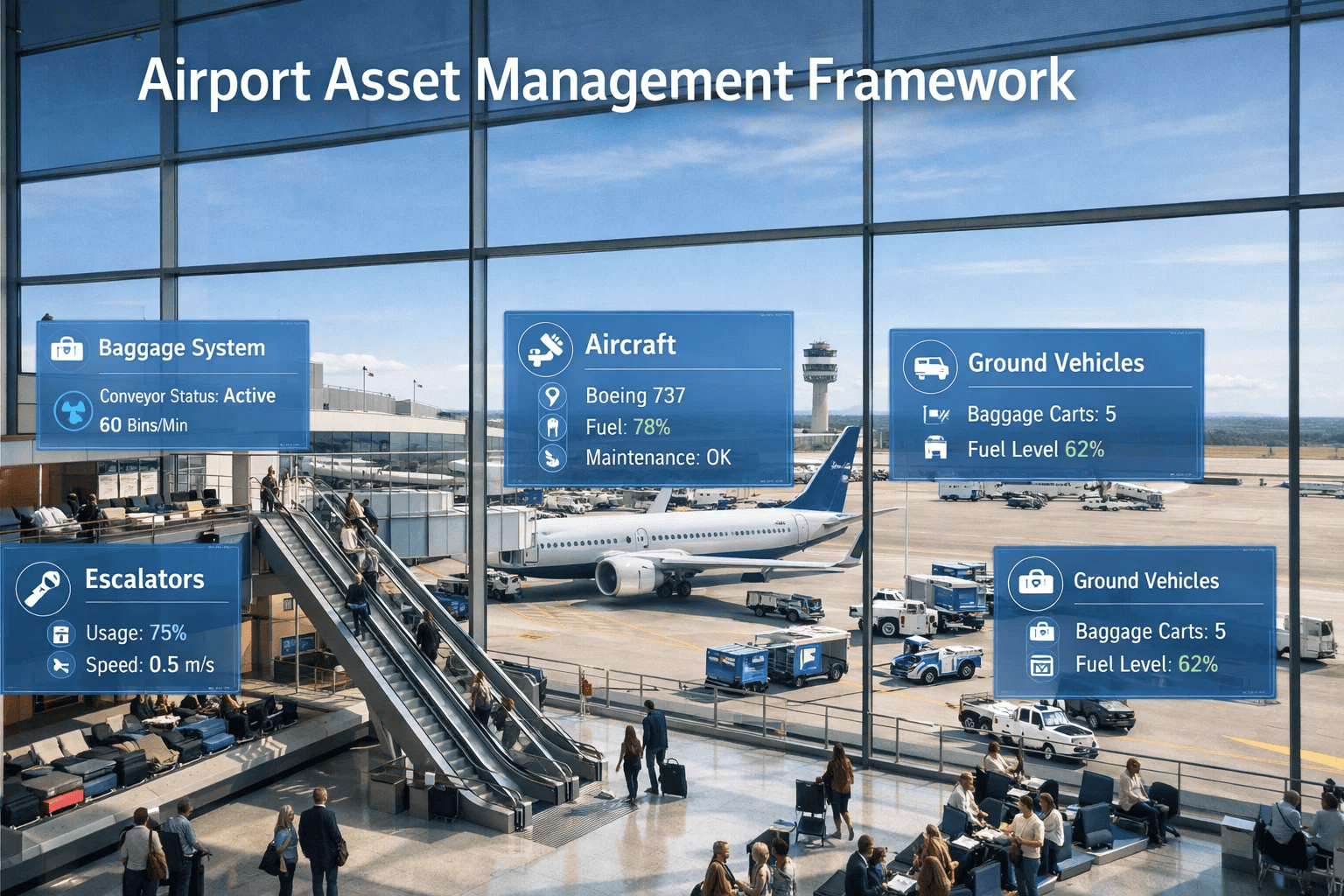
A single Aircraft on Ground event costs airlines between $10,000 and $150,000 per hour. A baggage conveyor failure during peak hours cascades into dozens of delayed flights within minutes. An HVAC shutdown in a crowded terminal affects thousands of passengers and triggers regulatory scrutiny. Predictive maintenance uses real-time sensor data, machine learning, and condition monitoring to detect these failures weeks before they happen—transforming aviation maintenance from expensive firefighting into precision-scheduled prevention. Schedule a demo to see how OXmaint brings predictive maintenance to airport operations.
The True Cost of Reactive Maintenance in Aviation
Aviation runs on uptime. Every minute an aircraft sits grounded or a baggage system sits jammed, the financial damage compounds—not linearly, but exponentially through cascading delays, passenger rebookings, and operational disruptions that ripple across entire networks.
$150K
per hour
Maximum AOG cost for a widebody aircraft including revenue loss, crew, and passenger compensation
$100.76
per minute
Average aircraft block time cost for U.S. passenger airlines in 2024 (Airlines for America)
$50B
annually
Estimated global airline cost from AOG events across all carriers worldwide
10-15%
of total airline operating costs are maintenance expenses—major carriers spend $2B+ annually
14 AOGs
Average number of Aircraft on Ground events per aircraft per year in the United States
30-50%
Higher cost of unplanned removals and repairs compared to scheduled maintenance activities
These numbers represent just the aircraft side. On the ground, airport equipment failures carry their own enormous costs. A single baggage handling system breakdown can delay dozens of departures, trigger mishandled baggage claims averaging $100 per bag, and require emergency maintenance at premium labor rates. When escalators, jet bridges, HVAC systems, and automated people movers fail without warning, the consequences are felt by every passenger in the terminal.
How Predictive Maintenance Actually Works
Predictive maintenance replaces calendar-based and run-to-failure strategies with a data-driven approach: continuously monitor equipment condition, detect anomalies that precede failures, and schedule repairs during planned downtime windows—before anything breaks.
The Predictive Maintenance Loop
IoT sensors capture vibration, temperature, pressure, current draw, and operating hours from equipment in real time—24/7, across every critical asset.
Data Collection
ML algorithms compare live data against baseline performance profiles, detecting subtle deviations that signal developing faults weeks in advance.
Pattern Recognition
AI correlates anomaly patterns with historical failure data to forecast which component will fail, when, and what parts will be needed for repair.
Failure Forecasting
Automated work orders with diagnosis, parts lists, and priority—scheduling repair during planned downtime before failure occurs.
Scheduled Intervention
Maintenance Strategy Comparison: What Changes with Prediction
Most aviation operations use some mix of reactive, preventive, and condition-based maintenance. Predictive maintenance doesn't replace all other strategies—it optimizes them by ensuring the right intervention happens at the right time, every time.
When maintenance occurs
After failure
On a fixed schedule
When data predicts need
Unplanned downtime
Maximum
Moderate
Near zero
Parts waste
Emergency premium costs
Replaced before end of life
Used to full safe life
Maintenance cost profile
Highest per event
Steady but wasteful
18-25% lower overall
Failure visibility
None until it breaks
Statistical estimates
Weeks of advance warning
Data requirement
Failure logs only
OEM intervals
Real-time sensor + historical
Still replacing parts on a calendar? OXmaint's predictive engine tells you exactly when each component actually needs attention—saving budget and preventing failures simultaneously.
Start Free
Aviation Assets That Benefit Most from Predictive Maintenance
Predictive maintenance applies across two interconnected domains: the aircraft themselves (managed by airlines and MROs) and the airport infrastructure that supports flight operations (managed by airport authorities and facility teams). Both domains share the same fundamental principle—real-time data prevents costly surprises.
Aircraft Systems
Airline & MRO Operations
Engines & APU
Vibration analysis, oil debris monitoring, exhaust gas temperature trending predict turbine wear and bearing degradation
Landing Gear
Shock strut pressure, brake wear sensors, and tire condition monitoring extend service life and prevent AOG
Avionics & Electrical
Power supply monitoring, connector health analysis, and thermal imaging identify degradation before system failures
Hydraulics & Pneumatics
Pressure trending, fluid contamination analysis, and actuator performance tracking catch leaks and seal wear early
Airport Equipment
Facility & Operations Management
Baggage Handling Systems
Motor vibration, belt tension, and sorting gate sensors detect conveyor issues 3-4 weeks before breakdown
HVAC & Climate Control
Compressor performance, refrigerant pressure, and filter condition monitoring prevent terminal comfort failures
Escalators & Elevators
Drive motor current, step chain tension, and door mechanism sensors predict mechanical wear patterns
Jet Bridges & Ground Equipment
Hydraulic pressure, electrical load, and structural strain monitoring ensure safe, reliable gate operations
The Market Is Moving Fast—Here's the Proof
Predictive maintenance in aviation is no longer experimental. Over 75% of global commercial fleets have already transitioned to condition-based or predictive maintenance models, and the investment acceleration is dramatic.
75%+
Of global commercial fleets now use condition-based or predictive maintenance models
80%
Of Tier 1 airlines use AI for predictive diagnostics as of 2024
$300M+
In venture capital directed toward predictive maintenance platforms in 2024
6,000+
Aircraft globally being considered for predictive maintenance retrofitting in 2025
Real-World Results: What Predictive Maintenance Delivers
The industry leaders who adopted predictive maintenance early are now seeing returns that make the business case undeniable for every aviation operator—from major carriers to regional airport authorities.
5,600 → 55
Maintenance-related cancellations reduced from 5,600 to just 55 annually (2010-2018)
8 Figures
Annual cost savings reported by Delta from the APEX predictive engine program
Delta's Advanced Predictive Engine (APEX) system collects real-time engine data throughout flights, using AI to predict failures weeks in advance. Won the Aviation Week Innovation Award in 2024.
3-4 Weeks
Advance warning of motor and gearbox failures from vibration anomaly detection
10:1 to 30:1
ROI reported within 12-18 months of deploying AI-driven predictive maintenance
Airports implementing IoT sensors on baggage conveyor motors and drives are detecting catastrophic failures weeks in advance, reducing unplanned downtime by 30-50% and cutting maintenance costs by 18-25%.
Bring Predictive Maintenance to Your Airport
OXmaint connects IoT sensors on your airport equipment to an intelligent analytics platform—detecting anomalies, predicting failures, and generating work orders before anything breaks.
What OXmaint's Predictive Platform Delivers for Airports
OXmaint bridges the gap between sensor data and maintenance action. The platform monitors critical airport infrastructure in real time, applies machine learning to detect developing faults, and automatically triggers the right maintenance response through your existing workflows.
Monitoring
Real-Time Asset Health Dashboard
Live visibility into the condition of every connected asset—baggage conveyors, HVAC systems, escalators, jet bridges, and ground support equipment. Color-coded health scores let operations teams see at a glance which assets need attention and which are running normally.
Intelligence
AI-Powered Failure Prediction
Machine learning models trained on your equipment's operating patterns detect subtle anomalies that precede failures—rising vibration in a conveyor motor, unusual power draw in an HVAC compressor, thermal drift in electrical panels. Alerts are generated with estimated time-to-failure and recommended actions.
Automation
Predictive Work Order Generation
When the system detects a developing fault, it automatically creates a work order with the diagnosis, affected component, predicted parts needed, and recommended repair window—assigned to the right technician with the right skills for that specific asset.
Optimization
Maintenance Scheduling Intelligence
The platform considers flight schedules, terminal occupancy patterns, and equipment criticality to recommend optimal maintenance windows that minimize operational disruption. Night shifts. Low-traffic periods. Scheduled downtime. Every repair happens at the least disruptive moment.
The Measurable ROI of Predictive Maintenance
Predictive maintenance pays for itself—typically within 12 to 18 months. The savings come from multiple compounding sources: fewer emergency repairs, lower parts costs, reduced downtime, extended equipment life, and dramatically less labor spent on unnecessary preventive maintenance.
35%
Reduction in unplanned aircraft downtime through early fault detection and scheduled intervention
18-25%
Lower total maintenance costs by eliminating unnecessary scheduled replacements and emergency repairs
40%
Faster mean time to repair when technicians arrive with pre-diagnosis and correct parts in hand
12%
Extension in component life cycles by running parts to their actual safe limit instead of arbitrary schedules
Frequently Asked Questions
What is predictive maintenance in aviation?
Predictive maintenance in aviation uses real-time sensor data, machine learning algorithms, and historical failure patterns to forecast when aircraft components or airport equipment will need maintenance—before failure occurs. Instead of replacing parts on fixed schedules (preventive) or waiting for breakdowns (reactive), predictive systems identify the exact right moment for intervention, maximizing equipment life while preventing unplanned downtime.
Schedule a demo to see predictive maintenance in action.
What airport equipment benefits most from predictive maintenance?
The highest-impact airport assets for predictive maintenance are those with high failure costs and high utilization: baggage handling conveyors (where IoT sensors can detect motor and gearbox issues 3-4 weeks before failure), HVAC systems (where compressor and filter monitoring prevents terminal comfort failures), escalators and elevators (where drive motor and mechanism monitoring prevents passenger-facing breakdowns), jet bridges (where hydraulic and electrical monitoring ensures safe gate operations), and airfield lighting systems. Starting with the equipment that causes the most operational disruption delivers the fastest ROI.
How quickly does predictive maintenance show ROI?
Airports deploying AI-driven predictive maintenance on critical assets like baggage conveyors and HVAC systems typically see ROI within 12 to 18 months. Industry data shows returns between 10:1 and 30:1 in that timeframe, driven by 30-50% reduction in unplanned downtime and 18-25% lower overall maintenance costs. Airlines with mature predictive programs, like Delta's APEX system, report eight-figure annual savings.
Start your free trial to begin building your predictive maintenance baseline.
Does OXmaint integrate with existing airport maintenance systems?
Yes. OXmaint is designed to integrate with your existing CMMS, asset management systems, and BMS infrastructure—not replace them. IoT sensor alerts automatically generate work orders with pre-populated diagnosis, parts lists, and priority levels. If you're using OXmaint as your primary CMMS, the integration is built in natively. The platform works with equipment from any OEM, so you're not locked into any single manufacturer's monitoring ecosystem.
What's the difference between condition-based and predictive maintenance?
Condition-based maintenance (CBM) monitors equipment parameters and triggers maintenance when readings cross a predefined threshold—for example, when vibration exceeds a set level. Predictive maintenance goes further by using machine learning to analyze trends in that data over time, forecasting when a threshold will be crossed in the future. This gives maintenance teams days or weeks of advance warning instead of reacting when a condition alarm fires. Over 75% of global commercial fleets now use one or both of these approaches.
Stop Reacting. Start Predicting.
Every hour of unplanned downtime costs your operation thousands. OXmaint's predictive platform turns sensor data into advance warning—so your team fixes problems before passengers ever notice them.