A cement plant technician who works without a mobile AR-enabled CMMS loses an average of 47 minutes every shift walking between equipment and the control room to retrieve work orders, check maintenance history,...
Maximize kiln uptime, prevent costly refractory failures, and ensure regulatory compliance with intelligent maintenance management designed for energy-intensive cement manufacturing.
24/7 clinker production maintenance platform
Refractory & shell tracking
Operating hours scheduling
Shift-based management
Production insights
Complete maintenance management tools for rotary kilns, cyclone preheaters, vertical roller mills, ball mills, grate coolers, and cement processing equipment operating in high-temperature, dusty environments
Customizable checklists for rotary kilns, preheater cyclones, VRM gearboxes, ball mills, grate coolers, and bag filters with offline capability for dusty plant floors.
Schedule maintenance based on kiln operating hours, mill grinding cycles, or tons produced—not arbitrary calendar intervals that waste resources.
Create, assign, and track work orders with structured handover notes across three shifts for continuous 24/7 clinker production.
Maintain compliance with OSHA silica dust standards (50 μg/m³), EPA emissions requirements, ISO 45001, and ISO 50001 energy management.
Monitor OEE, MTBF, MTTR, and equipment reliability metrics in real-time across kiln lines, grinding departments, and packing plants.
Empower maintenance teams with mobile access designed for dusty, high-temperature cement plant environments with offline sync capability.
MOBILE SOLUTION
Equip your operators and maintenance crews with a mobile inspection app built for dusty, high-temperature cement manufacturing environments:
For Cement Plant Maintenance Teams
Work in dusty areas with limited connectivity
Refractory logs & failure records
Log vibration, temperature & readings
QR/barcode for rapid identification
Make data-driven decisions with comprehensive cement manufacturing performance analytics:
Clinker Production & Equipment Insights
Kilns, mills, crushers & coolers
MTBF, MTTR & availability tracking
Kiln stops & mill trip tracking
ISO 50001 aligned tracking
Deep asset management supporting plant-to-component tracking across all cement manufacturing stages—from quarry to dispatch:
Complete Asset Management
Kilns, preheaters, precalciners, coolers
VRM, ball mills, roller presses, separators
Crushers, stackers, reclaimers, conveyors
ID fans, bag filters, ESPs, coal mills
Pre-configured inspection templates ensure compliance with cement industry safety, environmental, and energy regulations:
Audit-Ready Documentation
Crystalline silica dust control
Clean Air Act compliance
Energy management systems
Kiln entry & isolation procedures
Predictive maintenance reduces unplanned kiln shutdowns by up to 70%. With kiln downtime costing up to $100,000 per hour, early detection of refractory issues and bearing failures saves millions annually.
Stay compliant with OSHA silica dust standards (50 μg/m³ PEL), EPA emissions requirements, and confined space regulations while protecting workers in high-temperature, dusty environments.
With energy making up 30% of cement production costs, proper maintenance of mills and kilns can reduce electrical energy costs by up to 25% through ISO 50001 aligned practices.
A 5,000 TPD cement plant with two kiln lines reduced unplanned kiln shutdowns by 70% and improved overall kiln availability from 85% to 94% after implementing Oxmaint's maintenance system, avoiding over $2.8 million in annual production losses.
Up from 85% with Oxmaint implementation
Annual avoided production losses
Early VRM gearbox bearing detection
"Oxmaint helped us detect a VRM gearbox bearing issue four months before it would have failed. The early warning saved us an estimated $270,000 in emergency repairs and avoided 56+ hours of unplanned grinding downtime during peak production."
Maintenance Manager
Cement Plant - 2 kiln lines, 5,000 TPD capacity
"The runtime-based scheduling transformed how we plan refractory inspections and mill overhauls. We now trigger work based on operating hours rather than arbitrary calendars, extending refractory life from 6 months to 12 months in our kiln head zone."
Plant Reliability Engineer
Cement Plant - 3,500 TPD with VRM and ball mill grinding

A cement plant technician who works without a mobile AR-enabled CMMS loses an average of 47 minutes every shift walking between equipment and the control room to retrieve work orders, check maintenance history,...

Cement plants co-firing waste-derived fuels — RDF, SRF, tire-derived fuel, biomass, and sewage sludge — unlock real fuel cost savings and decarbonization credits, but every percentage point increase in...

Most cement plants invest in predictive maintenance tools and see an initial improvement — then plateau. Downtime drops in month three, stabilises in month six, and by month twelve the gains are no longer...

Cement plants spending $4–12M annually on MRO supplies are making procurement decisions that directly determine equipment reliability — yet fewer than 1 in 5 tracks part-level MTBF by supplier.

Traditional FMEA in cement plants is a document created once, revised annually if you are disciplined, and consulted during failure reviews when the damage is already done. A rotary kiln running at 1,450°C does...

At 02:14 on a Tuesday morning, a 4,200 TPD cement plant in Southeast Asia lost kiln feed. Stage 4 of the preheater had blocked. By the time the control room operator noticed the differential pressure spike, the...

A cement plant in South Asia was spending ₹8.4 crore a year on maintenance — and could not understand why the number kept rising despite buying newer spare parts and hiring more contractors. When the plant...

A cement plant running a 3,500 TPD kiln was absorbing ₹14 crore in annual maintenance costs — 60% of it unplanned, reactive, and avoidable. When their maintenance manager loaded 24 months of failure records...

Most cement plant predictive maintenance programmes do not fail because of bad sensors or wrong software — they fail because of a broken implementation sequence. Skipping asset criticality ranking, deploying...

For years, predictive maintenance was a privilege reserved for large cement plants with dedicated reliability engineers, $500K software budgets, and in-house IT teams. Small cement plants under 1,000 TPD were...

Cement plants in Sub-Saharan Africa, Southeast Asia, and Latin America are expanding faster than their maintenance infrastructure. With Sub-Saharan Africa's...

Cement plant bag filters consume 15–25% of total compressed air supply, yet most plants run pulse jet cleaning on fixed timers regardless of actual filter condition. AI vision...

Calendar-based preventive maintenance schedules in cement plants are built on averages — and averages are wrong for every individual machine. A kiln drive that runs hard in summer heat ages faster than the...

A single undetected kiln shell hotspot can force an emergency shutdown costing $300,000 or more — not counting refractory rebuild labour, delayed shipments, and lost contracts.

Every undetected tramp metal piece on a cement plant conveyor belt is a countdown to a $50,000–$200,000 crusher or belt damage event. Oxmaint's AI-integrated CMMS platform...

Raw vibration waveforms from cement plant rotating equipment hide fault signatures that calendar-based maintenance schedules simply cannot detect. AI-powered spectral...

A cement kiln in Alabama missed a developing shell hot spot detected only by manual thermal gun readings taken once per shift — by the time the anomaly was visible, the refractory had already failed, the steel...


Cement plants lose an average of $9,000 per minute when critical equipment fails — and 60% of those shutdowns trace back not to the failure itself, but to a missing spare part that should have been on the...

Cement plant spare parts inventories hold $2–$8 million in stocked items, yet 30–45% of that capital sits unused for over 2 years while critical components stock out during breakdowns. Manual criticality...

Cement plant shutdowns cost between $500,000 and $2 million per event, yet 20–40% of planned tasks are unnecessary or could be deferred. Traditional scope planning relies on fixed schedules and manual...

A cement plant shutdown that runs 3 days over schedule does not just cost labour hours — it costs kiln production at $40,000 to $120,000 per day depending on clinker output and market pricing. AI-driven...

Cement kilns run at over 1,400°C — and when the refractory lining fails without warning, the cost is not just a repair bill. It is 10 to 21 days of lost production, emergency contractor mobilisation, and...

A cement plant that ties up $4M in storeroom inventory but still faces a 6-week kiln downtime waiting for a girth gear segment has a criticality problem, not a budget problem. AI spare parts criticality scoring...

Every cement plant turnaround that runs on gut feeling and last year's scope list leaves money on the table — or worse, misses a kiln shell crack that surfaces three weeks after restart. AI shutdown scope...


Most cement plant operators discover refractory failure the hard way — a sudden kiln shutdown that costs $500K to $2M in lost output per day. AI-driven...

A single refractory failure in a cement kiln can cause 5–10 days of unplanned downtime and up to $2M in lost production plus $500k in emergency relining. Traditional schedules...

Every month, cement plants lose 3–8% of production capacity due to unplanned stops — but the real loss is hidden in poor downtime coding. Without AI-driven classification, production loss...

A single unexpected kiln or mill trip in a cement plant can cost $250k–$1.2M in lost production and emergency repairs. AI prescriptive maintenance doesn't...

Your CMMS holds thousands of work orders written by technicians over the past 5 to 10 years — and buried inside that unstructured text are failure patterns, recurring faults, and asset-specific degradation...

Maintenance consumes 15 to 25% of total cement manufacturing expenditure — and most plants have no idea where that money actually goes until the year-end review reveals another budget overrun. A single...

Your cement plant's best maintenance technician just retired — and 34 years of institutional knowledge about restarting the #3 boiler after a flame-out, aligning the VRM separator, and diagnosing girth gear...

Cement kilns burn at 1,450°C around the clock — and the refractory lining protecting your shell steel is degrading with every rotation. A single unplanned refractory failure costs cement plants

A cement kiln refractory lining running at 1,450°C does not fail suddenly — it cracks first, spalls second, and catastrophically breaches third. The problem is that by the time a crack is visible to a human...

A cement kiln girth gear failure does not announce itself — it sends warnings for weeks through vibration harmonics, thermal signatures, and mesh pattern changes that conventional inspection cycles miss...

Cement plant maintenance teams in 2026 are drowning in data — kiln temperatures, mill vibration logs, conveyor sensor feeds, work order histories, compliance checklists — yet most plants still spend 15 to 20...

A 3,000 TPD cement plant in South Asia was running its kiln within what every quarterly energy audit considered acceptable limits — specific heat consumption of 3,410 MJ per tonne of clinker, well inside the...

Energy is the single largest cost in cement production — consuming 30 to 40 percent of every rupee spent — yet most plants are running their kilns and grinding mills on setpoints configured years ago,...
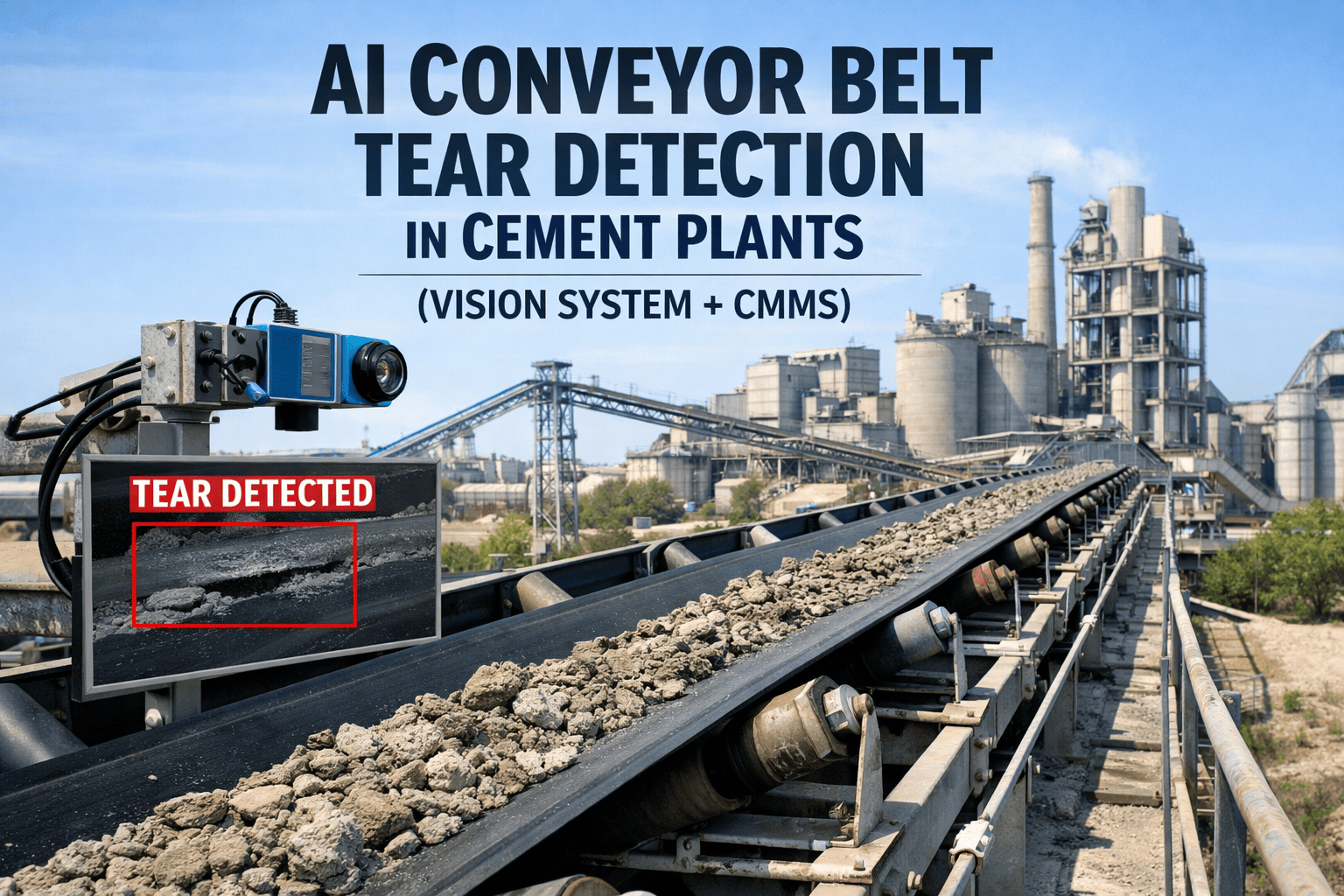
A cement plant's conveyor network moves 50,000 to 200,000 tonnes of raw material every single day — and a single belt tear that goes undetected for even 20 minutes can cascade into a full kiln shutdown costing...

A 3,200 TPD cement plant in South Asia was running two finish mills at 34–38 kWh per tonne — 15% above the regional best-in-class benchmark of 30–32 kWh/tonne. The culprit was not the mill itself. It was...

Cement manufacturing produces roughly 8% of global CO₂ emissions — more than aviation, shipping, and long-distance trucking combined. But here is what most decarbonization conversations miss: a significant...

Every shift in a cement plant starts with a safety briefing. Every shift also ends with footage nobody watched — cameras that recorded twelve hours of PPE violations, dust mask removal, hard hat-free zones,...

When a cement kiln trips at 3 AM, the first question is never "what failed" — it is "why did it fail, and why did it fail again." A kiln that has tripped three times in 90 days for what appears to be an...

Belt splice failures are the single longest unplanned stoppage event in cement plant bulk material handling — averaging 6 to 18 hours per event when a full splice separation requires belt extraction,...

A cement mill gearbox failure gives three warning signals before it destroys itself. The first microcrack propagation in a gear tooth is detectable by acoustic emission sensors six to twelve months before the...

Water management and cooling system maintenance for cement plants is a CMMS program that schedules and documents cooling tower PM, chemical dosing, blow-down cycle management, make-up water...

A cement plant in a remote location faces a 12-week lead time for a proprietary wear part. The kiln auxiliary drive coupling has failed. The OEM cannot expedite. The plant is down. At an average clinker...

A limestone quarry fleet does not fail on calendar dates. Haul trucks degrade on tonne-kilometres hauled under abrasive dust loads. Drill rigs wear on metres drilled per shift in variable rock hardness. Jaw...

A slewing drive pinion wear failure on a circular blending bed reclaimer — undetected because the last vibration reading was taken 11 weeks past its scheduled date — forced an unplanned 72-hour shutdown at a...

A cement plant managing 35 to 80 kilometers of conveyor belt infrastructure across raw material handling, kiln feed, clinker transport, and cement dispatch operates one of the most failure-prone asset categories...

A cement plant's primary crusher is the first and most consequential bottleneck in the raw material process chain. When a jaw crusher toggle plate fractures mid-shift, or an impact crusher rotor becomes...

A rotary kiln running at 1,450°C does not give you a second chance to test the wrong maintenance decision on live equipment. Yet most cement plants optimise PM intervals, evaluate component substitutions, and...

Instrumentation and calibration failures are the invisible driver behind cement plant process inefficiency — a miscalibrated kiln inlet temperature sensor drifts process control setpoints silently for weeks...

Cement kilns, raw mills, and clinker coolers generate thousands of process alarms per shift — and in most plants, fewer than 12% of those alarms ever produce a maintenance work order. The rest are...

A failed kiln main drive motor at a cement plant — with no current insulation resistance record, no vibration baseline, and no predictive alert — stops production for an average of 4.2 days at a cost of...
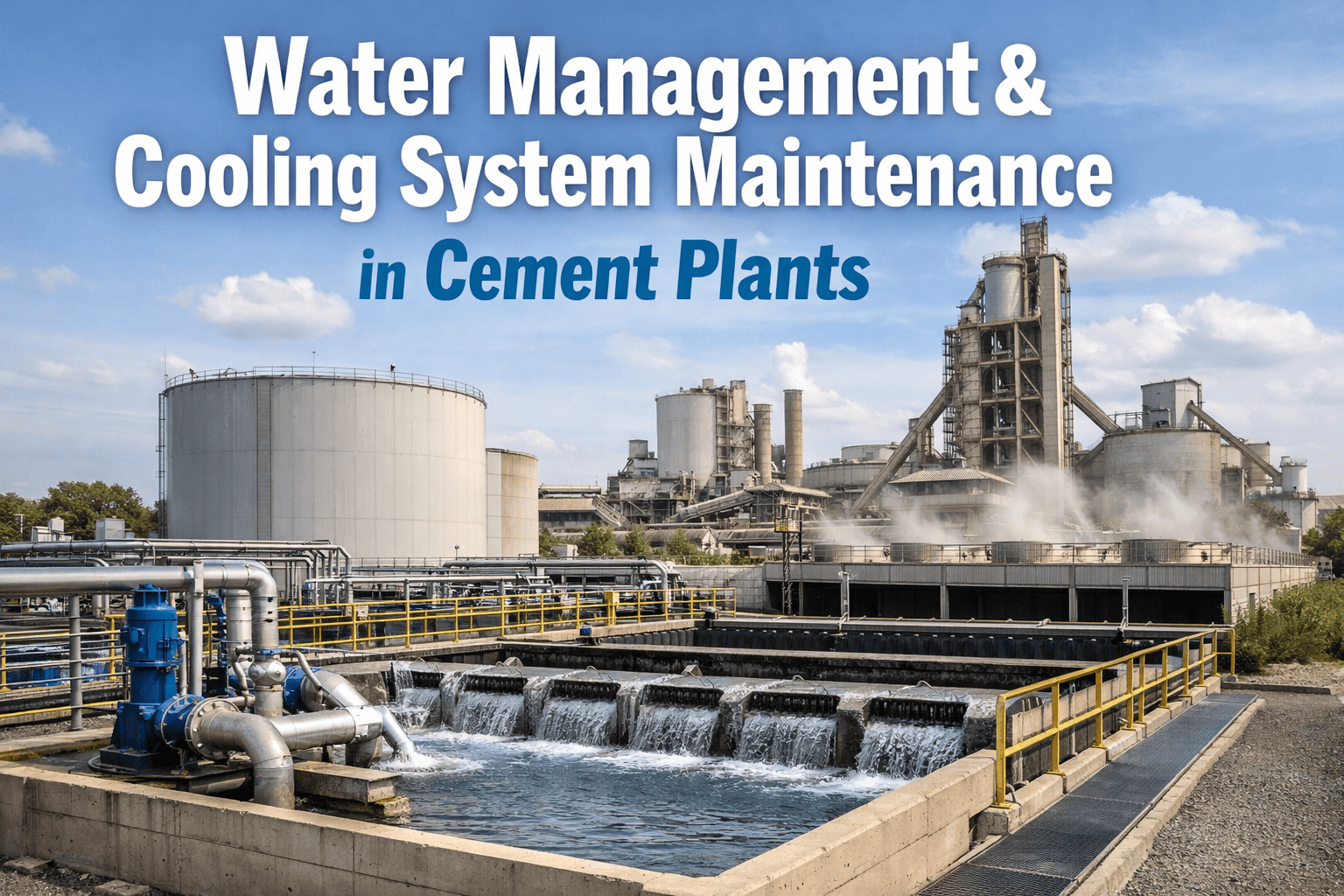
Efficient water management is critical to maintaining operational stability and environmental compliance in cement plants. From cooling towers and process water systems to wastewater treatment and recycling,...

A Continuous Emissions Monitoring System that fails a calibration drift check during an EPA Method 19 relative accuracy test audit doesn't just produce a data gap — it creates a regulatory notice of violation,...

Cement plants operating under ISO 14001 and ISO 50001 face a dual compliance burden that paper-based management systems cannot sustain — environmental registers spanning dust emissions, kiln NOx, SO2, CO2, and...

Cement manufacturing accounts for approximately 8% of global CO₂ emissions — making it one of the most scrutinised industries under expanding carbon disclosure mandates, EU ETS obligations, EPA GHG reporting...

A confined space entry at a preheater cyclone tower — without a current gas test, without a posted rescue team, and without a signed permit — costs a US cement plant an average OSHA citation of $156,000 per...

Cement manufacturing is among the most heavily regulated industrial sectors globally — responsible for approximately 7% of worldwide CO2 emissions, generating significant particulate matter, NOx, SO2, and...

A single failed bag filter in a cement plant kiln line can push particulate matter emissions above EPA permit thresholds within hours — triggering regulatory notices, production curtailments, and emergency...

The European Union’s Carbon Border Adjustment Mechanism (CBAM) imposes a carbon cost on imports of emission-intensive goods such as cement, aligning them with the EU’s internal carbon pricing system. This...

A North American cement producer managing three integrated plants faced a board-level crisis in Q3 2024: their sustainability committee requested a verified ESG report covering Scope 1 and Scope 2 emissions,...

Cement manufacturing is one of the most energy-intensive industries on earth, with power representing 30–40% of total production cost. Captive solar generation and waste heat recovery (WHR) from kiln exhaust...

Cement production accounts for 8% of global CO₂ emissions — and the technology pathway to decarbonization runs directly through your maintenance program. Carbon capture systems, LC3 blended cement processing...

Alternative fuels now account for 20–80% of thermal energy substitution at leading cement operations globally — yet the feeding systems, pre-processing equipment, and burner modifications that enable...

Cement manufacturing consumes 110–150 kWh per tonne of clinker — making energy the single largest variable cost at 30–40% of total production cost. Most cement plants have real-time energy meters but no...

Catastrophic cement mill gearbox failures cost $280,000–$620,000 per event in parts, emergency labor, and lost production — yet every failure begins as a detectable oil contamination signal or vibration...

Raw mill circuit failures cost North American cement plants $85,000–$320,000 per unplanned stop in lost kiln feed and emergency repair spend — yet 74% of these events trace back to roller press wear,...

Wrong liner profile delivered, crane not booked, bolt torque records missing — turns a 36-hour planned shutdown into a 72-hour overrun costing $140,000–$280,000 in lost clinker production. This checklist...

Cement grinding consumes 40–45% of a plant's total electrical energy — yet most North American plants lack the asset-linked performance data to identify where that energy is being wasted. Separator...

Vertical roller mill roller tire failures are responsible for 31% of unplanned finish grinding shutdowns across North American cement plants — each emergency roller change costs $95,000–$260,000 in lost...

Ball mill liner failures account for 38% of all unplanned grinding circuit shutdowns in North American cement plants — each emergency relining event costs $140,000–$380,000 in lost clinker production and...

Waste heat recovery systems in cement plants represent $1.5M to $4M in annual energy value per kiln line — yet most WHR assets operate without structured PM schedules, relying on reactive responses to...

Kiln refractory assessment during a cooldown stop is one of the highest-risk, highest-consequence inspection tasks in cement manufacturing — a missed hotspot or unmapped lining failure that goes undetected...

Kiln burner and fuel system failures are among the fastest-escalating events in cement pyroprocessing — a burner pipe burnout or fuel feed interruption forces a kiln stop within minutes, costing $22,000 to...

Clinker cooler failures are among the most costly unplanned events in cement pyroprocessing — a single grate plate collapse or fan trip can force a kiln shutdown costing $18,000 to $45,000 per hour in lost...

Kiln misalignment costing a North American cement plant $180,000 in unplanned downtime is not an equipment failure — it is a measurement gap that developed over six to eighteen months without a structured...

A single preheater blockage event shuts down clinker production for 8 to 36 hours, costing cement plants $180K to $650K in lost output and emergency clearing labor. Over 60% of these events originate from...

Rotary kiln failures are the most expensive unplanned events in cement manufacturing — a single uncontrolled shell overheat or refractory collapse can mean 5 to 14 days of lost production worth $1.4M to $4.8M...

Unplanned kiln refractory failures cost cement producers $800K to $2.5M per event when emergency relining, production loss, and expedited brick procurement are combined. Most plants still track lining condition...

A 2.4 MTPA single-kiln cement plant in East Java was recording 14.3 unplanned production stops per year — each averaging 31 hours of lost kiln run time at a cost of $22,400 per event in clinker production loss...

Japan and South Korea operate the world's most technically advanced cement plants — average kiln availability exceeds 94% in Japan versus a global benchmark of 79%, achieved not through larger maintenance...

Latin America's cement market is expanding at 4.2% annually — driven by Brazil's Novo PAC infrastructure programme, Mexico's infrastructure execution backlog, and Colombia's 4G and 5G highway concession...

Sub-Saharan Africa's cement industry is entering its most significant expansion phase — installed capacity is projected to double from 180 MTPA to over 360 MTPA by 2030, driven by greenfield investments in...

Turkey's cement industry operates at a scale and export intensity that makes maintenance quality a trade competitiveness issue, not just an operational one. As the world's second-largest cement exporter —...

European cement producers — Heidelberg Materials, Holcim, Cemex Europe, and Buzzi — operate under the world's most aggressive decarbonization mandate: EU ETS carbon prices above $80 per tonne, CBAM import...

China produces over 50% of global cement output across approximately 1,700 operating plants — yet most still run maintenance on fixed-interval schedules that absorb 14% to 22% of available kiln hours in...

The Infrastructure Investment and Jobs Act has injected over $550 billion into roads, bridges, ports, and water systems — placing American cement producers at the center of the largest public construction...

MEA cement plants operating across Saudi Arabia, UAE, Egypt, and Nigeria face a dual challenge unique in global cement operations: explosive demand growth driven by Vision 2030 mega-projects and Africa's...

Five platforms dominate cement plant CMMS shortlists in 2026: Oxmaint, IBM Maximo, SAP PM, MaintainX, and Limble. Scored across 11 capabilities weighted for integrated kiln-line operations — AI prediction,...

Southeast Asia's cement industry is expanding faster than any other region — Vietnam, Indonesia, and the Philippines collectively added 42 MTPA of new kiln capacity between 2018 and 2024, yet unplanned...

Indian cement plants operating at 380+ MTPA of installed capacity lose an estimated 12–18% of available kiln hours annually to unplanned stoppages — failures that structured preventive maintenance,...

A top-10 Indian cement producer running three kilns across two plants was spending ₹2.4 crore per unplanned kiln stop — parts at spot pricing, overtime labor, and clinker shortfall penalties combined. With...

Daily operator rounds are the primary early-warning mechanism between condition monitoring cycles. This checklist covers six inspection zones per shift — 40 check points with parameter thresholds and priority...

When the EU Emissions Trading System expanded its scope in 2023 and increased audit stringency for cement kilns above 500 tonnes per day clinker capacity, a multi-plant European cement producer operating seven...

When the maintenance manager at a 2.4 MTPA integrated cement plant in the U.S. Southeast walked into his first board meeting with a maintenance performance report, it was a 38-tab Excel workbook that took three...

Refractory failure is the leading cause of unplanned kiln stops — and 73% of those failures show detectable precursor conditions at the previous inspection. This checklist gives cement process engineers and...

Preventive maintenance programs in cement manufacturing fail not from lack of intent but from lack of structure — inspections missed because schedules live in spreadsheets, findings not captured because paper...

Baghouse failure in cement operations rarely announces itself — differential pressure drift, blinded bags, and cage corrosion accumulate over weeks before emission exceedances or fan trip events force an...

Oxmaint's free tier covers the core maintenance execution stack — work orders, asset register, PM scheduling, and mobile field access — with no time limit and no credit card required. The ceiling is 50...

OxMaint and MaintainX are both mobile-first CMMS platforms. The difference for cement is depth: kiln revolution PM triggers, per-shift OEE, native DCS integration, and benchmark analytics against the 2026 cement...

Cement plants that run maintenance programmes built on calendar-based intervals rather than failure mode analysis spend an estimated 22% to 35% more on preventive maintenance than necessary — while...

Cement plants spend 25 to 35% of production costs on maintenance — yet most of that goes to reactive repairs costing 4 to 6 times more than planned interventions. TPM changes that ratio by shifting equipment...

Cement plants relying on fixed-interval schedules lose 12% to 18% of available kiln production hours to unplanned stoppages that condition monitoring would have predicted 4 to 8 weeks in advance. Vibration...

Cement plants carry between 18 and 34 months of critical spare parts lead time on slow-moving components — kiln tyre pads, clinker cooler grate segments, preheater cyclone wear liners, and specialised gearbox...

Cement plants relying on fixed-interval schedules lose 12% to 18% of available kiln production hours to unplanned stoppages that condition monitoring would have predicted 4 to 8 weeks in advance. Vibration...

Cement plants running SCADA systems, DCS networks, and CMMS platforms connected to enterprise IT layers are now high-value targets for ransomware groups and state-sponsored threat actors — and 92% of...

Cement plant equipment inspections that require confined space entry, scaffolding, or kiln cooldown cost between $18,000 and $85,000 per event in access preparation, lost production, and technician safety risk....

Cement plant maintenance teams lose 47 minutes per technician per shift walking between preheater towers, raw mill galleries, and control rooms to retrieve procedures and expert guidance. Augmented reality...

Within seven years, 42% of experienced cement plant technicians will retire — taking decades of undocumented process knowledge no hiring programme replaces at speed. Plants without structured knowledge capture...

Cement plants that depend on corrective and time-based maintenance lose between $180,000 and $340,000 per unplanned kiln stop — costs that compound across 8 to 15 unplanned events per year in facilities...

Cement plants running calendar-based PM, paper inspection logs, and spreadsheet shutdown trackers in 2026 are operating on pre-digital infrastructure. AI prediction engines, digital twins, and autonomous sensor...

Cement plants that operate without real-time KPI visibility lose between 8% and 15% of available kiln production hours annually to unplanned stoppages — failures that generate $150,000 to $220,000 in lost...

A planned cement plant shutdown involves hundreds of contractors, dozens of vendors, and millions of dollars in labour and materials compressed into a 10 to 21 day window. When contractor qualification records...

Cement plants lose 18 to 22% of production time to equipment failures, and 73% are repeat events from unresolved root causes. A repeated rotary kiln bearing failure costs $180,000 to $280,000 per event. Plants...

Every unplanned rotary kiln stop costs between $18,000 and $45,000 per hour. Plants without documented shutdown checklists spend 35 to 60 percent more per outage than those running structured digital procedures....

Cement plants managing 500-plus shutdown work orders across rotary kilns, preheater cyclone towers, and ball mills cannot rely on spreadsheets and radio coordination to execute an annual outage costing between...

Cement plants that operate without a structured CMMS programme spend 4 to 5 times more per repair event than plants running disciplined preventive maintenance cycles. A single unplanned rotary kiln stop costs...

Cement plant maintenance managers evaluating software in 2026 face a decision that carries 3 to 5 years of operational consequence: deploy a purpose-built cloud CMMS in 60 to 90 days or commit to an SAP PM...

Cement manufacturing is one of the most asset-intensive industries on earth — a single integrated plant runs 2,400-plus maintainable assets across rotary kilns, ball mills, vertical roller mills, clinker...
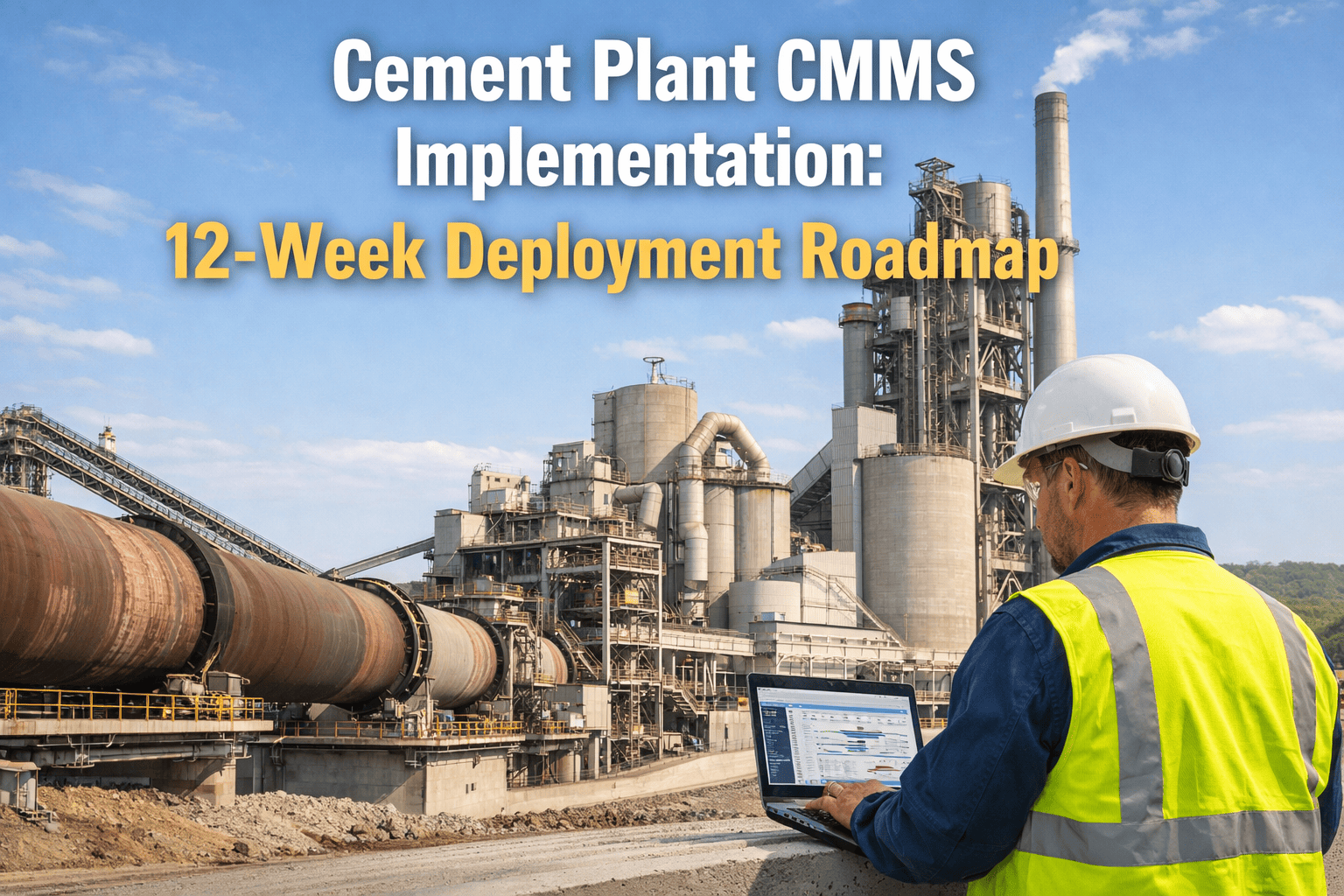
A cement plant CMMS implementation that takes 12 to 18 months to reach usability is not a deployment — it is a failed project. Plants running rotary kilns at $45,000 per hour of unplanned downtime cannot...

An unplanned rotary kiln stop caused by a stockout of refractory bricks that cost $180 per unit costs between $18,000 and $45,000 per hour in lost clinker production — a ratio that makes even the most...

Cement plant field technicians operate in some of the most demanding maintenance environments on the planet — rotary kiln platforms coated in clinker dust, raw mill galleries with airborne particulate...

Cement plants retire 23% of major rotating equipment prematurely because maintenance teams lack total cost of ownership data at the moment capital decisions are made. A rotary kiln shell with 8 years of...

An unplanned kiln stop costs $18,000–$45,000 per hour — yet 73% of critical cement failures show measurable anomaly signals 4–8 weeks before breakdown. AI analytics and IoT sensor networks close the gap...

Cement plants managing 2,400-plus maintainable assets across rotary kilns, ball mills, vertical roller mills, girth gears, clinker coolers, and preheater cyclone towers cannot operate on spreadsheets and...

A 50-tonne EOT crane that fails mid-lift in a cement plant kiln bay does not produce a work order — book a demo to see how a...

The global construction sector is undergoing a materials specification shift that cement producers who ignore it will lose market share to those who do not. Green building rating systems now influence over 40%...

Corrosion is the single largest contributor to premature structural and equipment retirement in cement plants — costing the global cement industry an estimated 3–5% of total maintenance budget annually, and...

A cement plant managing 250 active maintenance suppliers — each with separate contact relationships, separate pricing agreements, separate invoice streams, and no performance measurement system — is not...

A cement plant consuming $4M–$12M in MRO supplies annually — bearings, lubricants, conveyor belts, refractory materials, electrical components, and mechanical consumables — is making hundreds of individual...

Cement transport pipes, air slides, pneumatic conveying lines, and valve assemblies carry raw meal, cement dust, clinker fines, and compressed air through every stage of the production process — and they do it...

A cement plant consuming 120–180 kg of coal or petcoke per tonne of clinker cannot afford an unplanned fuel stockout. A kiln forced into unscheduled shutdown due to fuel supply failure costs $50,000–$300,000...

Cement packing plants are the final link in the production chain — and the most overlooked from a maintenance standpoint. Industry data shows that unplanned packer downtime reduces dispatch capacity by...

A cement plant capacity expansion is one of the highest-capital decisions an operations leadership team will make — greenfield lines run $150M–$400M, brownfield additions $40M–$120M, and major equipment...

A cement kiln operating on uncalibrated thermocouple readings is making fuel combustion decisions on false data. A cement mill controlled by a drifted pressure transmitter is grinding to the wrong setpoint. A...

A cement silo that cannot accurately report its contents is an inventory liability. A silo that develops a rathole, bridging event, or structural crack without detection is a safety emergency. Yet across cement...

Cement production generates, handles, and stores some of the most hazardous materials in industrial manufacturing — hexavalent chromium in clinker dust, polycyclic aromatic hydrocarbons in petcoke, heavy...

A rotary kiln drive produces 105–115 dB(A) at one metre. A cement ball mill runs at 95–105 dB(A) continuously across an entire production shift. A primary jaw crusher peaks at 110 dB(A) during impact...

Every hour a loaded cement truck spends waiting at the dispatch gate is an hour of working capital locked in inventory, a customer relationship eroding, and a loading bay blocked from the next vehicle. Cement...

Limestone accounts for 78–82% of total raw material feed in integrated cement plants — yet quarry operations remain the least digitised stage of the production chain. Inconsistent CaO content from...

Compressed air is the invisible utility consuming 8–12% of total electrical energy in every cement plant — yet most plants have no real-time visibility into how much of that energy is escaping through leaks,...

Cement plants spend 25–35% of total production costs on maintenance — yet most of that budget is consumed by reactive responses to failures that were entirely predictable months in advance. A single...

The cement industry stands at a pivotal crossroads in 2026. Responsible for approximately 8% of global CO2 emissions—making it the fourth-largest industrial emitter worldwide—cement manufacturing generates...

Cement plants operating without artificial intelligence are leaving millions on the table annually. In 2026, AI-powered cement manufacturing delivers documented results that redefine operational benchmarks: 18%...

A cement plant's raw material stockpile represents millions of dollars in tied-up working capital—yet most facilities manage this critical inventory through manual visual estimates and truck weight tickets...

A cement producer in Germany reduced unplanned downtime by 42% and cut shutdown planning time from 6 weeks to 10 days after implementing a digital twin platform that simulates their entire production line from...

Grinding to 4,000 cm²/g Blaine consumes approximately 30% more energy than achieving 3,200 cm²/g—yet most cement plants routinely over-grind by 200–400 cm²/g as a quality safety margin. This conservative...

Equipment failures in cement plants follow a predictable pattern that most maintenance teams miss: 20% of failure modes cause 80% of total downtime. Research analyzing cement plant reliability over nine-year...

Advanced Process Control (APC) and expert systems have transformed cement manufacturing from reactive operator-dependent operations to predictive, self-optimizing production environments. Modern cement plants...

A maintenance technician enters a preheater cyclone for routine inspection at 6:14 AM. The confined space permit was issued the previous shift—but atmospheric testing happened 9 hours ago, and an overnight raw...

Falls from height account for approximately 25% of all cement plant fatalities, making it the single deadliest hazard category in the industry—exceeding mobile equipment strikes, confined space incidents, and...

Electrical systems in cement plants consume 110–120 kWh per tonne of cement produced, representing 20–25% of total production costs. With hundreds of motors ranging from 400V low-voltage units to 11kV...

Every 72 hours, a cement manufacturing facility somewhere in the world experiences a significant fire incident, with coal handling systems and electrostatic precipitators accounting for 68% of all industrial...

Cement plants lose an average of $300,000 per day of unplanned downtime—yet over 60% still manage maintenance with paper logbooks and fragmented spreadsheets. The global CMMS software market is projected to...

Maintenance and operating expenses consume 15-25% of total cement production costs, yet 55% of that budget typically drains into emergency reactive repairs that cost 4-6 times more than planned interventions...

A typical cement plant operates over 2,000 motors with more than 5,000 lubrication points—each one a potential failure waiting to happen if neglected. The harsh reality: up to 80% of premature bearing failures...

Global cement manufacturing accounts for approximately 8% of worldwide CO2 emissions—1.6 billion metric tons in 2022 alone—making the industry the world's third or fourth largest emitter if it were a...

Cement manufacturing contributes approximately 7-8% of global carbon dioxide emissions while releasing nitrogen oxides, sulfur dioxide, particulate matter, and heavy metals that directly impact surrounding...

Cement plant maintenance managers spend an average of 15-20 hours per week compiling compliance reports manually—extracting data from spreadsheets, cross-referencing work orders, formatting documentation for...

A single cement plant must manage 15 to 25 distinct regulatory frameworks simultaneously, with permit violations costing $25,000 to $50,000 per day and potentially triggering consent decrees reaching $10 million...

Cement plants endure some of the harshest operational conditions in heavy industry—extreme temperatures exceeding 1450°C in the kiln zone, constant vibration from rotating equipment, corrosive dust exposure,...

Cement plants generate over 14.3 million tons of particulate emissions annually, making dust collection systems the critical lifeline between compliant operations and costly environmental violations. Your...

Cement manufacturing is a brutal environment for heavy machinery. In 2026, the leading plants no longer rely on rigid calendar-based maintenance or wait for equipment to break. They use Reliability Centered...

Water is the unsung hero of cement production. It cools extreme equipment, mitigates dust, and forms the core of gas conditioning in preheater towers. However, the industry is waking up to a stark reality: water...

Plant managers know that industrial waste doesn't just eat up physical space—it destroys profit margins through rising tipping fees, regulatory fines, and missed energy recovery opportunities. A comprehensive...

It's 6:15 AM on a Monday in October. The plant manager at a 1.5M ton/year cement facility receives the latest energy and carbon compliance report. Coal prices have spiked again, the regional carbon tax just...

Cement and ready-mix concrete logistics present one of the most complex routing challenges in the transportation industry. In 2026, leading dispatch systems no longer just assign a truck to a route — they...

Carbon Capture, Utilization, and Storage (CCUS) systems are becoming the most critical infrastructure in the modern cement industry. Operating in harsh, high-temperature environments, they provide the essential...

The technical director at a regional cement plant was struggling to meet new sustainability targets. Despite optimizing the kiln and switching to alternative fuels, their carbon emissions remained stubbornly...

Cement quality dictates the structural integrity of the modern built environment. From initial quarrying to final grinding, producing cement requires strict adherence to international testing standards like...

Cement manufacturing is one of the most resource-intensive and heavily regulated industries in the world. Operating around the clock, these facilities process massive volumes of raw materials while navigating...

The night shift superintendent at a 5,000 TPD cement plant thought their lubrication route was bulletproof. Every trunnion, fan, and conveyor bearing had a dedicated grease schedule. Then, a massive ID fan...

The cement industry is one of the most resource-intensive sectors globally, processing massive volumes of raw materials and consuming vast amounts of thermal and electrical energy. Historically, production has...

Cement plant operations involve some of the most hazardous industrial environments globally, featuring massive rotating equipment like kilns, extreme temperatures, confined spaces in silos, and high-voltage...

The safety siren echoes across the quarry at 2:14 PM—a contractor bypassed a critical lockout/tagout (LOTO) protocol on the primary crusher. The control room halts operations immediately, but instead of a...

A cement plant in Kentucky lost $280,000 in a single shutdown because one $340 drone propeller was not in stock — the 4-day vendor lead time pushed kiln inspection past the relining contractor's arrival...

The cement industry operates on razor-thin margins where a 5% demand miscalculation in either direction triggers a cascade of costly consequences. Overproduce, and you burn fuel grinding clinker that sits in...

A maintenance technician at a 5,000 TPD cement plant needs a set of kiln shell bearings urgently — the vibration readings crossed the alarm threshold 48 hours ago. He walks to the warehouse, fills out a paper...

Cement logistics accounts for 30-40% of total production costs, yet nearly half the industry still manages supply chains with spreadsheets and manual calls. In 2025, 48% of cement digital projects target supply...

A 6,500 TPD cement plant was running at 68% OEE — 17 full points below the world-class benchmark of 85%. Monthly reports arrived too late for action. Shift supervisors made decisions on gut feel while the kiln...

Cement kilns with preheater and precalciner systems consume 70–80% of a plant's total thermal energy budget, yet most facilities operate 15–20% above the theoretical minimum of 2.9 GJ per tonne of clinker....

At 2:14 AM on a Thursday, the induced draft fan at a 4,500 TPD cement plant seized without warning. The kiln went cold within 40 minutes. By the time the emergency maintenance crew sourced replacement bearings,...

A cement plant laboratory generates thousands of data points every day — XRF raw meal analysis, free-lime measurements, Blaine fineness readings, compressive strength results, particle size distributions, and...

A cement plant producing 200 tons per hour generates over 2.3 million sensor data points every single day — kiln temperatures, mill feed rates, fan pressures, clinker chemistry, vibration signatures, and power...

Cement production exceeds 4.1 billion tonnes annually, yet clinker quality remains the most unpredictable variable in the entire manufacturing chain. The gap between what the quarry delivers and what the kiln...

A cement plant consuming 120 kWh of electrical energy per ton of cement has no way of knowing whether that number represents strong performance or catastrophic waste — without a benchmark to measure against....

In a cement plant's pyroprocessing system, the clinker cooler is where 35–40% of total process heat is either recovered or lost. That single piece of equipment determines your secondary air temperature feeding...

Energy data in most cement plants is scattered across DCS archives, lab servers, and spreadsheet reports that arrive days or weeks too late — by the time a monthly summary reveals a kiln burned thousands of...

Electricity accounts for 30% of total cement manufacturing costs, and grinding operations alone consume up to 70% of a plant's entire electrical load. Yet across the global cement sector, energy efficiency has...

In a cement plant's pyroprocessing system, the clinker cooler is where 35–40% of total process heat is either recovered or lost. That single piece of equipment determines your secondary air temperature feeding...
Electricity accounts for 30% of total cement manufacturing costs, and grinding operations alone consume up to 70% of a plant's entire electrical load. Yet across the global cement sector, energy efficiency has...

The cement industry burns through 8% of global CO₂ emissions and consumes roughly 120 kg of coal per tonne of cement produced — making energy the single largest controllable cost at 40% of total production...

Cement plants consume 110–120 kWh of electrical energy per ton of cement produced, yet most facilities operate 15–25% above optimal efficiency benchmarks. An electrical energy audit systematically uncovers...

Cement grinding devours up to 70% of a plant's total electrical load — yet most mills operate at barely 5% thermodynamic efficiency. For a 1 MTPA facility consuming 33–40 kWh per tonne through conventional...

Cement manufacturing is one of the most energy-intensive industrial processes on the planet, and nearly 40% of the total thermal energy input is lost as waste heat through preheater exhaust gases and clinker...

Gearbox failure is one of the most common and costly failure modes in cement plant operations. In ball mills, gear misalignment, tooth wear, and lubrication breakdown are among the top three causes of unplanned...
Mean Time Between Failures is the single most important number on a cement plant maintenance manager's dashboard. It answers a straightforward question: how many hours does your equipment actually run before...

A single undetected vibration anomaly in a cement plant can cascade into a catastrophic failure costing $300,000 per day of unplanned kiln downtime. The global vibration monitoring market reached $1.87 billion...

A cement plant's conveyor network is its circulatory system — when a belt stops, everything upstream backs up and everything downstream starves. Across the global cement industry, conveyor systems account for...

Cement plants lose an average of $260,000 per hour of unplanned kiln downtime — yet 82% of equipment failures still arrive without warning, detected only after catastrophic breakdown. Global...

Cement plant workers face one of the most hazardous breathing environments in any industrial sector. Dust concentrations at raw material crushers reach 38.6 mg/m³ — nearly four times OSHA's...

A rotary kiln failure does not announce itself — it builds silently through weeks of subtle indicators that unmaintained plants miss entirely. When the kiln finally stops, the average cost is...

Cement manufacturing consumes 3–4 GJ of thermal energy and 90–130 kWh of electricity per tonne of clinker — making it the most energy-intensive industry on the planet after aluminum...

Only 14% of global cement plants have moved beyond basic process control into true Industry 4.0 operations — yet those plants report 38% lower maintenance costs, 22% higher kiln utilization,...
A rotary kiln operating at 1,450°C processes up to 6,000 tonnes of clinker per day — and when it fails, every hour of unplanned downtime costs a mid-size cement plant between $20,000 and $85,000 in lost...

Cement plants carry between $2 million and $18 million worth of spare parts inventory at any given time — yet 20–30% of all maintenance delays in the cement industry are caused by the wrong...

The global cement industry produces over 4.2 billion tonnes annually — and yet, most plants still lose 18–22% of production time to unplanned equipment failures. A single kiln shutdown in a mid-size cement...

A rotary kiln that seizes at 2:43 AM doesn't announce itself in advance — but the bearing vibration that caused it was measurable three months earlier, buried in a paper logbook no one reviewed. That single...

A cement plant technician walking the 800-metre stretch between the preheater tower and the raw mill loses an average of 47 minutes per shift walking back to a control room or supervisor desk to...

Cement plants operate in one of the most demanding industrial environments on earth — continuous 24/7 production cycles, extreme heat, abrasive dust, and critical rotating equipment that cannot afford...

Cement manufacturing is one of the most heavily regulated industries on the planet. A single plant may face simultaneous oversight from environmental agencies, occupational safety bodies, mining regulators, and...
-in-cement-plants.png)
Cement plants are among the most capital-intensive and equipment-dependent operations in heavy industry. A single unplanned kiln stoppage can cost $50,000–$150,000 per day in lost production. Yet most plants...

A mid-scale cement plant running a 40-year-old raw mill faces a decision that will determine its production economics for the next decade: invest $1.2–$3.5 million to retrofit the existing...

A girth gear that reaches end-of-life six months ahead of schedule doesn't fail overnight — it degrades through measurable wear stages that paper-based maintenance programs consistently miss. One premature...

The cement industry accounts for approximately 8% of global CO₂ emissions, making it one of the most carbon-intensive sectors under regulatory scrutiny. With the EU Emissions Trading System (ETS) entering...
The cement industry accounts for approximately 8% of global CO₂ emissions, making it one of the most carbon-intensive sectors under regulatory scrutiny. With the EU Emissions Trading System (ETS) entering...

Cement plants operate on razor-thin margins where even a 1% improvement in OEE can translate to millions in annual savings. Yet most plants still rely on shift-end paper reports and monthly Excel reviews to...

The cement industry must cut its emissions by 75-90% by 2050 to align with Paris Agreement targets. That means reducing from today's ~4.1 billion tonnes of CO₂ annually to under 1 billion — while global...

Cement manufacturing is responsible for approximately 8% of global CO₂ emissions — more than aviation and shipping combined. A single cement plant producing 1.5 million tonnes of clinker annually emits...

A cement plant contains more confined spaces per square meter than almost any other industrial facility. Preheater cyclones, raw meal silos, clinker silos, cement silos, ball mills, the kiln shell, cooler...

A cement plant contains more confined spaces per square meter than almost any other industrial facility. Preheater cyclones, raw meal silos, clinker silos, cement silos, ball mills, the kiln shell, cooler...

A maintenance electrician is found unconscious inside a ball mill. The investigation reveals the mill was re-energized while he was still inside — his paper LOTO tag had fallen off the MCC disconnect during...

At 6:14 AM on a Tuesday, a maintenance technician enters a preheater cyclone for a routine inspection. The confined space permit was issued the previous shift — but the atmospheric testing was done 9 hours...
At 6:14 AM on a Tuesday, a maintenance technician enters a preheater cyclone for a routine inspection. The confined space permit was issued the previous shift — but the atmospheric testing was done 9 hours...

A single batch of off-spec cement can destroy months of customer trust. When 500 tonnes of OPC shipped to a ready-mix plant fails the 28-day strength test by just 2 MPa, the consequences cascade—rejected...

Fuel accounts for 30–40% of total cement production cost—and the kiln consumes over 90% of that fuel. For a plant producing 1.5 million tonnes of clinker annually, even a 3% improvement in kiln thermal...

Refractory lining is the single most expensive consumable in a cement plant—and its failure is the single most expensive event. A typical kiln reline costs $800,000 to $1.5 million in materials alone, but the...

A well-executed shutdown is the difference between a cement plant that runs 330+ days a year and one that struggles to hit 300. Yet most plants treat shutdowns as chaotic fire drills—scrambling for parts two...

It's 2:43 AM when the kiln drive motor seizes. Within minutes, the entire production line grinds to a halt. Raw meal backs up in the preheater tower, clinker cooling stops, and the cement mill sits idle. By the...

The ball mill is the workhorse of cement grinding, consuming 40-50% of the total energy in a cement plant and representing one of the largest capital investments in the production line. When a ball mill fails,...

The blast furnace has been the foundation of steelmaking for over 500 years. But its chemistry is also its carbon problem: reducing iron ore with coke produces roughly 1.8-2.2 tonnes of CO₂ for every tonne of...

A cement plant in Georgia experienced a conveyor belt contact incident that resulted in a hand injury. The supervisor filed a paper incident report, but it sat in a folder for three weeks before the safety...

A cement plant in Vietnam passed their first OSHA inspection without citations after implementing a systematic EHS compliance audit program that identified and corrected 47 deficiencies before regulators...

A cement plant in Morocco avoided a fatal asphyxiation incident when atmospheric monitoring during a silo entry detected dropping oxygen levels 47 seconds before the entrant would have lost consciousness. The...

A cement plant electrician in Maharashtra suffered fatal injuries when a 6.6kV motor feeder was energized while he was performing maintenance—the electrical isolation had...

A cement plant in Texas faced a $156,000 OSHA citation after an employee entered a raw mill without proper confined space clearance—the clearance had expired 36 hours earlier, but...

A cement plant in Pakistan reduced recordable injuries by 67% within 18 months of implementing an EHS dashboard that gave supervisors real-time visibility into leading indicators—catching safety gaps before...

A cement plant in Pennsylvania ran SAP for enterprise resource planning and Oxmaint for maintenance execution—but the systems operated as separate islands. Work orders created in Oxmaint required manual entry...

An EPA inspector arrived at a cement plant in Texas requesting documentation for their Title V operating permit, CEMS calibration records, and quarterly emission reports. The environmental coordinator spent two...

A cement plant shift supervisor in Nevada needed to know which equipment was currently locked out before starting the ball mill for the morning production run. Three different maintenance crews had worked...

A cement plant in Brazil eliminated 100% of LOTOTO documentation gaps after replacing paper-based procedures with a digital system that enforces step completion and captures photo evidence at each isolation...

A cement plant in Alabama experienced a near-miss when welding operations ignited residite dust in a storage silo—a hot work permit had been issued, but the required atmospheric testing wasn't completed before...

Connecting SAP S/4HANA with Oxmaint transforms how cement plants manage maintenance operations. This guide walks you through every step: from gathering prerequisites and...
Connecting SAP S/4HANA with Oxmaint transforms how cement plants manage maintenance operations. This guide walks you through every step: from gathering prerequisites and...

A cement plant in Indonesia prevented a fatal electrical contact incident when a maintenance technician followed the 7-step LOTOTO verification process and discovered the kiln drive motor remained energized...

A cement plant in Kentucky scheduled major ball mill maintenance during what they thought was a low-production window—only to discover production had committed to a large order requiring maximum mill capacity...

Connecting SAP S/4HANA with Oxmaint transforms how cement plants manage maintenance operations. This guide walks you through every step: from gathering prerequisites and...

A cement plant in Kentucky scheduled major ball mill maintenance during what they thought was a low-production window—only to discover production had committed to a large order requiring maximum mill capacity...

A cement plant in Madhya Pradesh faced a regulatory audit that revealed 23 incomplete incident investigations and 8 expired work permits in their SAP EHS system—all from maintenance...

A cement plant in Egypt reduced maintenance part search time from 23 minutes to 47 seconds after integrating their CMMS with SAP Warehouse Management. Previously, technicians walked the warehouse manually...

A cement plant in Indiana ended their fiscal year $1.8 million over their maintenance budget—but couldn't explain where the overrun originated. Work orders posted costs to generic cost centers, making it...

A cement manufacturer with two plants in Gujarat discovered their maintenance costs were 23% higher than budgeted—but only found out during quarterly financial review, weeks after the...

A cement plant in Turkey reduced their spare parts procurement cycle from 14 days to 3 days after implementing automated purchase requisition creation from work orders. Previously, maintenance technicians...

A cement plant maintenance team needed to add 340 new spare parts for a kiln upgrade project. Manually creating each material master in SAP—entering basic data, plant data, purchasing views, and storage...

A cement plant in Ohio ran SAP for materials management but struggled with maintenance spare parts coordination. Technicians couldn't see real-time stock availability from their CMMS—they'd create work orders...

A cement manufacturer with three plants across Rajasthan struggled with fragmented maintenance data—SAP stored equipment masters and cost centers, spreadsheets tracked daily work, and paper...

A cement group operating six plants across three countries reduced cross-plant equipment failures by 41% after implementing unified IoT visibility that enabled corporate engineering to identify maintenance...

A cement plant in Georgia needed to connect 47 different data sources—PLCs from three vendors, legacy Modbus sensors, and new wireless vibration monitors—to their cloud-based maintenance platform. Direct...

A cement plant in Madhya Pradesh installed 52 vibration sensors on critical equipment—and lost 38 of them within the first four months. The sensors had IP65 ratings, adequate for indoor...

A cement plant in Vietnam reduced unplanned downtime by 34% after implementing IoT analytics dashboards that transformed 2.3 million daily sensor readings into actionable maintenance insights. Before the...

A cement plant in Arizona struggled with IoT connectivity across their 2-mile quarry-to-plant operation. WiFi coverage gaps left mobile crushers and conveyor transfer points without monitoring. Cellular IoT...

A cement plant in Rajasthan had 47 vibration sensors installed across their kiln and grinding sections—but technicians still missed critical bearing failures because sensor alerts went to...

A cement plant in Morocco saved $1.4 million in emergency repairs when their IoT alert system notified the maintenance supervisor of abnormal kiln shell temperatures at 2:47 AM—while the operator on shift had...

A cement plant in Ohio ran SAP for materials management but struggled with maintenance spare parts coordination. Technicians couldn't see real-time stock availability from their CMMS—they'd create work orders...

A cement plant in Gujarat lost 47 hours of production data when their consumer-grade WiFi network failed under kiln area temperatures exceeding 65°C. The plant had deployed sensors on...

A cement plant in Turkey prevented a $1.8 million refractory replacement when their IoT sensor network detected a developing hot spot 23 days before visible shell deformation occurred. The thermal imaging...

A cement plant in Pennsylvania deployed 340 IoT sensors across their kiln, mills, and conveyor systems—then struggled to extract value from the data. Sensors from four different vendors fed into separate...

A cement plant in Kentucky learned the cost of robot spare parts stockouts when their primary inspection drone required propeller replacement during their annual kiln shutdown—but no replacement propellers...

A cement plant in Germany discovered unauthorized access attempts on their kiln control DCS after deploying inspection robots with default network credentials—the same robots transmitting quality control data...

A cement producer in Germany reduced unplanned downtime by 42% and cut shutdown planning time from 6 weeks to 10 days after implementing a digital twin platform that simulates their entire production line from...

A cement plant in Alabama experienced catastrophic kiln shell failure when undetected refractory damage allowed shell temperatures to exceed 400°C—warping the steel shell and requiring 45 days of emergency...

A cement plant in Turkey lost $1.2 million in production revenue when their kiln inspection robot failed mid-shutdown—bearing seizure from cement dust infiltration that vibration sensors would have flagged...

A cement plant in India detected 47 developing crusher component failures during a single quarter after deploying quadruped robots for continuous patrol of their primary and secondary crushing stations. Their...

A cement plant in Egypt extended their vertical roller mill campaign from 8,000 to 11,500 hours by deploying inspection robots during scheduled outages—the drone-captured wear measurements identified uneven...

A cement plant in Brazil eliminated 94% of packaging department injuries and reduced worker turnover from 45% to 8% annually after deploying collaborative robots and automated palletizers across their bag...

A cement plant in Georgia faced 340% annual turnover in their packaging department—workers couldn't sustain the physical demands of stacking 50-lb cement bags onto pallets for entire shifts. Workers'...

A cement plant in Ohio lost $180,000 in a single shift when a failed idler roller on their limestone conveyor caused belt damage that halted raw material feed to the mill. The roller had been running hot...

A cement plant in Morocco eliminated rope access inspections entirely after deploying specialized drones for their 85-meter kiln stack assessment. Their previous inspection approach required a 4-person rope...

A cement plant in Texas experienced unexpected grate plate failures that caused 72 hours of unplanned downtime—$540,000 in lost production plus emergency repair costs. Post-incident analysis revealed that...

A cement plant in Texas achieved 100% EPA NESHAP compliance and reduced worker exposure to respirable silica by 85% after deploying quadruped robots equipped with multi-gas detection arrays across their...

A cement producer in Germany achieved 99.2% sample analysis accuracy and reduced clinker factor by 3.5% after deploying Fuller Technologies QCX RoboLab automation across their quality control laboratory. Their...

A cement plant in Indiana faced a 21-day annual shutdown for preheater tower relining—with 8 days consumed waiting for safe entry temperatures and manual demolition of existing refractory. After deploying...

A cement manufacturer in Pennsylvania spent $45,000 annually on scaffold-based silo inspections—each requiring 3-day shutdowns, confined space permits, rescue teams on standby, and workers exposed to...

A cement plant in Turkey eliminated all confined space entries for preheater cyclone inspections after deploying cage-protected inspection drones. Their four-stage preheater tower required 18 workers, 3 days of...

Rotary kiln inspections have traditionally required full cooldown periods lasting 3-5 days, scaffold installation inside 4-meter diameter vessels, and confined space entry protocols that expose workers to...

CRH's Ash Grove Spot robot deployment in Washington State represents one of the most successful implementations of quadruped robot cement plant inspection in North America....

Cement plants represent some of the most challenging environments for maintenance operations—extreme temperatures exceeding 1400°C in kilns, abrasive clinker dust that destroys equipment, confined spaces...

This real-world case study documents how a 2.4 million ton per year cement plant in Indonesia transformed their maintenance operations through robotic inspections and CMMS...

A cement plant in Germany deployed ROS 2-based inspection robots to monitor their kiln zone, preheater towers, and clinker cooler—areas where temperatures exceed 400°C and toxic gas...

A cement plant in Turkey reduced their annual shutdown duration from 28 days to 19 days—a 32% improvement—by deploying robots for inspection, cleaning, and maintenance assistance during turnarounds. The...
A cement plant in Germany deployed ROS 2-based inspection robots to monitor their kiln zone, preheater towers, and clinker cooler—areas where temperatures exceed 400°C and toxic gas...

A cement plant in Pakistan lost $1.2 million in a single quarter when their primary crusher experienced catastrophic liner failure during peak production season. The failure occurred three weeks before scheduled...

A cement plant in Morocco experienced a catastrophic silo collapse that killed two workers and shut down production for seven weeks. Investigation revealed the silo's internal structure had been...

A cement plant in Egypt lost $1.8 million in a single year from conveyor belt failures—splices separating, belts misaligning, and idlers seizing without warning across their 12km of conveyors. Manual...

A cement plant in India reduced unplanned robot downtime by 73% after implementing predictive maintenance strategies powered by PLC sensor integration and CMMS analytics. Their kiln inspection...

A cement plant in Texas lost $2.3 million annually to unplanned kiln and mill shutdowns—temperatures exceeding 1400°C, abrasive clinker dust, and confined spaces made human inspection dangerous and...

A cement plant in Ohio faced repeated OSHA citations for respirable crystalline silica exposure—each citation carrying $15,000+ penalties and requiring costly remediation. Fixed monitoring stations showed...

A cement plant in Texas faced a critical challenge: their annual kiln shutdown consumed 14 days—costing $180,000 per day in lost production. Manual inspection of the 450-foot rotating kiln required...

Your cement plant already has cameras. Dozens of them — mounted on walls, pointed at conveyors, overlooking the kiln area. But here's the uncomfortable truth: those cameras are just recording. Nobody watches...

If you've ever rushed to a cement plant at odd hours because of an injury report, you already know — safety data buried in spreadsheets doesn't protect anyone. The cement industry remains one of the most...

Cement manufacturing is the third largest industrial source of air pollution, releasing over 500,000 tons of sulfur dioxide, nitrogen oxide, and carbon monoxide into the atmosphere every year. Dust emissions...

Every cement plant runs on a handful of assets that cannot afford to fail. Your rotary kiln operates at 1,450°C around the clock. Your ball mills grind raw meal through 44+ bearing points under constant...

In cement manufacturing, data delays kill productivity. When your kiln sensor detects rising temperatures but that data takes 48 hours to reach the maintenance team, you've already lost...

Cement plant equipment maintenance involves multiple hazardous energy sources—electrical systems powering 5,000 HP motors, hydraulic pressures exceeding 3,000 PSI, thermal zones reaching...

Your SAP system holds the financial truth. Your maintenance team holds the operational reality. When these two worlds operate in isolation, cement plants face delayed decisions,...

Cement plants running SAP S/4HANA often struggle with a painful disconnect: your ERP holds financial and procurement data in one silo, while maintenance teams work with spreadsheets,...

Cement rotary kilns operate at extreme temperatures—flames reaching 2,000°C, burning zones at 1,450°C, and shell surfaces that must never exceed 400°C to avoid permanent steel damage....

Cement crusher systems endure extreme punishment—jaw crushers processing 1,200mm limestone boulders, impact crushers spinning at 50,000+ RPM, and hammer mills absorbing constant shock...

Cement plants are asset-intensive operations where equipment reliability directly determines profitability. A single unplanned kiln stop can cost $500,000 or more in lost production, emergency repairs, and...

The cement industry stands at an inflection point. For decades, competitive advantage came from scale, location, and operational know-how passed down through generations. Today, a new force is reshaping the...

Running a cement plant is an orchestra of complexity—kilns burning at 1,450°C, mills grinding around the clock, quality specifications that must hit narrow targets, equipment that can't afford to fail, and...

Sensors are the eyes and ears of modern cement plants—without them, optimization is guesswork and predictive maintenance is impossible. But not all sensors are created equal. Smart sensors go beyond simple...

Data flows through cement plants in torrents—temperatures, pressures, flows, compositions, power draws, quality measurements—yet most of it disappears into historians, never analyzed, never acted upon....

Cement plants are asset-intensive operations where equipment reliability directly determines profitability. A single unplanned kiln stop can cost $500,000 or more in lost production, emergency repairs, and...

Cement supply chains face unique pressures: bulk materials with high transport costs, production that can't easily flex to demand changes, customers expecting just-in-time delivery, and thin margins that punish...

A digital twin is more than a 3D model or dashboard—it's a living, breathing virtual replica of your cement plant that mirrors physical operations in real-time. Every sensor reading, every process change,...

The cement industry stands at a transformation point. While the basic chemistry of cement production hasn't changed in over a century, the way plants operate is undergoing radical evolution. Industry 4.0...

Cement manufacturing is one of the most energy-intensive industrial processes on Earth. Energy typically accounts for 30-40% of production costs, with the kiln alone consuming massive amounts of thermal energy...

Cement manufacturing demands precision at every stage—from raw material blending through clinker production to final grinding. Traditional quality control relies on periodic lab sampling, often catching...

The cement plant of the future doesn't just run—it thinks. While traditional operations rely on operators making hundreds of manual adjustments daily, smart cement plants leverage AI, MES...

The cement industry stands at a crossroads. While other manufacturing sectors have embraced Industry 4.0 technologies to achieve breakthrough efficiency gains, not a single cement plant has...

Raw mills are the heartbeat of cement production—grinding limestone, clay, and iron ore into the fine powder that becomes clinker. But when particle size drifts, chemistry fluctuates, or...

A single kiln failure can cost your cement plant $50,000 to $100,000 per hour in lost production. Traditional maintenance approaches force you to choose between expensive over-maintenance or...
.png)
Cement plant equipment operates under extreme conditions—rotary kilns reaching 1,450°C, ball mills grinding 24/7, and gearboxes transmitting...

Cement plants face relentless pressure: fluctuating raw material quality, volatile energy costs, and aging equipment that fails without warning. Traditional operations rely on experienced...

Cement manufacturing demands precision at every stage—from raw material grinding to clinker formation at 1,450°C. OxMaint's AI-driven process optimization platform uses machine learning,...

Raw mill performance determines your cement quality. When particle size varies, moisture fluctuates, or grinding efficiency drops—your entire production line suffers. Predictive Cp/Cpk...

Every cement plant generates millions of data points daily—from kiln temperatures and grinding parameters to energy consumption and quality metrics. OxMaint transforms this raw data into...

The cement industry stands at a transformative crossroads—where artificial intelligence, autonomous systems, and sustainable practices converge to reshape manufacturing forever. OxMaint...

Cement plants are among the most hazardous industrial environments—with extreme temperatures, toxic dust, rotating machinery, and confined spaces threatening worker safety every shift....

Every cement bag tells a story. Cracks, tears, and printing failures speak of quality issues your customers will notice before you do. AI-powered surface inspection catches what human eyes...

Foreign objects on your conveyor belts don't announce themselves. Vision AI does it for them—detecting metal fragments, oversized rocks, and debris before they destroy your crushers. In...
Oxmaint integrates with IoT sensors, kiln shell scanners, and OEM equipment systems to create a unified cement plant maintenance ecosystem.
Explore all integrations


Oxmaint supports the complete cement manufacturing process including rotary kilns with refractory zone tracking (burning zone, transition zone, preheating zone), cyclone preheaters (4-6 stage) and precalciners, vertical roller mills (VRM), ball mills, roller presses, grate coolers, raw mills, coal mills, cement mills, crushers, conveyors, bucket elevators, bag filters, and electrostatic precipitators (ESPs). Our asset hierarchy supports tracking from plant level down to individual components like gearboxes, bearings, and refractory linings.
Unlike calendar-based maintenance, Oxmaint triggers maintenance tasks based on actual operational metrics. For kilns, this means scheduling refractory inspections based on operating hours or thermal cycles. For VRM gearboxes, which typically require complete overhaul every 48,000 operating hours, Oxmaint tracks runtime automatically and generates work orders at the right time. This approach avoids both premature maintenance (wasting resources) and unexpected failures (costly downtime).
Yes, Oxmaint's mobile app features offline-first functionality designed for cement plant conditions. Technicians can complete inspections, log work orders, and capture data even in dusty areas near kilns, mills, or crushers with limited or no connectivity. Data syncs automatically when connection is restored. The app supports ruggedized devices commonly used in high-dust, high-temperature industrial environments.
Oxmaint provides templates and tracking for OSHA respirable crystalline silica standards (50 μg/m³ permissible exposure limit), EPA Clean Air Act requirements for cement plant emissions, ISO 45001 occupational health and safety management, and ISO 50001 energy management systems (critical since energy makes up 30% of cement production costs). Our permit-to-work and LOTO features ensure safety protocols are followed for kiln entry and confined space work.
Yes, Oxmaint provides API-based integration with SCADA systems, kiln shell infrared scanners, vibration monitoring systems (for VRM and ball mill bearings), ERP platforms like SAP, and condition monitoring solutions. This enables real-time data flow from equipment sensors to trigger maintenance alerts—such as kiln shell hot spots indicating refractory damage, or elevated vibration levels on mill gearboxes signaling bearing problems.
Join leading cement manufacturers who trust Oxmaint to maximize kiln uptime, reduce energy costs, and ensure regulatory compliance in demanding 24/7 clinker production environments.