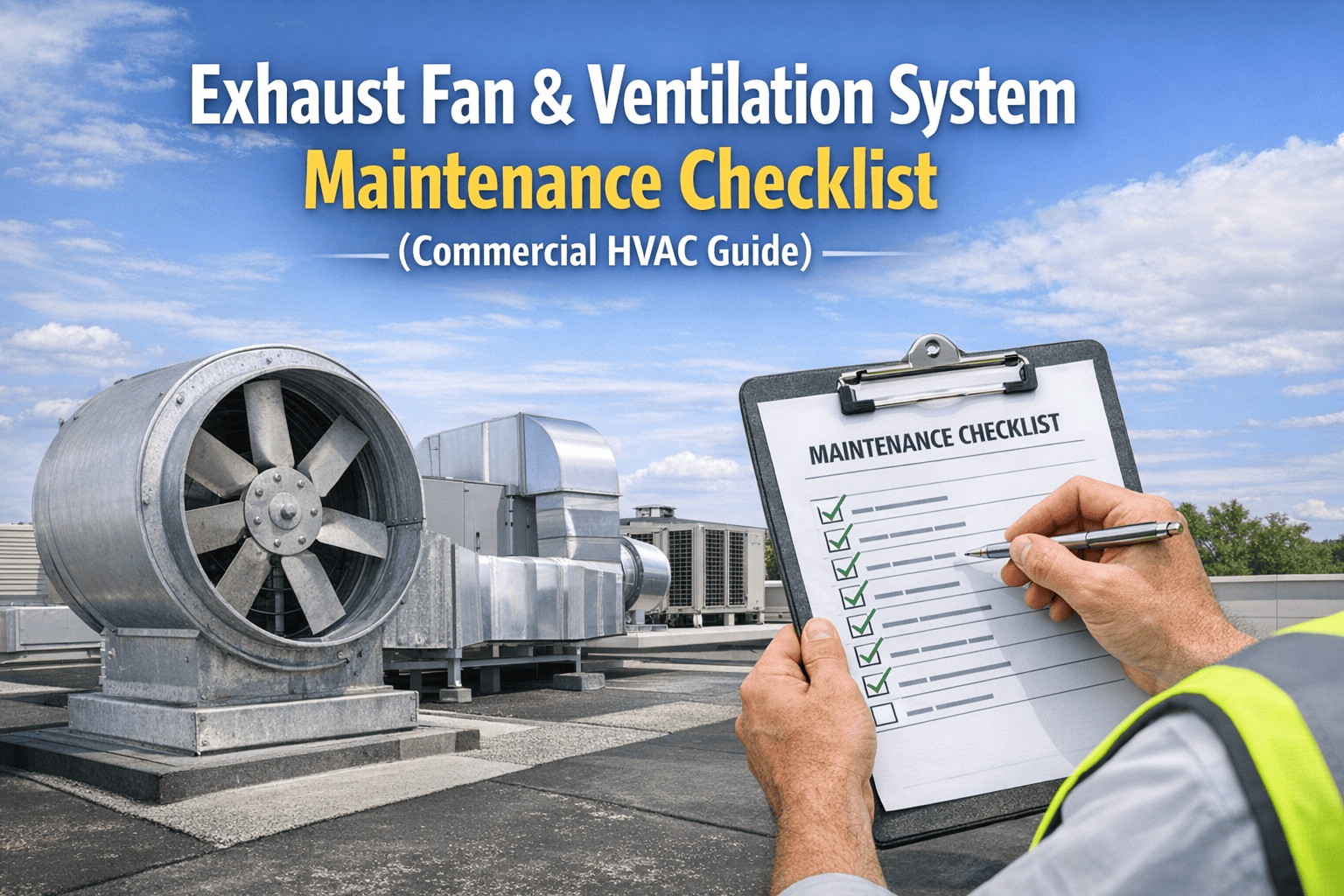
An exhaust fan is the quietest critical asset in a commercial building — until it fails. A kitchen rooftop unit with a loose belt burns 11% more energy before anyone notices. A garage CO exhaust system with a seized damper becomes an occupant health incident by the end of a single shift. A laboratory fume hood operating at 62 fpm when the specification calls for 100 fpm is a containment breach that only shows up on the annual ANSI/AIHA Z9.5 certification — weeks or months after the exposure happened. The single discipline that prevents all three scenarios is a documented, cadence-driven inspection checklist tied to the asset in the CMMS, with every task timestamped, attributed, and closed out against a measurable threshold. Book a demo to see how Oxmaint structures exhaust fan and ventilation maintenance checklists across commercial HVAC portfolios.
A complete exhaust fan and ventilation maintenance program runs on four cadences — daily visual checks, monthly mechanical inspections, quarterly deep-cleaning and calibration, and annual compliance certification. Each equipment type (general exhaust, kitchen rooftop, laboratory fume hood, garage ventilation, makeup air) carries its own measurement thresholds, regulatory standard, and failure-mode profile. This page provides the cadence structure, the per-equipment checklist, and the failure-to-action diagnostic matrix that commercial HVAC teams use to keep all five systems in compliance and prevent the silent degradation that precedes equipment failure.
Why a Cadence-Driven Ventilation Checklist Is Not Optional
Ventilation failures are invisible until they are catastrophic. A belt loses tension over weeks and the fan still spins — just at lower CFM. A bearing overheats over months and the motor still runs — until it does not. Grease accumulates in a kitchen duct over a single summer and a routine flame becomes a Class K fire. The four scenarios below are the most common failure paths teams see when checklists are unstructured, undocumented, or skipped.
Five Ventilation System Types This Checklist Covers
Commercial HVAC ventilation is not one equipment class — it is five distinct system types, each with its own regulatory standard, inspection cadence, and failure-mode signature. The checklist framework below applies to all five, but the specific thresholds and tasks differ by equipment. Use the cards to identify which sections of the inspection checklist apply to your building.
See the Full Exhaust Fan Checklist Template Inside Oxmaint
Oxmaint ships preconfigured preventive maintenance templates for all five ventilation system types above — with NFPA 96, Z9.5, and ASHRAE 110 thresholds already structured per asset. Book a demo to load the template into your asset registry in under 30 minutes.
The Four-Cadence Inspection Framework
Every ventilation asset operates on four parallel inspection cadences. Daily visual checks catch obvious anomalies. Monthly mechanical inspections verify belt tension and lubrication. Quarterly deep work handles cleaning, calibration, and vibration analysis. Annual certification satisfies regulatory compliance. The cadence blocks below define what belongs at each tier.
The General Exhaust Fan Inspection Checklist
The table below is the monthly and quarterly inspection sheet for a belt-driven centrifugal exhaust fan — the most common configuration in commercial buildings. Each line item carries the measurement target and the action trigger. Use it directly as a PM template or load it into Oxmaint as a work order template per fan asset.
| Inspection Task | Measurement / Target | Action Trigger |
|---|---|---|
| V-belt tension at midspan | Approximately 1" deflection under thumb pressure | Adjust tension if below or above spec; replace belt if cracked or glazed |
| Sheave and pulley alignment | Straightedge check across drive and driven sheaves | Realign if lateral deviation exceeds 1/16" over 24" span |
| Motor amperage (three-phase) | Within 90-100% of nameplate FLA across all phases | Investigate load, bearing drag, or duct restriction if outside range |
| Bearing housing temperature | IR reading below 160°F under normal load | Lubricate per spec; replace bearing if temperature rise continues after lube |
| Vibration at bearing housing | Baseline reading ±20% (FFT analysis quarterly) | Balance impeller, check alignment, or replace bearing based on frequency spectrum |
| Impeller and fan wheel condition | No cracks, corrosion, material buildup, or blade damage | Clean or replace — imbalance accelerates bearing and motor degradation |
| Vibration isolators / rubber mounts | Intact, flexible, no dry rot or cracking | Replace isolators — degraded mounts transfer vibration to structure |
| Electrical connections and terminations | Tight, no corrosion, no discoloration on conductors | Retorque per NEMA spec; replace corroded lugs or damaged insulation |
| Roof curb and weather seal | No rust-through, flashing intact, gasket compressed | Reflash or reseal — water ingress destroys motor windings |
Kitchen Exhaust & Fume Hood Checklists
Kitchen exhaust under NFPA 96 and laboratory fume hoods under ANSI/AIHA Z9.5 carry compliance obligations that go beyond generic fan maintenance. The tables below cover the equipment-specific items — grease management for kitchens, face velocity and containment for labs.
| Equipment Area | Checklist Task | Standard / Threshold |
|---|---|---|
| Kitchen Hood | Baffle filter cleaning, hood interior degrease, access panel inspection | NFPA 96 — monthly for solid-fuel cooking, quarterly moderate, semi-annual low volume |
| Kitchen Duct | Full duct system clean by certified ASCS contractor, grease depth measurement | NFPA 96 — professional certification, 0.078" (2mm) grease depth triggers cleaning |
| Kitchen Fan | Fan wheel and housing degrease, belt and bearing per general exhaust checklist, roof drain clear | Monthly fan-wheel clean for high-volume; quarterly for moderate-use operations |
| Fire Suppression | UL 300 system inspection, nozzle alignment, tank pressure, fusible link integrity | NFPA 17A — semi-annual inspection by certified fire protection contractor |
| Fume Hood Sash | Sash operation, counterweight balance, safe height marking visible and correct | ANSI/AIHA Z9.5 — smooth operation, marked working sash position, sash stop functional |
| Fume Hood Velocity | Average face velocity traverse at working sash height, minimum 9-point measurement | ANSI Z9.5 / ASHRAE 110 — 80-120 fpm (60 fpm for high-performance hoods) |
| Fume Hood Monitor | Low-flow alarm calibration, audible and visible alarm test, monitor display accuracy | Alarm at 80% of setpoint, accuracy within 5% of average face velocity reading |
| Fume Hood Containment | Smoke visualization test at face opening and inside hood, no escape at 6" inside hood | ASHRAE 110 — tracer gas test at annual cert, smoke pattern test semi-annually |
| Lab Exhaust Fan | VFD operation, stack discharge integrity, bypass damper function, no short-circuit to intake | ANSI Z9.5 — stack height per plume dispersion calc, VAV response within spec |
Every Ventilation System. Every Standard. One Inspection Platform.
Oxmaint loads NFPA 96, ANSI Z9.5, ASHRAE 110, and OSHA ventilation templates directly into asset-level PM schedules — with measurement capture, photo evidence, and auto-generated compliance reports for every inspection cycle.
Symptom-to-Cause Diagnostic Matrix
When a fan or ventilation system underperforms, the symptom rarely points cleanly to the cause. The matrix below links the six most common field symptoms to their likely root causes and the checklist item that catches each one before it becomes a failure event.
| Field Symptom | Most Likely Causes | Checklist Item That Catches It |
|---|---|---|
| Reduced airflow / low CFM | Clogged filter, belt slipping, damper stuck, duct obstruction, impeller fouling | Monthly filter check, belt tension measurement, quarterly damper cycle test |
| Unusual noise or rattling | Bearing wear, loose mount, impeller imbalance, foreign object, belt slippage | Monthly auditory check, quarterly vibration FFT, bearing temperature scan |
| Excessive vibration | Impeller imbalance, misalignment, bearing defect, worn isolators, loose hardware | Quarterly vibration analysis with frequency spectrum review, isolator inspection |
| Motor overheating | Overamperage, bearing drag, belt too tight, blocked ventilation, winding fault | Monthly amperage reading, bearing temperature, annual megger test |
| Fume hood alarm sounding | Sash above safe height, exhaust fan fault, duct restriction, damper drift | Daily alarm check, annual certification, quarterly damper cycle and sensor cal |
| Building pressure imbalance | Makeup air unit off, exhaust-to-supply mismatch, envelope leakage, door seal failure | Monthly makeup air CFM verification, quarterly building pressure test |
What Structured Ventilation Maintenance Actually Delivers
Teams moving from ad-hoc or paper-based ventilation PM to a structured, CMMS-driven checklist program report consistent operational and compliance wins within the first two quarters. The numbers below are drawn from rolling industry benchmarks and Oxmaint customer deployments across commercial and institutional HVAC portfolios.
Standards Coverage by Ventilation System
| System Type | Governing Standards | Oxmaint Checklist Coverage |
|---|---|---|
| General Exhaust Fans | SMACNA HVAC Systems, NEMA motor standards, local mechanical code | Belt, bearing, amperage, vibration, and electrical task templates per fan asset |
| Kitchen Exhaust | NFPA 96, NFPA 17A fire suppression, UL 300, IMC kitchen ventilation | Hood, duct, fan, fire suppression, and grease depth inspection cycles documented |
| Laboratory Fume Hoods | ANSI/AIHA Z9.5, ASHRAE 110, NFPA 45, OSHA 1910.1450, SEFA 1.2 | Face velocity, smoke pattern, tracer gas test results, annual certification log |
| Garage CO Ventilation | ASHRAE 62.1, IMC 404, local life-safety ventilation codes | CO sensor calibration, demand ventilation response, damper actuator function tests |
| Makeup Air Units | ASHRAE 62.1, IMC makeup air requirements, utility rebate program standards | Supply/exhaust balance, filter cadence, gas-fired burner tune-up, building pressure verification |
Perspective: What HVAC Technicians Said
Frequently Asked Questions
Stop Running Exhaust Fans on Hope. Run Them on a Documented Checklist.
Oxmaint structures ventilation inspections, measurement capture, and compliance documentation into one platform your HVAC team uses on their phones and your compliance auditors review from a dashboard. NFPA 96, ANSI Z9.5, and ASHRAE 110 already loaded.


