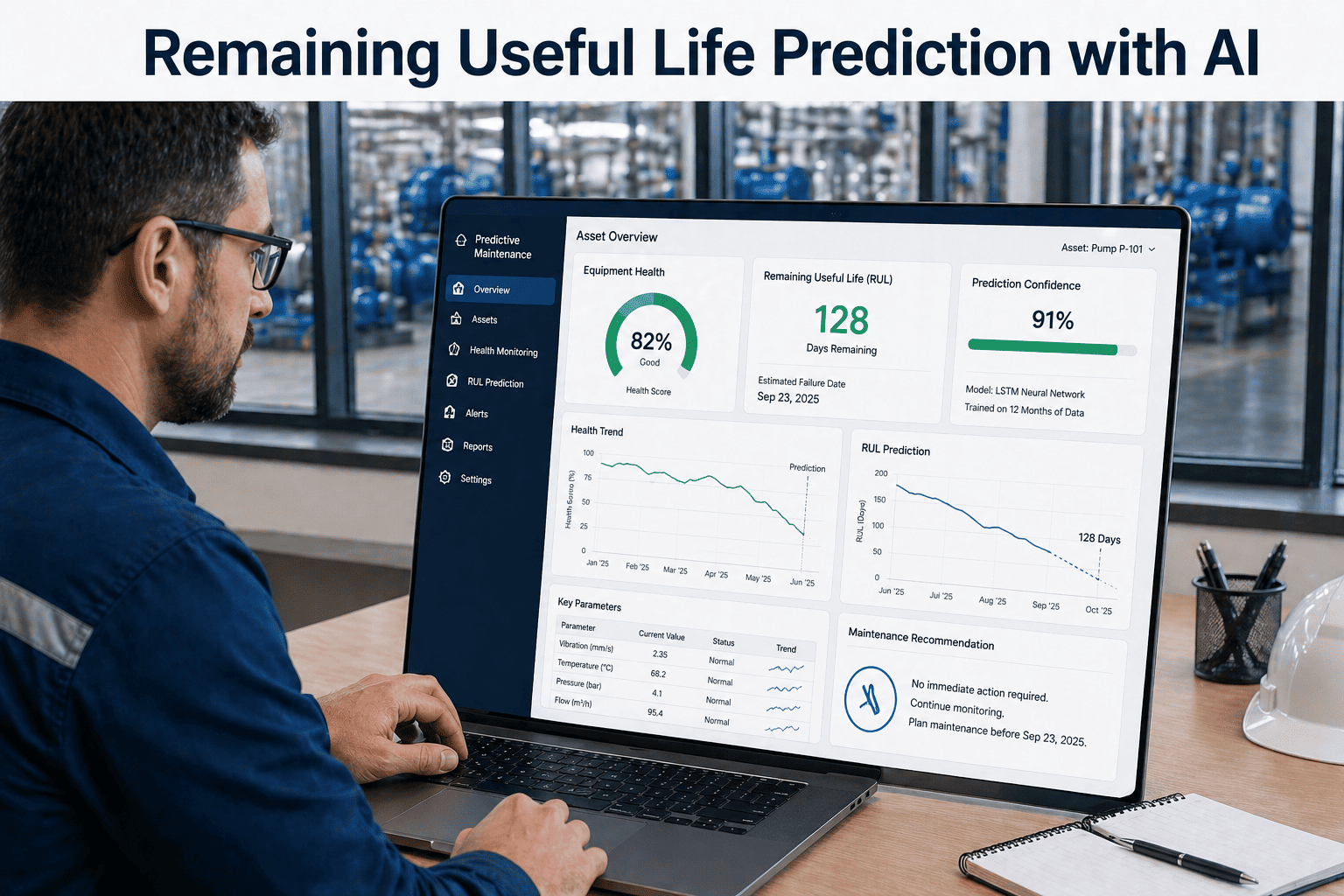
A pulp mill replaced its lead recovery boiler feed pump on a fixed 18-month schedule for nearly a decade. Last year, the same pump — equipped with vibration, temperature, and runtime sensors feeding into OxMaint — ran 27 months before the AI flagged a Remaining Useful Life of less than 60 days. The replacement was scheduled into the next planned outage. Cost of that single decision: zero unplanned downtime, $94,000 saved in deferred capital, and a maintenance window that closed in eight hours instead of the emergency 31-hour scramble that the pump's older sister suffered eighteen months earlier. Plants using AI-driven RUL prediction report 41% reduction in unplanned failures, 28% extension of average asset life, and 19% cut in spare parts inventory carrying cost. RUL is not a forecast number on a dashboard — it is a planning instrument that lets the maintenance team move from "replace on calendar" to "replace just before the asset would actually fail." If you want to see RUL prediction running on your own asset data, you can start a free trial and connect your first sensor stream in under thirty minutes, or book a demo with a reliability engineer who will walk through the model architecture.
Predictive Maintenance · Remaining Useful Life
Remaining Useful Life (RUL) Prediction in CMMS Using AI
A practical guide to AI-driven Remaining Useful Life forecasting — how sensor data, runtime history, and machine learning combine to predict equipment failure weeks in advance and shift maintenance from calendar-based to condition-based.
Reduction in unplanned equipment failures across plants using AI-driven RUL prediction in CMMS
28%
Extension in average asset operational life when replacements move from calendar-based to RUL-based
19%
Cut in spare parts inventory carrying cost as just-in-time procurement replaces buffer stocking
$94K
Typical capital cost deferred per critical rotating asset extended from 18 months to 27 months service
Stop Replacing Healthy Equipment
The Asset You Replaced on Schedule Last Quarter Probably Had Six More Months of Life Left
Calendar-based preventive maintenance is conservative for a reason — nobody wants the pump to fail mid-shift. But conservative also means premature. Plants discover that 60-70% of replaced components had significant remaining life when they fitted RUL prediction across critical assets. The AI model does not eliminate replacement — it tells you the right week to do it, instead of the wrong year.
What Remaining Useful Life Prediction Actually Means
Remaining Useful Life (RUL) is the predicted operating time an asset has left before it reaches a defined end-of-life condition — typically the threshold beyond which performance degrades, safety risk rises, or failure becomes likely. AI-driven RUL prediction inside a CMMS combines real-time condition data (vibration, temperature, current draw, oil chemistry), runtime accumulation, work order history, and OEM degradation curves into a machine learning model that outputs RUL as a continuously updated forecast with a confidence interval. The model does not predict the exact failure date — it predicts the window in which failure becomes probable, and revises that window every time fresh sensor data arrives. To see how RUL is calculated for one of your real assets, you can book a demo with the OxMaint reliability team.
6 Data Inputs That Feed the RUL Model
SENSOR · HIGH WEIGHT
Vibration Spectra
FFT-decomposed vibration amplitude across bearing, shaft, and gearmesh frequencies. Single most predictive input for rotating assets — bearing degradation is detectable 30-90 days before audible failure.
SENSOR · HIGH WEIGHT
Operating Temperature
Bearing housing, motor winding, and lubricant temperatures. Trend deviation from baseline correlates strongly with insulation breakdown, lubrication failure, and seal degradation.
RUNTIME · MEDIUM WEIGHT
Cumulative Runtime Hours
Accumulated operating hours, start-stop cycle counts, and load-weighted runtime. Anchors the model against the OEM's published reliability curve and historical service intervals for the asset class.
SENSOR · MEDIUM WEIGHT
Electrical Signature
Motor current, power factor, and voltage imbalance. Rising current draw under constant load is a leading indicator of mechanical binding, broken rotor bars, or coupling misalignment.
LAB · MEDIUM WEIGHT
Oil & Lubricant Analysis
Iron, copper, and silicon particle counts; viscosity drift; water contamination. Periodic oil samples produce wear-particle trends that confirm or contradict sensor-derived predictions.
HISTORY · HIGH WEIGHT
Failure History & Work Orders
Prior failure modes, repair work orders, and replacement records for the asset and its sister units. Trains the model on plant-specific failure signatures that generic OEM curves do not capture.
Why Time-Based Preventive Maintenance Falls Short
Pain 01
Healthy Assets Replaced Prematurely
A blanket 18-month replacement interval discards components with 6-12 months of remaining life. Aggregated across a fleet of pumps and motors, the over-replacement waste runs into hundreds of thousands annually.
Pain 02
Failures Still Happen Before Schedule
Calendar intervals are an average. Roughly 15-20% of assets fail before the scheduled service date because their actual operating stress exceeded the design assumption baked into the OEM recommendation.
Pain 03
Spare Parts Over-Stocked
Without RUL forecasts, storerooms hold 6-12 months of buffer inventory for critical assets. The carrying cost of that float runs at 20-25% of inventory value annually — a quiet line on the maintenance budget.
Pain 04
Outage Windows Misaligned
Replacements forced by calendar dates rarely line up with planned plant outages. The result: extra outages scheduled solely for PM, or rushed in-production swap-outs that elevate safety risk.
Pain 05
No Differentiation Across Duty Cycles
Two identical pumps — one running 24/7 in primary service, one as standby — receive the same calendar-based replacement. RUL models naturally weight by actual runtime and load, ending the one-size policy.
Pain 06
Capital Decisions Made on Hunch
"Replace or rebuild" decisions on aging assets default to gut feel from senior engineers. RUL plus historical degradation rate gives capital planners a data-anchored answer rather than a meeting-room debate.
How OxMaint Predicts RUL: 4-Stage Model Pipeline
A
Sensor Ingestion & Cleaning
Multi-protocol sensor streams (Modbus, OPC-UA, MQTT) ingested at 1-second to 1-minute resolution. Outlier rejection, gap-filling, and frequency-domain transformation handled in the edge layer before storage.
B
Feature Engineering
Vibration spectra reduced to bearing-fault frequency bands, temperature signals to baseline-deviation curves, current to power-factor trends. Each asset class has a feature template tuned to its known failure modes.
C
Hybrid Model Inference
Ensemble of physics-based degradation models and gradient-boosted ML, blended per asset class. The physics model anchors against OEM curves; the ML layer captures plant-specific failure signatures from historical work orders.
D
RUL Output & Action
RUL surfaces as a number (days/hours), a confidence interval, and a recommended action band — "monitor", "schedule replacement", "act now". Auto-generated work orders trigger when RUL crosses the planning threshold.
Model Quality & Confidence Controls
QC 01
Confidence Interval on Every Output
Every RUL number ships with an upper and lower bound at 90% confidence. Engineers see the spread, not just the point estimate — "58 days ± 11" is a planning input; "58" alone is a false precision.
QC 02
Backtested Against Historical Failures
Every model is validated against the plant's last 24-36 months of failure work orders. RUL predictions are scored on how well they would have flagged failures that actually happened — not just simulated runs.
QC 03
Physics-Anchored Degradation Floor
The hybrid ensemble prevents the ML model from drifting into physically implausible predictions. A bearing cannot have an RUL longer than its OEM-rated life under measured load — the physics layer enforces this.
QC 04
Drift Detection & Retraining
Model drift is monitored continuously. When prediction error rises past a threshold, the model is flagged for retraining with the most recent failure data — the system stays accurate as the asset base ages.
Time-Based PM vs RUL-Based Maintenance: Side-by-Side
Decision Point
Time-Based PM
RUL-Based with OxMaint AI
Replacement trigger
Fixed calendar interval
RUL crosses planning threshold
Average asset life utilised
62-72% of true life
88-94% of true life
Unplanned failure rate
15-22% per asset class per year
4-9% per asset class per year
Spare parts inventory level
6-12 months buffer
2-4 weeks just-in-time
Outage scheduling fit
Forced timing — misaligned with plant outages
Replacements deferred to next planned outage window
Duty cycle differentiation
None — identical schedule for all units
Each asset's actual runtime drives its own RUL
Capital expenditure planning
Annual lump — replace whatever is "due"
Forecasted 12-24 months out per asset
Engineering decision quality
Schedule-driven judgement
Data-driven with confidence intervals
ROI Snapshot from RUL-Driven Plants
41%
Fewer unplanned failures
Across rotating, electrical, and HVAC asset classes after 12 months of RUL deployment
28%
Asset life extension
Replacements move from blanket 18-month cycle to RUL-driven 24-32 month cycles
19%
Spare inventory reduction
Buffer stock cut as RUL forecasts enable just-in-time procurement of critical spares
$2.1M
Annual savings — mid-size plant
Combined effect of deferred capital, reduced inventory, and avoided unplanned downtime
Frequently Asked Questions
How much sensor data is required before the RUL model produces useful output?
For rotating equipment with vibration and temperature instrumentation, useful RUL output begins after 4-8 weeks of baseline data per asset. The model accuracy improves substantially over the first six months as more operating conditions and load variations are observed. For asset classes without sensors, RUL is initialised from runtime hours, OEM curves, and similar-class historical failures — less granular but still better than calendar-only PM.
Does OxMaint require new hardware sensors, or does it work with existing instrumentation?
OxMaint ingests data from existing PLC, SCADA, vibration analyzers, and oil-analysis lab feeds via Modbus, OPC-UA, MQTT, and REST. New sensor deployment is recommended only for critical unmonitored assets. Most plants reach meaningful RUL coverage on 60-70% of their critical fleet using existing instrumentation, then add sensors selectively for the highest-value gaps.
How does the model handle assets with no historical failure records?
For assets with no plant-specific failure history, the model leans on the physics-based degradation curve from OEM data and on cross-plant failure signatures from similar asset classes. Confidence intervals are wider during this cold-start phase and narrow as the asset accumulates operating history. The system always reports the confidence band so engineers know how much weight to put on early-stage predictions.
What asset types are best suited to AI-driven RUL prediction?
Rotating equipment (pumps, motors, fans, compressors, gearboxes), electrical assets (transformers, switchgear, large drives), and HVAC chillers and AHUs are the strongest fits because their failure modes are well-characterised and produce clear sensor signatures. Static assets (vessels, piping, structural members) benefit from inspection-driven RUL rather than continuous sensor RUL. The OxMaint platform supports both modalities under a single CMMS view.
RUL Prediction · From Calendar to Condition
Stop Replacing Equipment by the Calendar. Start Replacing It at the Right Time.
Every asset on your fixed-interval replacement schedule is being changed too early, too late, or on the wrong week of the wrong month. AI-driven Remaining Useful Life prediction collapses that uncertainty into a forecasted window with a confidence interval — and the planning team gets months of lead time instead of days. The replacement still happens. The capital still gets spent. They just happen at the moment when the asset has actually given you everything it had.