US elevators make 18 billion passenger trips every year. Elevators worldwide break down an average of four times annually — generating 272 million hours of lost service each year that affects tenants, passengers, compliance status, and building liability exposure simultaneously. The regulatory stakes are higher than at any point in the past decade: ASME A17.1-2025, the current Safety Code for Elevators and Escalators, now includes cybersecurity requirements alongside its longstanding mechanical, electrical, and structural mandates, and every building is legally required to maintain a documented Maintenance Control Program (MCP) per Section 8.6 — one of the most commonly cited inspection violations nationwide. A missing or incomplete MCP signals to your Authority Having Jurisdiction that proper maintenance is not being performed, regardless of the actual condition of the equipment. OxMaint's asset lifecycle management platform automates MCP documentation, inspection scheduling, compliance certificate tracking, and predictive fault detection across your entire vertical transportation portfolio — so every unit is audit-ready, every certificate is current, and maintenance decisions are driven by condition data rather than the calendar.
Blog · Equipment & Asset Management
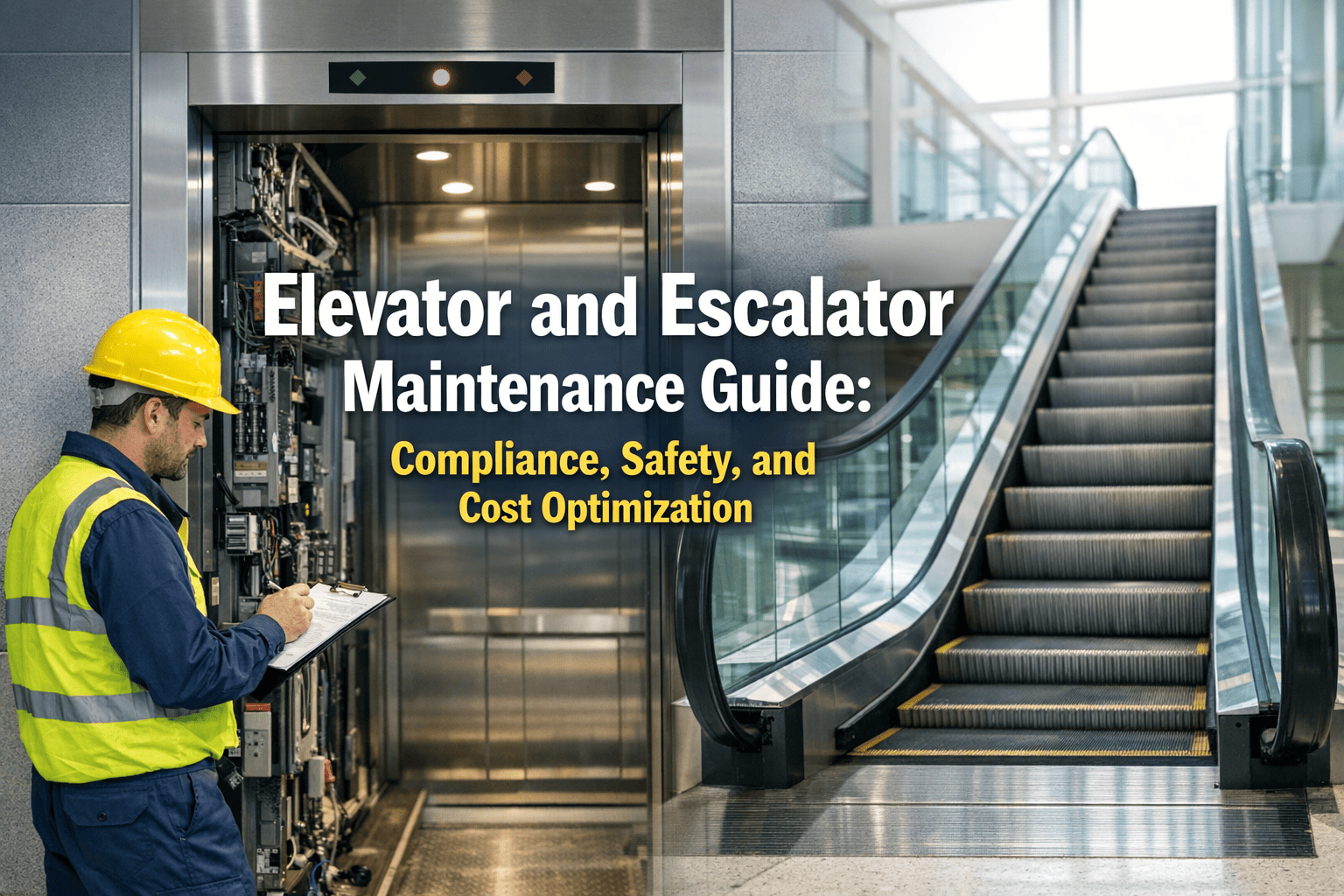
Elevator and Escalator Maintenance Guide: Compliance, Safety & Cost Optimization
Updated April 2026 · 12 min read · ASME A17.1-2025 · OSHA · ADA
18B
US elevator passenger trips per year — ASME A17.1-2025
4×/yr
average breakdown frequency per elevator worldwide without predictive maintenance
4.8×
emergency repair cost premium vs. planned maintenance events
70–85%
reduction in unplanned downtime achievable with IoT predictive monitoring
01 — Compliance Framework: What Every Building Owner Must Track
ASME A17.1-2025 governs elevator and escalator design, construction, installation, operation, testing, inspection, maintenance, alteration, and repair across North America (harmonised with CSA B44-2025 in Canada). It is adopted — at varying edition years — by all 50 US states, meaning your first compliance action is confirming which edition your Authority Having Jurisdiction (AHJ) is currently enforcing. Compliance with the 2019 edition does not satisfy an AHJ that has adopted the 2022 or 2025 edition.
The 2025 edition adds cybersecurity requirements for the first time — a direct response to networked elevator control systems and destination dispatch platforms that are now standard in commercial buildings. Every building must now document and maintain security review records for connected elevator systems alongside traditional mechanical and electrical maintenance records.
Beyond ASME A17.1, building owners must simultaneously manage compliance with ADA Title III vertical accessibility requirements (every elevator outage where no equivalent accessible path exists constitutes a documentable ADA gap), OSHA 29 CFR general duty and lockout/tagout requirements for machine room and pit work, and state-level elevator safety acts that may impose additional inspection frequencies, permit requirements, and licensed mechanic obligations.
| Compliance Requirement |
Standard / Authority |
Frequency |
Documentation Required |
OxMaint Tracking |
| Periodic safety inspection |
ASME A17.1 / State AHJ |
Annual (QEI-licensed inspector) |
Posted certificate + deficiency report |
Inspection calendar + certificate storage |
| Full-load safety test |
ASME A17.1 Section 8.10 |
Every 5 years |
Witnessed test report; licensed mechanic + QEI |
5-year work order auto-scheduled |
| PM / Maintenance Control Program |
ASME A17.1 Section 8.6 |
Per MCP (monthly–quarterly typical) |
Documented MCP per unit; visit records |
MCP template per unit; digital PM records |
| Emergency communication test |
ASME A17.1 + ADA Title III |
Monthly per cab |
Call-completion evidence per cab |
Monthly PM linked to communication log |
| Escalator skirt performance test |
ASME A17.1 Escalator provisions |
Annual |
Test completion record; separate from elevator cert |
Separate escalator compliance calendar |
| Firefighter service test |
ASME A17.1 / Local fire code |
Monthly |
Monthly activation log per unit |
Monthly PM checklist item + log |
| Cybersecurity review (NEW 2025) |
ASME A17.1-2025 |
Periodic (per MCP) |
Security review record per networked unit |
Asset record includes cybersecurity PM tasks |
02 — Inspection Schedules by Equipment Type and Usage
A single inspection schedule does not apply to all vertical transportation equipment. ASME A17.1 bases required inspection and maintenance frequencies on equipment type, drive system, and usage intensity. A freight elevator running 200 cycles daily accumulates wear at a fundamentally different rate than a low-traffic residential cab — yet most building operators apply the same calendar-based PM schedule to both.
The correct approach segments every unit in your portfolio by equipment class and usage tier, assigns frequency-appropriate PM templates, and then adjusts those templates dynamically as condition data reveals actual wear rates. For commercial buildings with mixed equipment portfolios, this means maintaining separate compliance calendars for hydraulic elevators, traction elevators, escalators, and moving walks — each with their own inspection trigger events and documentation requirements.
Hydraulic Elevators
Statutory inspectionAnnual — QEI-licensed inspector
PM frequencyMonthly (high-use) to quarterly (low-rise residential)
Key checksHydraulic fluid level and condition, piston seal integrity, pressure relief valve test, pit sump pump
Failure riskFluid leaks, slow leveling, cylinder seal deterioration — environment sensitive
5-year testFull load test of safeties, buffers, and relief valve
Traction Elevators (Rope)
Statutory inspectionAnnual + 5-year full-load test (governor/safety/buffers)
PM frequency4–6 weeks (mid-rise commercial); weekly (high-rise/hospital)
Key checksRope tension and wear, brake adjustment, sheave groove condition, guide rail lubrication
Failure riskDoor operator faults (most common), rope wear, brake pad wear, controller faults
5-year testGovernor/safety test, buffer test, counterweight safety test at full rated load
Escalators
Statutory inspectionAnnual skirt performance test; state inspection requirements vary
PM frequencyWeekly (airport/transit); monthly (retail/commercial)
Key checksCombplate finger condition, skirt gap measurement, handrail speed parity, step demarcation, emergency stop function
Failure riskStep/skirt entrapment (leading cause of injury), handrail slippage, combplate damage, chain wear
Chain lubricationPer OEM schedule — typically monthly in high-use environments
Moving Walks
Statutory inspectionAnnual — same code framework as escalators
PM frequencyWeekly (airport/transit); bi-weekly (retail)
Key checksBelt/pallet tension and tracking, handrail speed alignment, combplate condition, emergency stop buttons
Failure riskBelt/pallet misalignment, combplate damage, high-cycle fatigue on airport installations (50,000+ cycles/day)
Cycle intensityAirport units accumulate wear 4–8× faster than commercial retail — PM schedule must reflect this
03 — Monthly Maintenance Checklist: What Every PM Visit Must Cover
ASME A17.1 Appendix N defines the required elements of the Maintenance Control Program. A compliant monthly PM visit covers six distinct areas: the car and hoistway, safety devices, machine room and controller, drive system components, escalator-specific items (where applicable), and ADA/emergency communication verification. Each item requires a documented record tied to the specific unit, visit date, and technician signature.
Car and Hoistway
Car interior — walls, floor, ceiling, lighting, and ventilation in good conditionPhoto documentation recommended · Role: Elevator Mechanic
Door operator — opening/closing force within ASME limits; door reversal device functionalDoor faults are the leading cause of elevator callbacks · Role: Elevator Mechanic
Leveling accuracy — car stops within ±12mm of floor level at all landingsPoor leveling is an ADA accessibility violation as well as a safety risk · Role: Elevator Mechanic
Emergency lighting and phone — test operation; log call completion per ADA Title IIIMonthly documentation required · Role: Elevator Mechanic + FM
Safety Devices
Governor and safety gear — visual inspection for wear, rope condition, and latch functionFull operational test at 5-year load test · Role: Licensed Elevator Mechanic
Buffers — inspect for oil level (hydraulic buffers) and structural condition (spring buffers)Pit access required · LOTO procedures apply · Role: Licensed Elevator Mechanic
Overspeed governor test — verify correct trip speed and reset functionAnnual at minimum; 5-year full test · Role: Licensed Elevator Mechanic
Firefighter service — Phase I and Phase II operation test; log activation per local fire codeMonthly activation log required · Role: Elevator Mechanic + FM
Machine Room and Controller
Machine room access — restricted to authorised elevator personnel; temperature within OEM limitsOverheating is a leading cause of drive and controller failures · Role: FM + Elevator Mechanic
Drive and controller — check for fault logs; verify brake coil voltage and brake release functionFault code review catches developing issues · Role: Licensed Elevator Mechanic
Motor and sheave — listen for unusual noise; check sheave groove wear and rope alignmentSheave groove wear accelerates rope deterioration · Role: Licensed Elevator Mechanic
Escalator-Specific Items
Combplate fingers — inspect for broken, missing, or bent teeth; gap to step surface within specCombplate damage is the leading cause of entrapment incidents · Role: Elevator Mechanic
Handrail speed — verify handrail travels at same speed as steps; no slippage or dragSpeed differential creates grip/fall risk · Role: Elevator Mechanic
Emergency stop buttons — test top and bottom landing stops; confirm response time within codeBoth stops required functional at all times · Role: Elevator Mechanic
Skirt guard deflectors — confirm in place; measure skirt-to-step gap within ASME toleranceExcessive gap is a code violation and entrapment risk · Role: Elevator Mechanic
Paper Checklists Don't Create Audit-Ready Records. Digital PM Does.
OxMaint's elevator PM templates capture every checklist item with photo documentation, timestamped completion, and licensed mechanic digital signature — automatically building the MCP record that ASME A17.1 Section 8.6 requires.
04 — Predictive Maintenance: From Calendar Visits to Condition-Based Intervention
The core limitation of time-based maintenance is the gap between scheduled visits. An escalator motor bearing that begins exhibiting elevated vibration on day 3 after a monthly service visit will continue degrading for 27 more days before a technician returns. By that point, the bearing may be at Stage 3 failure — hours from catastrophic seizure. IoT-enabled predictive monitoring eliminates this blind spot: continuous sensor monitoring detects degradation in real time, alerting maintenance teams within minutes of threshold exceedance rather than waiting for the next calendar visit.
Industry leader KONE achieved 70% more fault detection and 40% fewer equipment issues after deploying advanced IoT sensor analytics across its global elevator and escalator fleet. Mixed-use towers with 6+ elevators implementing predictive analytics report $75,000–$200,000 in annual savings through reduced emergency calls, extended component life, and avoided tenant penalties. After-hours emergency call-outs for traction elevators typically cost 3–5× standard labour rates — converting 60% of emergency repairs to planned maintenance events recovers sensor hardware costs within 12–18 months.
Time-Based PM Only
✗Same visit frequency regardless of actual usage or wear rate
✗27-day blind spot between monthly visits for developing faults
✗Emergency call-outs at 3–5× standard labour rate
✗Components replaced on schedule, not condition — waste and missed faults
✗Tenant complaints before building team knows of fault
Predictive Monitoring + OxMaint
✓Continuous monitoring — alerts within minutes of threshold exceedance
✓Vibration anomalies detected 2–6 weeks before breakdown
✓Planned repair during low-traffic window at standard rate
✓Component replacement triggered by condition, not calendar
✓Auto-generated work order with fault type and part number before tenant notices
What IoT Sensors Monitor on Elevators and Escalators
Retrofit IoT sensor packages can be added to virtually all elevator and escalator equipment regardless of age, manufacturer, or control system generation — with installation typically taking 2–4 hours per unit without extended downtime. Older relay-logic elevators often produce the clearest wear signatures because their analog components exhibit more pronounced degradation signals than modern digital systems.
Door Operation Monitoring
Door current and cycle time tracking detects worn door operators, misaligned tracks, and deteriorating clutch mechanisms — the single most common source of elevator callbacks and regulatory violations.
Motor Current & Drive Health
Motor current signature analysis detects bearing degradation, rotor imbalance, and brake coil issues through electrical signatures — compatible with MCC-based installation for machine rooms with difficult physical access.
Ride Quality Analysis
Triaxial accelerometers in the cab detect guide rail wear, roller guide degradation, rope sway, and leveling drift from subtle ride quality changes — creating a quantified baseline before passengers notice or report issues.
Machine Room Environment
Temperature, humidity, and power quality monitoring in the machine room detects ventilation failures before they cause overtemperature drive shutdowns, and identifies power quality events (voltage sag, harmonics) that cause premature controller failure.
05 — Cost Optimization: Where the Maintenance Budget Goes and How to Recover It
Elevator and escalator maintenance typically represents 15–25% of a commercial building's total maintenance budget. The cost distribution is heavily skewed toward reactive spend: emergency call-outs at 3–5× planned rates, parts procurement at premium prices under time pressure, and tenant compensation or penalty clauses for extended outages. A building with 6 elevators averaging 12 emergency calls annually can save $40,000–$80,000 per year by converting those calls to planned events — before counting extended component life and deferred CapEx.
Cost Impact Model: 6-Elevator Commercial Building
Emergency call-out rate (reactive)
12 calls/year @ $3,500–8,000 each
4–5 calls/year with predictive
Emergency call-out cost premium
3–5× standard labour rate after hours
Standard planned rate — low-traffic window
Annual savings at 6-elevator scale
—
$40,000–$80,000/yr from call reduction alone
Multi-tower portfolio (6+ units)
—
$75,000–$200,000/yr documented (industry benchmark)
IoT system ROI payback period
N/A — reactive cost continues
Typically 12–18 months from emergency elimination
06 — Lifecycle Planning: Maintenance, Modernization, or Replacement?
Elevator modernization is one of the most significant CapEx events in a commercial building's lifecycle — typically $100,000–$300,000 per cab for full modernization, with partial component upgrades (controls, hydraulics, cab finishes) available in the $25,000–$80,000 range. The decision between continued maintenance, partial modernization, and full replacement requires asset condition data that most FM teams do not have — specifically, lifetime repair cost trends per unit, component replacement history, and failure frequency over the last 36 months.
Regenerative drive modernization reduces energy consumption by 25–40% versus legacy systems. Modern controller modernization cuts PM costs by 30–50% post-upgrade through improved diagnostics and remote monitoring capability. These economics change the break-even calculation significantly for high-age equipment: a 25-year-old elevator with $12,000/year in maintenance spend and $8,000/year in energy cost may reach break-even against a $120,000 modernisation within 6–7 years, particularly when tenant retention risk and accessibility compliance costs are included.
Continue Maintenance
When: Equipment age 0–15 years; annual repair cost below $8K/unit; no regulatory non-compliance
Action: Implement predictive monitoring to extend component life; document MCP fully for liability protection
Partial Modernization
When: 15–25 year equipment; controls obsolete; energy costs elevated; specific components driving repair cost
Action: Controller and drive replacement ($25K–$80K); add remote monitoring capability simultaneously
Full Replacement
When: Equipment age 25+ years; repair costs exceeding 10% of replacement annually; code non-compliance
Action: Full cab and drive modernization ($100K–$300K); plan around ASME A17.1-2025 cybersecurity requirements
Frequently Asked Questions
What is the most commonly cited elevator compliance violation during AHJ inspections?
How does the ASME A17.1-2025 cybersecurity requirement affect facility managers?
The 2025 edition requires building owners and maintainers to document and maintain cybersecurity reviews for networked elevator control systems, destination dispatch platforms, and remote monitoring connections — a first in the code's century-long history. The practical implication is that maintenance records must now include cybersecurity review items alongside traditional mechanical and electrical PM tasks. Buildings that have not yet confirmed which edition of ASME A17.1 their AHJ is enforcing should do so immediately, as enforcement of the 2025 edition is rolling out jurisdiction by jurisdiction.
Book a demo to see how OxMaint tracks both mechanical and cybersecurity compliance obligations per unit.
How often should escalator combplates be inspected and what constitutes a violation?
Escalator combplate condition should be visually checked at every monthly PM visit — broken, missing, or bent combplate teeth are an immediate out-of-service condition under ASME A17.1 because they create the primary entrapment hazard. The gap between the combplate and the step surface is a measured tolerance, not a judgment call: any gap outside the ASME-specified dimension requires corrective action before the unit returns to service. High-traffic units (retail, transit, airports) should have combplate inspections weekly, as step debris and passenger load accelerate tooth damage. All combplate inspections should generate a documented record with the finding, corrective action, and sign-off — a paper log is not sufficient for a defensible compliance record.
Can predictive maintenance IoT sensors be added to older elevators without replacing the control system?
Yes. Retrofit IoT sensor packages are available for virtually all traction and hydraulic elevator equipment regardless of age, manufacturer, or control system generation — including relay-logic elevators with no digital bus. Sensors attach to motors, door operators, controllers, and mechanical components without modifying core equipment; the installation typically takes 2–4 hours per unit with no extended shutdown. Older equipment often produces stronger and clearer fault signatures than modern digital systems precisely because analog component wear manifests more distinctly in vibration and current data. The ROI case for adding predictive monitoring to high-age equipment is typically stronger than for new installations because failure frequency is higher and the emergency call-out cost baseline is larger.
What documentation must be posted inside the elevator cab?
ASME A17.1 and most state elevator safety acts require the current annual inspection certificate to be posted and visible inside the elevator car. Some jurisdictions also require the rated capacity placard and the permit number to be posted. The certificate must show the date of last periodic inspection — a missing or expired certificate is a visible compliance failure that can trigger a mandatory stop-operation order. Beyond the posted certificate, the full maintenance record (work order history, PM logs, component replacement records, and the MCP) must be accessible for AHJ review within a defined timeframe — the typical expectation is retrieval within 5 minutes for a building under active inspection.
Asset Lifecycle Management — OxMaint
Every Elevator. Every Certificate. Every PM Record. Audit-Ready in One Platform.
OxMaint manages ASME A17.1 compliance calendars, MCP documentation, inspection certificate tracking, 5-year load test scheduling, ADA outage planning, and IoT predictive fault detection across your entire vertical transportation portfolio — from a single dashboard your team uses daily.