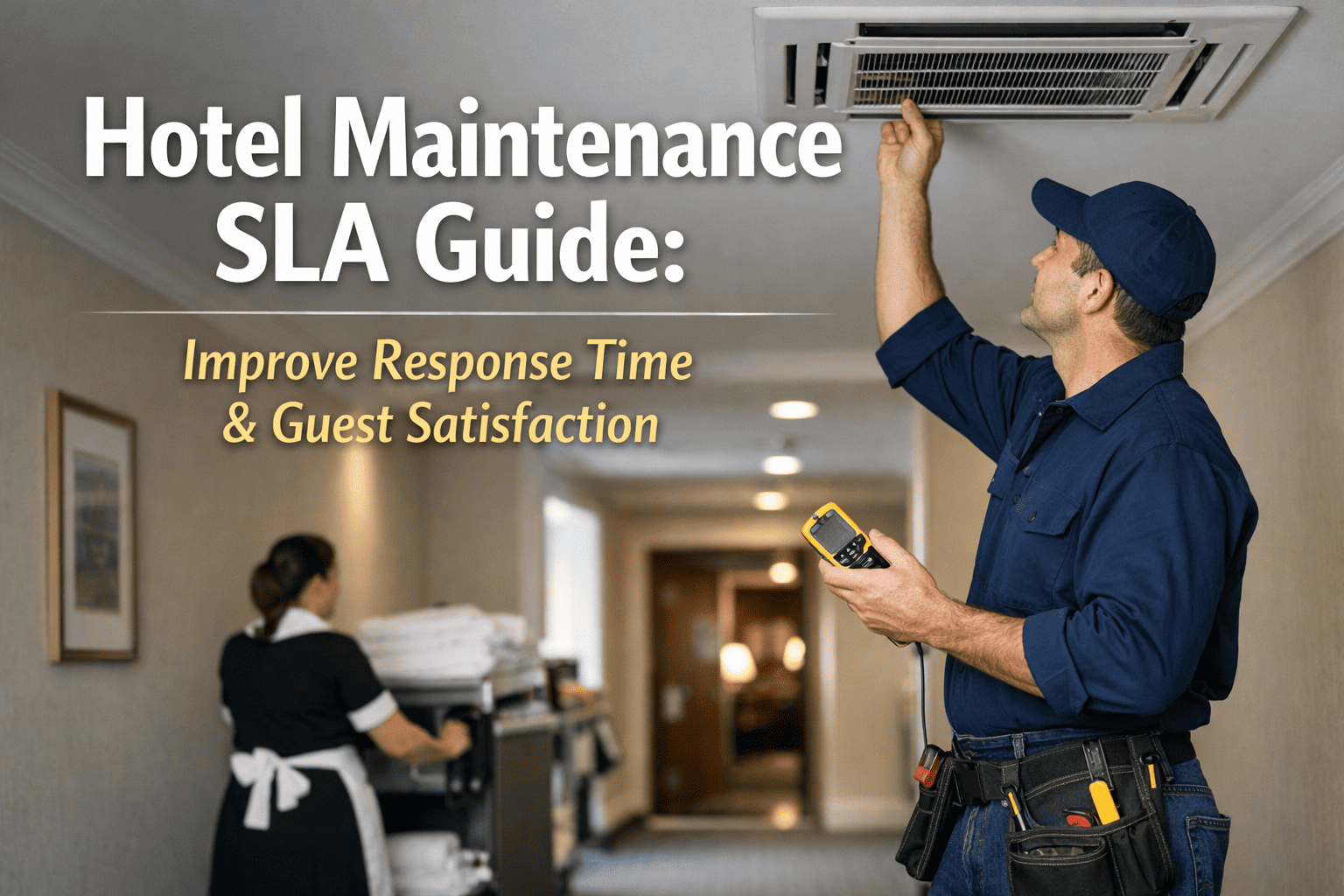
AI-powered preventive maintenance scheduling transforms hotel operations by predicting equipment failures 2-4 weeks before they occur reducing emergency repair costs by 65% and extending asset lifespans by 40-60%. Hotels managing 200-500 maintenance assets—from HVAC systems and elevators to kitchen equipment and laundry machines—lose an average of $47,000 annually to unplanned downtime and reactive repairs. Intelligent scheduling algorithms analyze equipment runtime data, failure patterns, and seasonal demand to automatically generate optimized work orders that keep every system running at peak performance without overmaintaining or undermaintaining any asset. Start your free trial today and let AI-driven scheduling eliminate maintenance guesswork while cutting your hotel's repair budget by up to 65%.
Traditional Scheduling vs. AI-Powered Maintenance
How intelligent automation transforms hotel maintenance operations
Traditional Scheduling
Annual Maintenance Costs
$42,000-$68,000
Unplanned Downtime
120-180 hours/year
Guest Complaints (Maintenance)
15-25 monthly
Work Order Efficiency
55-65%
AI-Powered Scheduling
Annual Maintenance Costs
$18,000-$28,000
Unplanned Downtime
15-30 hours/year
Guest Complaints (Maintenance)
2-5 monthly
Work Order Efficiency
92-97%
Average Annual Savings Per Hotel: $32,000
How AI Scheduling Optimizes Hotel Maintenance Operations
AI-powered preventive maintenance platforms process data from five critical hotel systems to generate intelligent scheduling: HVAC units and chillers (analyzing runtime hours, temperature differentials, and refrigerant pressure trends), elevators and escalators (monitoring trip counts, door cycle data, and vibration patterns), kitchen and laundry equipment (tracking cycle completions, energy consumption, and component wear rates), plumbing and water systems (detecting flow rate changes, pressure drops, and leak indicators), and electrical and fire safety systems (scheduling code-mandated inspections based on equipment age and compliance deadlines). Hotels using AI-driven CMMS platforms report 82% fewer emergency work orders and 94% on-time completion of preventive tasks compared to calendar-based scheduling methods. Schedule a 30-minute demo to see how AI scheduling adapts to your hotel's specific equipment and operational patterns.
AI Maintenance Scheduling Intelligence
Predictive Alerts
2-4 Weeks
Early failure detection before breakdowns
Work Order Automation
92% Auto
AI generates and assigns tasks automatically
Smart Scheduling
Zero Conflicts
Avoids peak occupancy and guest disruption
Resource Optimization
35% Less Labor
Right technician, right time, right parts
Equipment Uptime
98.5%
Near-zero unplanned downtime across assets
Compliance Tracking
100% Audit Ready
Auto-documented inspections and certifications
AI Scheduling Features That Eliminate Maintenance Guesswork
Modern AI maintenance platforms deliver four core scheduling capabilities that traditional calendar-based systems cannot match. Condition-based triggers analyze real-time sensor data and usage patterns to schedule maintenance exactly when equipment needs it—not too early (wasting labor and parts) and not too late (risking failures). Occupancy-aware scheduling automatically shifts non-urgent maintenance to low-occupancy periods, preventing guest disruptions during peak seasons. Technician load balancing distributes work orders evenly across maintenance staff based on skill sets, certifications, and proximity to equipment locations. Parts forecasting predicts replacement needs 30-60 days in advance, ensuring critical components are in stock before scheduled maintenance begins. Hotels implementing these AI features reduce maintenance labor costs by 35% while improving first-time fix rates from 68% to 94%.
AI Scheduling Intelligence Framework
01
Condition-Based Triggers
Runtime & usage pattern analysis
Sensor data anomaly detection
Failure probability scoring
Accuracy: 94%
02
Occupancy-Aware Timing
PMS integration for room status
Peak season auto-deferral
Guest disruption minimization
Guest Impact: Near Zero
03
Smart Resource Allocation
Skill-based technician matching
Workload balancing algorithms
Route optimization for large properties
Efficiency: 35% Gain
04
Predictive Parts Forecasting
30-60 day demand prediction
Auto-reorder at threshold levels
Vendor lead time optimization
Stockouts: Zero
ROI of AI-Powered Maintenance Scheduling for Hotels
Hotels switching from manual or calendar-based scheduling to AI-powered preventive maintenance consistently achieve $28,000-$45,000 in annual savings through five measurable channels: reduced emergency repairs (saving $12,000-$18,000 by preventing 82% of unplanned breakdowns), optimized labor utilization (saving $8,000-$12,000 through intelligent technician scheduling and elimination of redundant inspections), extended equipment lifespan (deferring $6,000-$9,000 in capital replacement costs annually), energy efficiency gains (saving $3,500-$5,500 through properly maintained HVAC and mechanical systems), and improved guest satisfaction scores (protecting $4,000-$8,000 in revenue that would be lost to maintenance-related complaints and compensation).
Annual AI Maintenance Scheduling ROI
150-room full-service hotel with 300+ maintenance assets
Eliminated Emergency Repairs
82% reduction × $18,500 avg emergency spend
$15,170
Optimized Labor Utilization
35% efficiency gain on $28,000 labor budget
$9,800
Extended Equipment Lifespan
40% longer asset life on $180,000 equipment base
$7,200
Energy & Utility Savings
15% reduction through maintained system efficiency
$4,800
Total Annual Savings
$36,970
AI CMMS platform investment: $4,800/year. Net savings: $32,170. ROI: 670% in first year.
These savings compound for hotel groups and multi-property portfolios where centralized AI scheduling creates cross-property learning—failure patterns identified at one property automatically update maintenance schedules across all locations. Create your free account now and deploy AI-powered scheduling that learns your hotel's unique equipment patterns within 30 days of implementation.
Transform Your Hotel Maintenance with AI Scheduling
Join leading hotel operations using Oxmaint's AI-powered CMMS to predict equipment failures, automate work orders, reduce maintenance costs by 65%, and deliver 98.5% equipment uptime that keeps guests happy and operations running smoothly.
Frequently Asked Questions
How does AI predict hotel equipment failures before they happen
AI maintenance platforms analyze multiple data streams including equipment runtime hours, energy consumption patterns, vibration signatures, temperature differentials, and historical failure records to build predictive models for each asset. Machine learning algorithms identify subtle pattern changes—such as a chiller drawing 8% more power than baseline or an elevator motor showing increased vibration frequency—that indicate developing problems 2-4 weeks before failure occurs. The system assigns failure probability scores to every asset daily, automatically generating work orders when risk thresholds are crossed. Hotels using AI prediction report 82% fewer emergency breakdowns because technicians address developing issues during scheduled maintenance windows rather than responding to sudden failures during peak occupancy.
Can AI scheduling integrate with existing hotel property management systems
Modern AI CMMS platforms integrate directly with major hotel PMS systems including Opera, Mews, Cloudbeds, and RoomRaccoon through API connections that share real-time occupancy data, room status updates, and guest arrival schedules. This integration enables occupancy-aware maintenance scheduling—the AI automatically defers non-critical tasks when occupancy exceeds 85%, routes technicians away from occupied floors, and prioritizes room-specific maintenance during checkout windows. Integration typically takes 2-5 days to configure and requires no changes to existing PMS workflows. The AI also connects with BMS (Building Management Systems) to pull sensor data from HVAC, elevator, and electrical systems for condition-based monitoring.
What hotel equipment benefits most from AI preventive scheduling
HVAC systems deliver the highest ROI from AI scheduling because they represent 40-50% of hotel energy costs and their performance degrades gradually in ways that AI pattern recognition detects early. Elevators rank second because downtime directly impacts guest experience and AI can optimize maintenance around traffic patterns. Commercial kitchen equipment—including dishwashers, refrigeration units, and cooking equipment—ranks third because health code compliance depends on consistent maintenance that AI automates and documents. Laundry equipment, boilers, water treatment systems, and fire safety systems also benefit significantly. Hotels with 200+ assets see the greatest improvement because AI scheduling eliminates the complexity of manually coordinating maintenance across diverse equipment types with different service intervals and technician skill requirements.
How quickly does AI maintenance scheduling show measurable results
Hotels typically see three phases of improvement after implementing AI scheduling. Phase one (weeks 1-4) delivers immediate gains through automated work order generation, elimination of missed preventive tasks, and digital documentation—reducing administrative time by 60% and achieving 100% PM compliance. Phase two (months 2-3) shows operational improvements as the AI learns equipment-specific patterns, optimizes technician routing, and begins generating condition-based alerts—emergency work orders typically drop 40-50% in this period. Phase three (months 4-12) delivers full predictive capability as the AI accumulates enough historical data to accurately forecast failures, optimize parts inventory, and recommend lifecycle replacement timing—hotels achieve the full 65% cost reduction and 98.5% uptime metrics during this phase.
Is AI maintenance scheduling cost-effective for smaller hotels
AI maintenance scheduling delivers positive ROI for hotels with as few as 50 rooms and 100 maintenance assets. Smaller properties typically save $12,000-$18,000 annually through eliminated emergency repairs, reduced overtime labor, and extended equipment life—against a platform investment of $2,400-$4,800 per year. The key advantage for smaller hotels is that AI scheduling replaces the need for a full-time maintenance manager by automating task generation, prioritization, and compliance tracking. Properties with limited maintenance staff benefit most from AI-optimized scheduling that ensures the right tasks are performed at the right time without relying on individual memory or paper-based systems that frequently result in missed preventive maintenance and costly reactive repairs.
Ready to Let AI Manage Your Hotel Maintenance
Stop losing revenue to unexpected equipment failures and inefficient scheduling. Oxmaint's AI-powered CMMS predicts failures before they happen, automates work orders, and delivers 670% ROI through intelligent preventive maintenance that keeps your hotel running flawlessly.
.png)