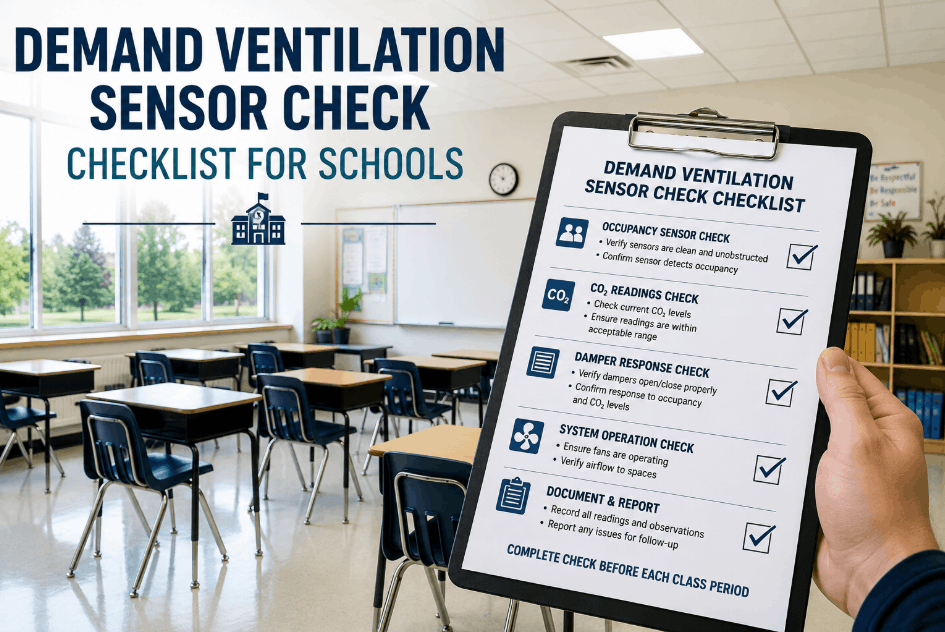
A demand ventilation system that passed its last inspection can still deliver poor indoor air quality and wasted energy if occupancy sensors, CO2 readings, and damper response have not been verified together before class periods begin. Unverified demand-controlled ventilation in school buildings allows CO2 to accumulate in occupied classrooms during peak attendance, impairs student concentration, and drives up heating and cooling energy costs when dampers remain stuck open outside occupied hours. Oxmaint's Sign up free platform gives school facilities teams a structured mobile environment to verify sensor accuracy, damper response, and CO2 setpoints as a coordinated system check — not a series of disconnected inspections. Whether you manage elementary, middle, or high school facilities with rooftop units, dedicated outdoor air systems, or fan coil units with DCV capability, unverified ventilation controls create indoor air quality risk and energy waste in every occupied zone. Book a demo to see how Oxmaint helps school facilities teams standardize demand ventilation verification and generate inspection records aligned with ASHRAE 62.1 and local code maintenance requirements. Use this checklist before each school term to confirm demand ventilation performance across sensors, controls, and air delivery before occupancy peaks.
1. Occupancy Sensor Verification
Occupancy sensors drive the ventilation response that protects indoor air quality during class periods. Sensors that report incorrectly leave classrooms under-ventilated during peak attendance or over-ventilated during unoccupied hours — both outcomes directly increase facility energy cost and IAQ risk.
2. CO2 Sensor Calibration and Setpoint Verification
CO2 sensors are the primary ventilation demand signal in most school DCV systems. Sensor drift of 100–200 ppm — common in sensors not calibrated annually — causes the ventilation system to respond to incorrect demand readings, wasting energy or under-protecting student health across every class period.
3. Damper Response and Airflow Delivery Verification
Damper performance translates sensor readings and control signals into actual ventilation delivery. A correctly calibrated sensor connected to a stuck or undersized damper produces no improvement in classroom air quality — the most common DCV failure mode found during post-complaint IAQ investigations in school buildings.
4. Controls Integration and Schedule Verification
DCV performance depends on correct interaction between occupancy sensors, CO2 controllers, damper actuators, and HVAC system scheduling. Controls integration failures produce the most persistent IAQ and energy problems because each individual component appears to be working when inspected in isolation.
5. Pre-Term IAQ Baseline and Record Closure
Returning classrooms to full occupancy without capturing a pre-term DCV baseline eliminates the ability to detect gradual sensor drift, demonstrate code compliance, or respond defensively when an IAQ complaint is received during the first weeks of the school year.