A single spark in the wrong location can turn a planned maintenance window into a catastrophic fire — and in power plants, where hydrogen, fuel oil, turbine lubricants, and coal dust coexist with ignition sources, the margin for error is zero. NFPA 51B, the Standard for Fire Prevention During Welding, Cutting, and Other Hot Work, establishes the framework that keeps welders, burners, and grinders from becoming the ignition source of a facility-level disaster. Hot work fires cause over $400 million in property damage annually in the U.S. — and the leading cause is unauthorized or improperly permitted hot work. This free NFPA 51B hot work permit template for power plants covers pre-work area surveys, fire watch protocols, ignition controls, combustible gas testing, and CMMS-linked sign-off so your team can authorize hot work with confidence and accountability. Sign up for Oxmaint free to digitize and manage hot work permits across your plant.
The Cost of Getting Hot Work Wrong
57%
of hot work fires occur when the permit was issued but fire watch was not posted or left early
3 hrs
is the minimum fire watch period after hot work ends in many NFPA 51B applications — not 30 minutes
$400M+
in annual U.S. property losses directly attributed to hot work incidents per NFPA data
10ft
minimum clearance radius required by NFPA 51B — combustibles beyond 10ft require additional protection
What NFPA 51B Requires — and Where Power Plants Add Risk
NFPA 51B establishes minimum requirements for fire prevention during all forms of hot work including welding, cutting, grinding, brazing, soldering, and any operation that produces sparks, heat, or open flame. Power plants face elevated risk because the building itself — insulation, oil-soaked cable trays, coal handling conveyors, hydrogen-cooled generators, and fuel oil piping — can become fuel if spark management fails. A compliant permit system must address the hazard profile of the specific location, not just a generic checklist.
Power Plant Hot Work Risk Zones
Critical
Hydrogen-Cooled Generator Bay
No hot work permitted while hydrogen supply connected. Purge with CO2, test to LEL before any ignition source introduced.
Critical
Fuel Oil / Diesel Storage Area
Permit requires facility fire brigade standby, minimum 50ft clearance from vents and fill points, continuous LEL monitoring.
High
Coal Handling / Bunker Area
Coal dust is explosive. Wet-down area 35ft radius, verify dust accumulation removed from surfaces before work begins.
High
Cable Tray / MCC Room
Oil-impregnated cable insulation is highly combustible. Shield all cable trays within 15ft. Fire watch both during and 3+ hours after.
Moderate
Turbine Hall — Upper Elevation
Lube oil mist accumulation on elevated surfaces. Remove or cover combustibles on all elevations below the work point.
Moderate
Boiler Casing / Insulation Work
Lagging and mineral wool can smolder invisibly for hours. Extended 4-hour fire watch required after work completion.
Paper hot work permits get lost. Digital ones get audited.
Oxmaint links hot work permits to specific assets, requires sign-off at each step, and auto-closes expired permits — giving your safety team full visibility across every active hot work job.
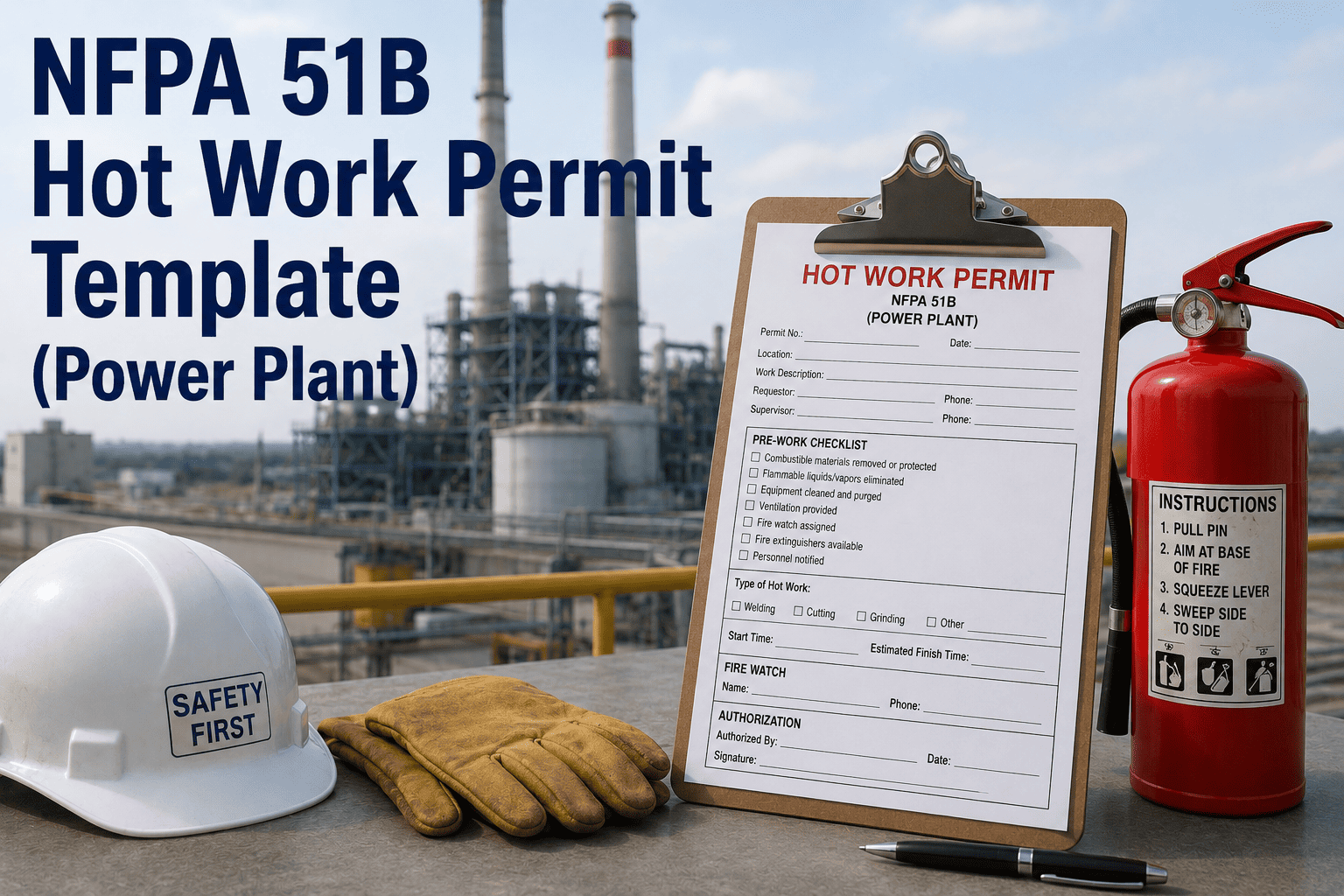
NFPA 51B Hot Work Permit Template — Power Plant
This template satisfies the documentation requirements of NFPA 51B and aligns with OSHA 29 CFR 1910.252 for welding and cutting in general industry. All sections must be completed before any hot work begins. The permit is not valid without fire watch assignment, area survey sign-off, and authorized issuer signature.
Section 1 — Work Authorization
| Permit No. |
[HWP-YYYY-XXX] |
Date of Work |
[MM/DD/YYYY] |
| Work Start Time |
[HH:MM] |
Permit Expiry |
[HH:MM — max 12 hrs or end of shift] |
| Equipment / Asset |
[Asset Name / ID] |
Work Order No. |
[CMMS WO Number] |
| Work Location |
[Building / Elevation / Bay / Grid Ref] |
Unit / System |
[Unit 1 / BOP / Common] |
| Type of Hot Work |
Welding / Cutting / Grinding / Brazing / Soldering / Other: ___________ |
Hot Work Operator |
[Name / Qualification No.] |
| Description of Work |
[Describe scope — material, process, piping/structural member, reason for hot work] |
Section 2 — Pre-Work Area Survey Checklist
Within 35 ft / 10 m Radius
Floors swept and wet mopped — no combustible dust accumulation
All combustible/flammable materials removed or protected with fire-rated blankets
Floors covered with fire-resistant material where combustibles cannot be removed
All wall and floor openings, cracks, and gaps sealed to prevent spark passage
Cable trays shielded with fire-rated covers or fire blankets
Oil-soaked insulation or rags removed from the area — no substitution with wet rags
Atmospheric Testing
LEL tested at work point and 3 ft above/below — result: ______% LEL (must be under 10%)
Oxygen content measured — result: ______% (acceptable range: 19.5% – 23.5%)
H2S tested if applicable — result: ______ ppm (must be under 10 ppm)
Testing equipment calibration verified within 30 days — instrument ID: __________
Continuous monitoring deployed if conditions may change during work
Local ventilation confirmed operational — exhaust direction away from occupied areas
Section 3 — Fire Protection Controls
Extinguishment Equipment Present
Minimum 2 × ABC extinguisher (min. 10 lb) within 30 ft of work point
Fire hose charged and accessible at nearest standpipe station
Fire blankets (2 minimum) staged at work location
Nearest fire alarm pull station identified and accessible — location: ___________
System Impairments Managed
Sprinkler impairment permit issued if sprinklers in work zone are blocked or disabled
Fire detection devices in work area: Active / Covered (circle one) — cover removed after work: ___________
Foam suppression systems in adjacent areas confirmed ARMED and NOT impaired
Plant fire watch notification issued — control room informed of permit start time
Section 4 — Fire Watch Assignment
Fire watch is required whenever hot work is performed in any location where a fire hazard exists. In power plants, fire watch is effectively required for all hot work without exception. The fire watch must remain on duty during all work and for a minimum of 30 minutes after completion — or longer as specified in the area-specific requirement below.
| Fire Watch Name |
Qualification / Training |
Coverage Period |
Extends Post-Work |
Sign-Off |
| [Name] |
[Fire Watch Cert. No.] |
[HH:MM] to [HH:MM] |
[30 min / 60 min / 3 hr / 4 hr] |
___________ |
| [Relief / Second Watch] |
[Fire Watch Cert. No.] |
[HH:MM] to [HH:MM] |
[30 min / 60 min / 3 hr / 4 hr] |
___________ |
Area-specific post-work fire watch duration: Boiler insulation / lagging = 4 hr | Cable tray work = 3 hr | Lube oil area = 3 hr | Standard structural = 30 min minimum
Section 5 — Authorization Signatures
| Area Owner / Operations |
________________________ Date/Time: ___________ |
Safety Officer |
________________________ Date/Time: ___________ |
| Permit Issuer (Hot Work Authority) |
________________________ Date/Time: ___________ |
Hot Work Operator Acceptance |
________________________ Date/Time: ___________ |
| CMMS Work Order Status |
[Open / In Progress] |
Permit Close-Out (Fire Watch End) |
________________________ Date/Time: ___________ |
Fire Watch Duties — What Your Personnel Must Actually Do
Before Work Starts
Conduct independent area survey — do not rely solely on the operator's assessment
Locate and confirm all fire extinguishers, hose stations, and alarm pull points
Identify and communicate evacuation route to all personnel in the work zone
During Hot Work
Maintain unobstructed line of sight to the work point at all times — no exceptions
Watch for sparks traveling beyond the shielded zone — especially upward drafts and downward fall through grating
Stop work immediately if LEL alarm sounds, sprinkler head pops, or uncontrolled fire appears
After Work Ends
Inspect ALL surfaces — vertical, overhead, and in adjacent spaces for smoldering material
Feel (do not touch) insulated surfaces for heat concentration — use IR thermometer if available
Sign the permit close-out only after the full post-work watch period is complete with no signs of fire
Every hot work permit needs a paper trail that holds up in court.
Oxmaint timestamps every sign-off, captures fire watch confirmations on mobile, and creates an unalterable audit record — so your safety program protects both your workers and your organization.
Frequently Asked Questions
How long must fire watch be maintained after hot work is complete?
NFPA 51B requires a minimum 30-minute fire watch after the completion of hot work. However, this is a floor, not a ceiling — power plant applications commonly require 1 to 4 hours depending on the combustibility of nearby materials. Boiler insulation and cable tray work warrant extended watch periods because smoldering can develop invisibly for hours before breaking into open flame.
Track fire watch duration automatically with Oxmaint permit close-out tools.
Does NFPA 51B apply to grinding and other spark-producing work, or only welding?
NFPA 51B covers all operations that produce heat, sparks, or open flames — including angle grinding, cutting, brazing, soldering, torch application, and thermal spray. In power plants, grinding is frequently the overlooked hazard: wheel-generated sparks can travel 30 to 35 feet and reach temperatures sufficient to ignite cable insulation and oil-saturated lagging.
Can the hot work operator also serve as the fire watch?
No. The fire watch must be a separate, dedicated individual whose sole responsibility is fire detection and response during the work. An operator performing welding cannot simultaneously maintain adequate observation of the surrounding area. NFPA 51B and most insurance requirements explicitly prohibit combining these roles.
Learn how Oxmaint enforces dual sign-off for operator and fire watch roles.
What atmospheric conditions require hot work to be stopped or postponed?
Hot work must not begin if LEL exceeds 10% of the lower explosive limit at the work point, oxygen is below 19.5% or above 23.5%, or visible combustible dust is present that cannot be controlled. Work already in progress must stop immediately if any of these conditions develop, or if an uncontrolled ignition source appears in the area.
What records must be retained for hot work permit compliance?
Retain the completed permit (both sides), atmospheric test results, fire watch sign-off times, any deviations or incidents, and the close-out signature. Most insurers and plant safety programs require at least 12 months of permit retention. OSHA citations following a hot work fire will specifically examine whether a permit was issued, whether fire watch was documented, and whether the area survey was completed.
Store all hot work records digitally in Oxmaint with automatic retention.
Protect Your Plant. Protect Your People. Digitize Hot Work Permits.
Hot work incidents are almost always preventable — and the documentation trail almost always shows where the permit process broke down. Oxmaint gives your team a system that makes it harder to skip steps than to follow them, with mobile sign-off, automatic fire watch timers, and an audit-ready permit history for every job.