HVAC service callbacks are one of the most damaging metrics a contracting business can carry. Every callback represents a second truck roll at cost, a technician pulled from revenue-generating work, and a customer whose confidence in the contractor is now in question. Industry data shows that HVAC businesses using OxMaint’s AI Copilot and Diagnostic Intelligence reduce callback rates by identifying the correct root-cause failure mode on the first visit — giving technicians a pre-arrival diagnostic context built from the system’s service history, fault code patterns, and component age before they open the service vehicle. This case study documents how one regional HVAC contractor with 28 field technicians reduced callbacks by 60% and increased first-time fix rate from 67% to 91% within nine months of deploying OxMaint across their service operation.
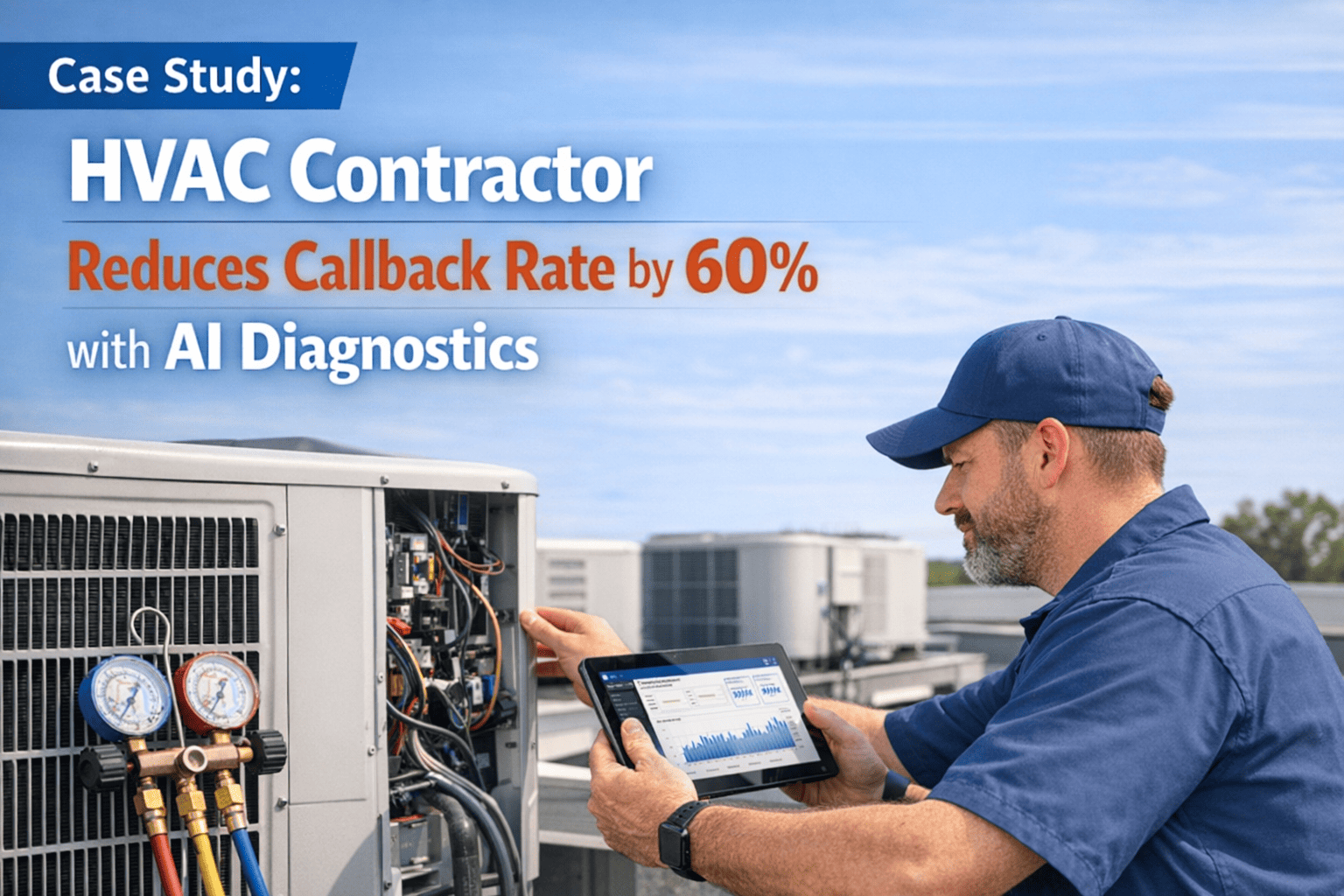
HVAC Contractor Reduces Callback Rate by 60% with AI Diagnostics
How a 28-technician regional HVAC contractor achieved 91% first-time fix rate and cut truck-roll cost by $186,000 annually using OxMaint’s AI Copilot.
What Was Causing the Callbacks
When the operations manager audited three months of callback records before the OxMaint implementation, four root causes accounted for 87% of all return visits. None of them were technician skill failures. All four were information failures.
Technicians arrived without the part most likely to be needed because dispatch had no visibility into the system’s service history. A capacitor failure on a Carrier 2-ton unit that had already been serviced twice for the same fault was dispatched as a “no cool complaint” with no context. Technician brought a contactor. Needed a dual-run capacitor. Second visit.
Technicians resolved the presenting symptom without identifying the underlying cause. A system with a refrigerant low-pressure fault was topped up without a leak check because there was no record flagging that the system had been charged four times in 18 months — a pattern that screams “find the leak,” not “add refrigerant.” Three weeks later: same call, different technician.
During peak season, technicians were dispatched to 8–10 calls per day. Diagnosis was cut short to stay on schedule. A confirmed compressor fault had a damaged capacitor and a failed start relay contributing — only the most visible component was replaced. The system failed again within 10 days. Customer left a 2-star review. Technician spent 4 hours on the return visit that could have been 45 minutes the first time.
Light-commercial customers with multi-split systems or rooftop units with communicating controls required technicians to diagnose from scratch because equipment data, fault code history, and prior repair documentation was in paper files at the office — not accessible in the field. Average pre-diagnosis time on these calls was 35 minutes before any actual work began.
The OxMaint Implementation
The contractor went live on OxMaint in a 6-week phased rollout. Week 1–2 focused on asset data: every customer system registered by address, equipment model and serial number, refrigerant type, full charge, installation date, and prior service history imported from paper records and existing invoices. Week 3–4 brought all 28 technicians onto the OxMaint mobile app with AI Copilot active on every assigned work order. Week 5–6 connected dispatch to the live work order queue with real-time technician location and parts inventory.
Stop Sending Technicians to Jobs Blind. Start Sending Them With a Diagnosis Already in Progress.
OxMaint’s AI Copilot analyses system service history, fault code patterns, and component age to deliver a pre-arrival diagnostic brief before your technician leaves the yard — turning information failures into first-time fixes.
Year 1 Results — Documented
| Metric | Before OxMaint | After OxMaint (12 months) | Improvement |
|---|---|---|---|
| First-time fix rate | 67% | 91% | +24 percentage points |
| Callback rate | 33% of service calls | 13% of service calls | 60% reduction |
| Callbacks per month | 252 average | 101 average | 151 fewer callbacks/month |
| Annual truck-roll cost (callbacks) | $142,000 | $56,000 (est.) | $86,000 saved |
| Pre-job dispatch time (avg per call) | 22 minutes | 4 minutes | 18 minutes recovered per call |
| Technician productive calls/day (avg) | 6.2 | 7.8 | +25.8% capacity |
| Additional revenue (capacity gain) | — | +$100,000 est. (peak season) | New revenue, same headcount |
| Google review average | 4.8 stars | 4.9 stars | Fewer 1–2 star reviews from callbacks |
| Total annual value documented | — | — | $186,000+ |
The number I care about is first-time fix rate, because it is the one metric that touches everything else simultaneously — labour cost, truck cost, customer satisfaction, and technician morale. Before OxMaint, a technician arriving at a “no cool” call on a 10-year-old Trane unit had the customer’s address and a complaint description. After OxMaint, that same technician has: the system’s full service history, the last three fault codes with dates, an AI assessment that the most likely failure mode based on that history is the capacitor-contactor combination, and a note that the last technician who serviced this unit found a refrigerant undercharge that was topped up without a leak test. That context changes the entire approach to the call. The technician walks in prepared, not guessing. The difference in resolution rate was visible within the first two weeks of go-live.
How quickly does the AI Copilot start generating useful diagnostic briefs?
The AI Copilot generates a diagnostic brief from the first service event recorded for each asset. As the service history builds — typically 3–5 events per asset — the diagnostic confidence improves because the AI can identify recurring patterns, component failure sequences, and refrigerant consumption trends that reveal underlying issues. For contractors with existing service history in paper records or another system, OxMaint can import prior service data to accelerate the baseline. The contractor in this case study imported 18 months of service history during the Week 1–2 onboarding, which is why AI Copilot impact was visible within the first 30 days of field deployment rather than after a data accumulation period. Start your free trial to begin building the diagnostic history behind your AI Copilot.
Does OxMaint integrate with equipment fault codes from communicating HVAC systems (Carrier Infinity, Trane ComfortLink, Lennox iComfort)?
Yes. OxMaint ingests fault codes from communicating control systems via API integration with BAS/BMS platforms and via technician-logged fault codes entered in the mobile app during the service visit. When a communicating system generates a fault code, OxMaint cross-references it against the equipment model’s fault code library and the asset’s prior fault history to identify whether the current fault is an isolated event or part of a recurring sequence. For non-communicating systems, technicians log fault codes and observations during the visit, building the same analytical record over time. The AI Copilot diagnostic brief draws from both data sources to produce pre-arrival context regardless of equipment vintage. Book a demo to see how OxMaint handles your specific equipment mix.
How does the AI Copilot suggest parts to carry before each call?
OxMaint’s AI Copilot analyses three inputs to generate a parts suggestion: the reported symptom (from the customer or dispatch), the system’s service history (prior faults, repairs, and component replacements), and component age derived from installation date and expected service life. For a 9-year-old heat pump with a reported heating fault and a prior service event that replaced a reversing valve 18 months ago, the AI might suggest carrying a defrost control board and a capacitor based on the age and fault signature. The suggestion does not replace technician judgement — it surfaces the high-probability items based on data the technician may not have had time to review. Parts suggestions are connected to the inventory system, so low-stock items are flagged before dispatch rather than discovered on the job.