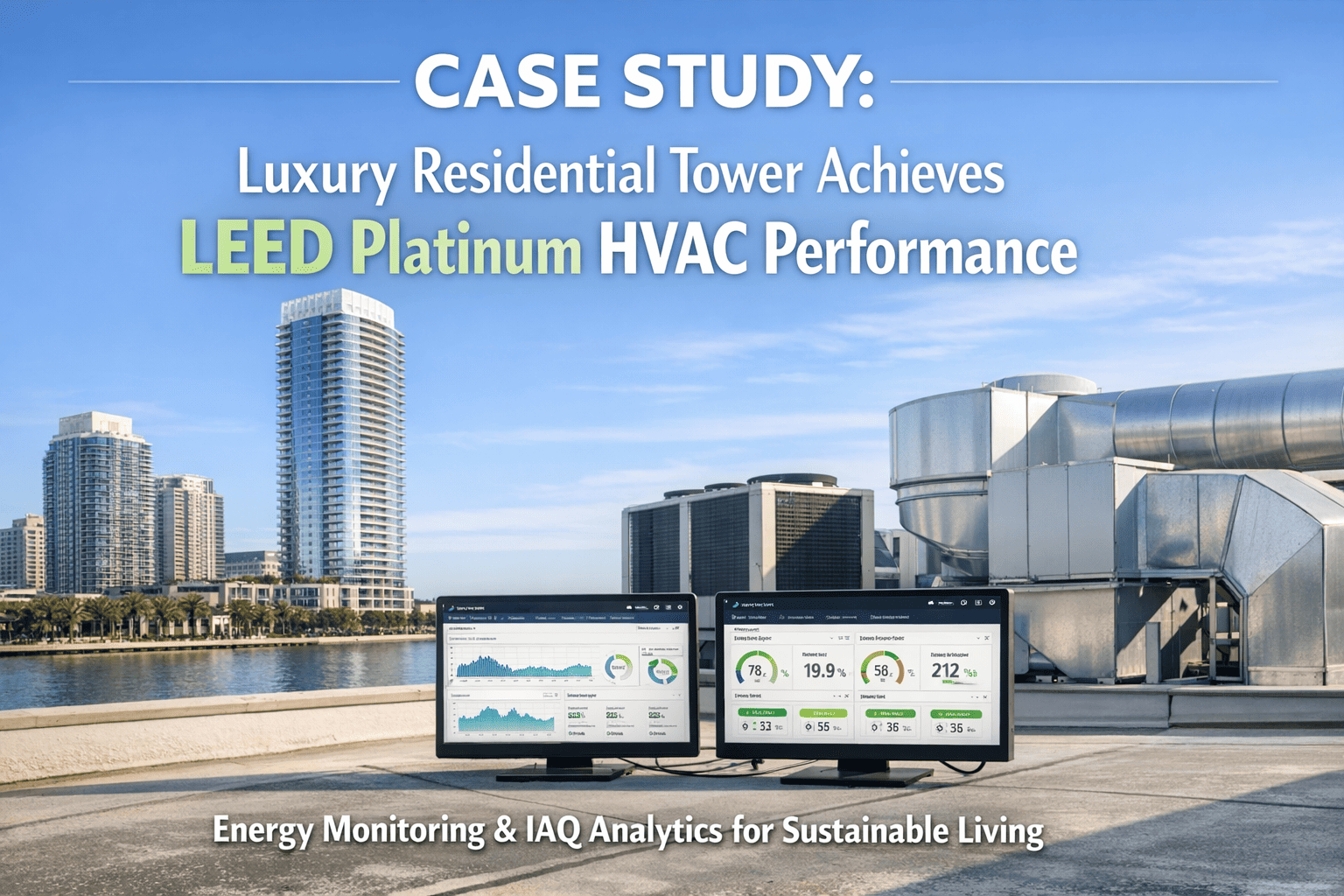
When a 48-story luxury residential tower in a Northeast US metropolitan market set a target of LEED v4.1 Platinum certification alongside operational net-zero carbon aspirations by 2030, the development team encountered the same structural gap that has stalled dozens of similar projects over the past five years. The design documents called for the systems — water-cooled VRF heat recovery, dedicated outdoor air with energy recovery, continuous CO₂ and PM2.5 monitoring, sub-metered tenant HVAC, and monitoring-based commissioning (MBCx) in accordance with EAc1 Option 2. The operational infrastructure to actually capture, trend, and report the 2,400+ continuous data points required for Enhanced Commissioning and five-year USGBC data sharing did not exist. The existing BMS produced logs. It did not produce the asset-level maintenance attribution, audit-ready evidence trail, or ESG-aligned performance reporting that Platinum-level certification required. Book a demo to see how Oxmaint structures LEED MBCx documentation and ESG analytics across luxury residential portfolios.
A 48-story luxury residential tower deployed Oxmaint to operationalize LEED v4.1 Platinum monitoring-based commissioning alongside continuous HVAC performance and indoor air quality tracking. The project achieved 83 LEED points for Platinum certification, validated EAc2 Optimize Energy Performance at 42% better than ASHRAE 90.1-2010 baseline, maintained an ENERGY STAR Portfolio Manager score of 91 across the first operating year, and consolidated five-year USGBC data sharing into automated monthly exports. Annual HVAC energy consumption came in 38% below baseline. IAQ violations against the monitored thresholds dropped to zero in the second quarter post-deployment. ESG reporting for the ownership fund moved from quarterly manual assembly to on-demand dashboard export.
Background: LEED Platinum as an Operational Problem, Not a Design Problem
LEED v4.1 Platinum for new construction requires 80 or more points on a scorecard where the Energy and Atmosphere category alone carries 33 available points — the largest single category. The design team had already secured strong point contributions through equipment selection: water-cooled VRF heat recovery for the residential floors, dedicated outdoor air systems with enthalpy wheels, chilled beams in the amenity spaces, and LED lighting throughout. Those design choices are table stakes. The harder problem was the ongoing operational verification.
EAp3 Building-Level Energy Metering is a prerequisite. EAc1 Enhanced Commissioning Option 2 requires monitoring-based commissioning with automated tools analyzing system performance against limits of acceptable values. EAc2 Optimize Energy Performance under the O+M pathway requires measured energy performance data, not just modeled projections. And the USGBC requires continuous data sharing for a minimum of five years post-certification. All of this is an operational discipline problem — and it is the problem that routinely costs projects the Platinum certification they spent the design phase earning.
Why Oxmaint Was Selected Alongside the Building Automation System
The ownership evaluated Oxmaint against three competing approaches: direct expansion of the BMS with vendor analytics modules, a standalone fault-detection and diagnostics (FDD) platform, and continuation of the commissioning authority's spreadsheet-based reporting. Each approach could satisfy a subset of the requirements. Only one could satisfy all four — MBCx evidence, five-year USGBC data sharing, 312-unit sub-meter consolidation, and fund-level ESG reporting — from a single operational platform.
The vendor BMS analytics module priced at $185,000 one-time plus $42,000 annually for the proprietary FDD layer, with LEED-specific reporting configured as professional services at $95,000 more. A standalone FDD platform added $78,000 annually without the maintenance work order management the facility team also required. The commissioning authority's manual reporting approach was already priced at $48,000 per quarter going forward. Oxmaint was selected on the basis that MBCx monitoring, asset-level maintenance records, sub-meter aggregation, and ESG-format reporting were all native capabilities — not post-configuration deliverables.
See How Oxmaint Structures LEED Platinum MBCx and ESG Reporting
Oxmaint generates Enhanced Commissioning evidence, ENERGY STAR Portfolio Manager inputs, and ESG fund reports from the same platform your building operations team uses for daily HVAC and maintenance work. Book a demo to review LEED and ESG outputs for your luxury residential portfolio.
Implementation: Eight Weeks From Asset Registry to Live ESG Dashboard
Deployment followed a structured four-phase approach that prioritized LEED MBCx readiness first, with ESG reporting and tenant-facing analytics activated in subsequent phases. The tower was live on the Oxmaint platform for MBCx evidence generation within eight weeks of deployment kickoff — ahead of the first post-occupancy commissioning review.
Results at 12 Months: Operational, Compliance, and ESG Outcomes
LEED Platinum certification was awarded three months after occupancy. Operational outcomes — actual energy performance, IAQ compliance, and ESG reporting automation — matured over the first four operating quarters as tenant occupancy ramped up and seasonal performance data accumulated. The numbers below reflect the first full operating year with the tower at 94% leased occupancy.
Key Metrics: Pre-Oxmaint Baseline vs 12 Months Post-Deployment
| Metric | Pre-Oxmaint Baseline | After Oxmaint (12 months) |
|---|---|---|
| LEED MBCx evidence assembly time | 48-60 hours per quarterly cycle — commissioning authority billable | Automated export from dashboard — zero manual assembly time |
| ENERGY STAR Portfolio Manager update | Monthly manual entry from utility bills by property manager | Live sub-meter feed; score updates daily, monthly check-in only |
| IAQ anomaly to work order time | 2-5 days — tenant complaint to chief engineer to contractor | Under 8 minutes — sensor threshold to auto-routed work order with SLA |
| GRESB reporting cycle effort | 80-120 analyst hours per quarterly ESG submission | 4-6 hours per cycle — narrative commentary only, data auto-exported |
| Sub-meter data utilization | Billing pass-through only; no analytics or anomaly detection | Unit-level efficiency benchmarking, tenant dashboard, anomaly alerts |
| HVAC PM documentation | Paper work orders, filed monthly, searchable only by date | Digital work orders with photo evidence, searchable per asset and task |
| Annual HVAC energy cost | Baseline operating budget at $3.1M for the tower | $1.9M — 38% below baseline with continuous optimization |
LEED and ESG Framework Coverage Across the Portfolio
| Framework | Applicable Credit or Standard | Oxmaint Documentation Coverage |
|---|---|---|
| LEED v4.1 BD+C | EAp1 Fund Cx, EAp2 Min Energy, EAp3 Metering, EAc1 Enhanced Cx, EAc2 Optimize Energy | MBCx procedures, acceptable-value limits, measured energy data, five-year USGBC export |
| LEED v4.1 O+M | Ongoing monitoring, measured performance, Portfolio Manager benchmark | Continuous sub-meter feed, seasonal performance trending, Portfolio Manager live sync |
| GRESB | Real Estate Assessment — Performance Component (energy, GHG, water, waste) | Asset-level data in GRESB-native export format, year-over-year trending, scope boundary documentation |
| SFDR Article 9 | EU Sustainable Finance Disclosure Regulation — dark-green fund reporting | Principal Adverse Impact indicators, EU Taxonomy alignment, PAI data exports |
| GHG Protocol | Scope 1, Scope 2, Scope 3 Category 13 (downstream leased assets) | Tenant-adjusted emissions allocation, refrigerant leak tracking, utility emissions factor updates |
LEED, GRESB, SFDR, and GHG Protocol — One Platform, Every Framework.
Oxmaint generates compliant documentation for all five frameworks above from the same dashboard used for daily HVAC operations. No quarterly analyst scramble. No five-year data sharing burden on the commissioning authority.
Perspective: What the Project Team Said
Frequently Asked Questions
QHow does Oxmaint satisfy LEED EAc1 Option 2 monitoring-based commissioning specifically?
QCan Oxmaint handle sub-metering data from 300+ residential units without performance degradation?
QDoes the same deployment address GRESB, SFDR, and fund-level ESG reporting?
QHow was the eight-week deployment timeline achieved for a 48-story tower?
Achieve LEED Platinum and ESG Reporting Without the Quarterly Scramble
Oxmaint structures LEED MBCx evidence, ENERGY STAR Portfolio Manager inputs, and ESG fund reports from the same platform your HVAC and operations team uses for daily preventive maintenance — with five-year USGBC data sharing automated from day one.