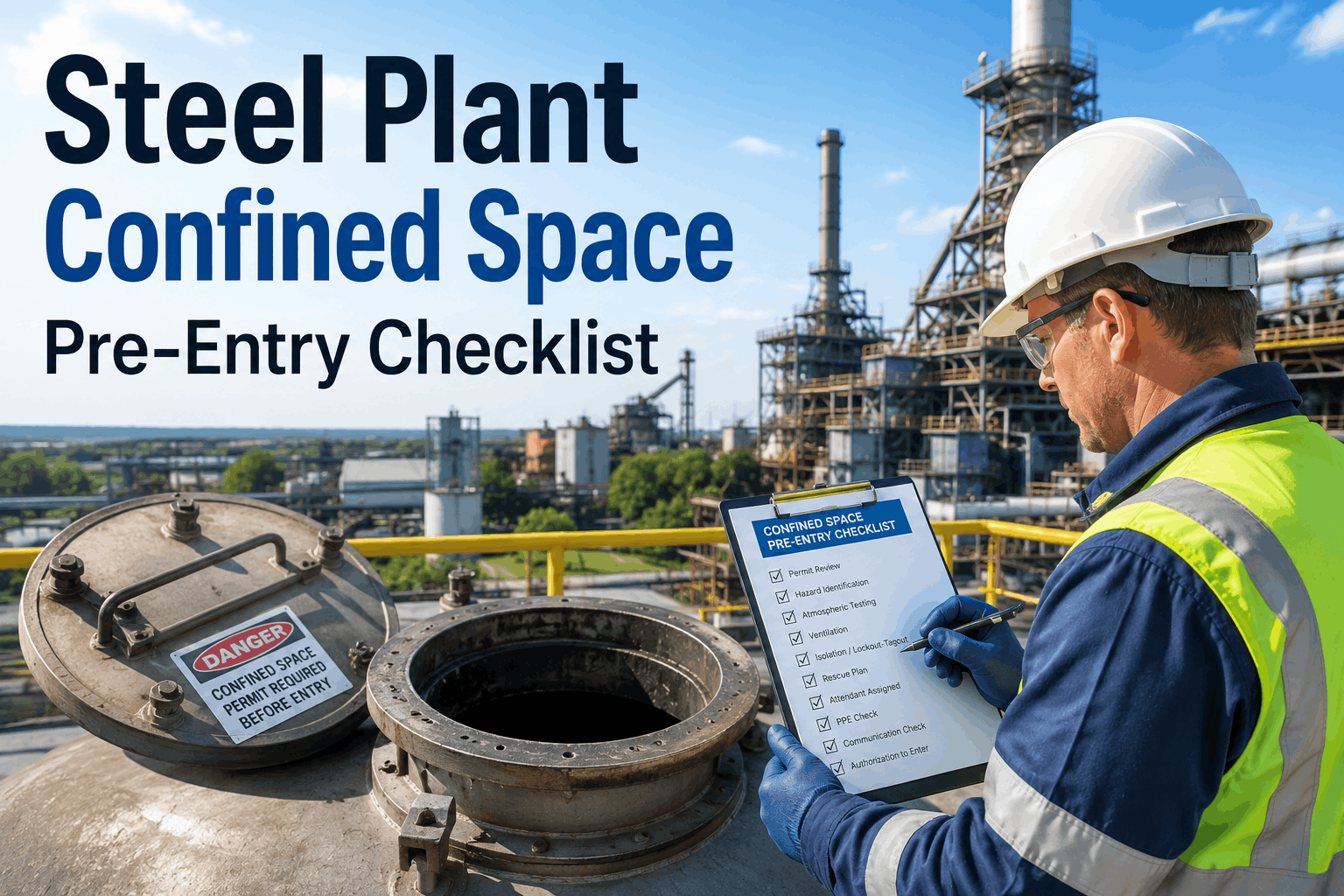
1. Permit-Required Confined Space Identification and Classification
OSHA 1910.146 applies to permit-required confined spaces, defined as spaces that: (1) are large enough to permit entry and bodily movement, (2) have limited/restricted means of entry or exit, and (3) contain or may contain hazardous atmospheres, engulfment material, internal configuration causing entrapment, or other serious hazard. Many steel plant spaces initially appear non-hazardous but qualify under the standard's broad definition. Misclassification is a common violation — spaces classified as non-permit-required are entered without atmospheric testing, rescue plans, or attendants, leading to fatalities.
2. Pre-Entry Atmospheric Testing and Ventilation Requirements
Atmospheric testing is the most critical step in permit-required confined space entry. Testing must occur in the correct sequence (oxygen first, then combustibles, then toxics), at the correct times (before initial entry, periodically during entry, and after any changes), and with properly calibrated equipment. Atmospheric testing failures are the leading cause of permit-required confined space fatalities — testing equipment that is inaccurate, not calibrated, or used incorrectly provides false assurance that a space is safe when it is actually hazardous.
3. Permit Documentation, Attendant Coordination, and Rescue Planning
The permit serves as explicit authorization from facility management that entry conditions are safe and rescue/emergency resources are available. The permit documents hazards, control measures, authorized entrants, attendants, rescue contacts, and atmospheric testing results. A complete permit provides legal defensibility if an incident occurs; a partial or incomplete permit indicates negligence and increases liability.
4. Non-Permit-Required Confined Spaces and Space Reclassification
OSHA 1910.146(c)(5) allows spaces to be managed as non-permit-required if the employer can demonstrate that the space contains no hazardous atmosphere and has no other serious hazard. This requires continuous forced air ventilation that controls all hazards, atmospheric monitoring to confirm safety, and documented procedures. Few steel plant spaces qualify for non-permit-required classification — most require permits.
Permit-Required Confined Space Entry Process
Pre-Entry Planning (24 Hrs Before)
Work request triggers confined space entry checklist. Entry supervisor reviews permit-required space procedures, verifies authorized entrants and attendants are scheduled and trained, confirms rescue resources are available.
Day of Entry — Pre-Entry Atmospheric Testing
Entry supervisor tests atmosphere: O₂ (must be 19.5-23.5%), combustibles (must be <10% LEL), toxics (H₂S <10 PPM, CO <35 PPM). If any reading is outside acceptable range, ventilate and retest until all readings are safe.
Permit Issuance
Entry supervisor issues written permit documenting: space, hazards, control measures, authorized entrants, attendant name, rescue plan, test results, entry duration. Entrants sign permit acknowledging they understand hazards and procedures.
Entry and Monitoring
Authorized entrants enter with harness and lifeline attached. Attendant remains outside maintaining communication and monitoring gas detector. Continuous atmospheric monitoring during entry if ventilation-dependent.
Work Completion and Exit
Entrants complete assigned work, remove equipment, and exit safely. Attendant confirms all personnel have exited and space is secure. Entry supervisor documents exit conditions and closes permit.
Post-Entry Documentation
Any findings, hazards encountered, or near-misses documented in permit record. Permit stored electronically for future reference and compliance audit.
Digitalize OSHA 1910.146 Confined Space EntryPre-entry permits, atmospheric testing documentation, attendant coordination, rescue plan verification, and comprehensive incident prevention tracking.
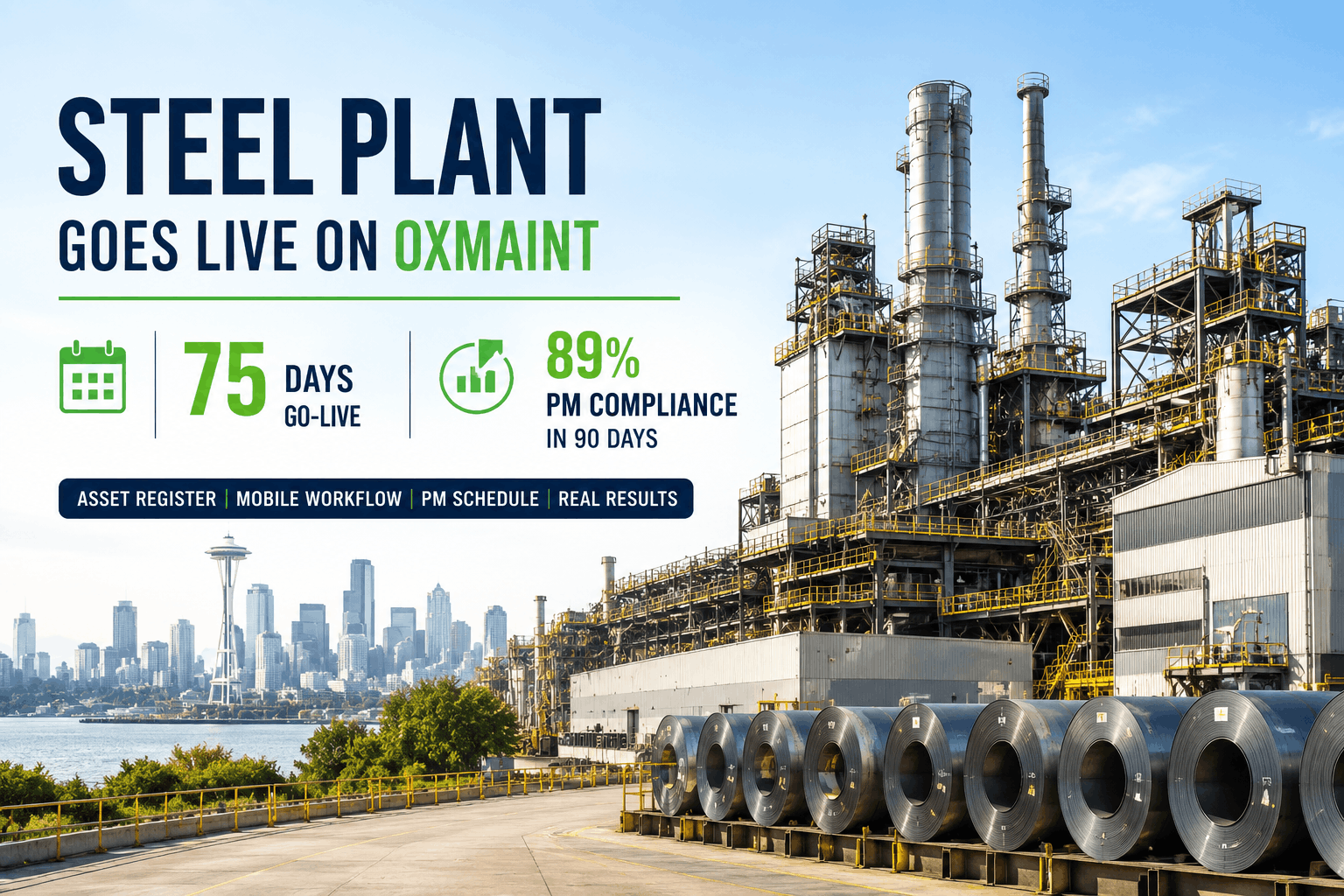
"We had a confined space entry where the atmospheric monitor batteries died midway through the entry. The entrant didn't notice and exposure to carbon monoxide nearly cost his life. We shifted to Oxmaint digital permits with equipment check-in reminders, atmospheric testing logs with equipment verification, and mandatory attendant sign-off on all permits. Now every entry is tracked, all equipment is verified before entry, and rescue coordination is instant."
— Robert H., Safety Director, Cleveland Steel Plant, USA
Frequently Asked Questions — OSHA 1910.146 Confined Space Entry
1. If atmospheric testing shows one hazard is safe (oxygen is 21%) but another hazard is unsafe (H₂S is 25 PPM), can entry proceed with special respiratory protection?
No. All atmospheric hazards must be below acceptable levels before entry. If H₂S exceeds 10 PPM, entry cannot proceed until ventilation reduces the concentration below 10 PPM. Respiratory protection alone cannot substitute for hazard control through ventilation. OSHA requires hazard elimination/control as the primary protection method.
2. Can the same person serve as both entry supervisor and attendant, or must these be two separate individuals?
OSHA 1910.146 allows one person to hold multiple roles if they are trained in each role. However, in practical terms, the entry supervisor (decision-maker, permit issuer) and attendant (monitor, communication, rescue initiator) have different responsibilities requiring focus. If one person tries to do both, attention will be divided. Best practice is to assign separate individuals to each role.
3. If a permit-required space will be entered daily or weekly on a continuous basis (e.g., daily tank inspection), can a single permit be issued for a month to cover all entries?
OSHA 1910.146 requires a permit for each entry, even if multiple entries to the same space occur. A permit for a single day cannot be extended to cover subsequent days. However, OSHA allows an "area entry permit" for routine repetitive entries to the same space under unchanged conditions. Area permits can be valid for up to one month if atmospheric conditions remain stable and procedures don't change.
4. What is the maximum penalty OSHA can assess for willful violations of OSHA 1910.146 in 2026?
OSHA can assess penalties up to $170,735 per willful violation. If a confined space entry results in a fatality, criminal charges may be brought against facility leadership in addition to civil penalties. Confined space fatalities have resulted in 10+ year prison sentences for responsible managers.
5. If a space is naturally ventilated (breezes through openings) without forced air ventilation, can it be classified as non-permit-required?
Natural ventilation alone cannot provide the continuous, reliable hazard control required for non-permit-required classification. OSHA 1910.146(c)(5) specifically requires mechanical ventilation to achieve non-permit status. Natural ventilation is unreliable because wind and atmospheric pressure changes affect air movement.
6. Is it acceptable to use a single trained rescue team for all permit-required confined spaces or must rescue be space-specific?
One trained rescue team can provide rescue for multiple spaces provided the team is trained for the types of hazards in each space and understands the space configurations. A team trained for atmospheric rescue may need additional training for spaces with engulfment or high-temperature hazards. Customize rescue training to match the specific hazards in spaces where rescue will be needed.
7. Can entrants use self-rescue respirators instead of relying on continuous attendant monitoring and gas detection?
Respirators are secondary protection only per OSHA 1910.146. The primary controls are hazard elimination through ventilation and atmospheric monitoring. Respirators are backup if an atmospheric monitor fails or unexpected hazard develops. Reliance on respirators alone without atmospheric monitoring is insufficient — entrants would not know to activate respirators until symptoms appear, which may be too late.
8. If a permitted entry is completed early and the entrant exits before the scheduled exit time, does the permit remain valid for re-entry by another person later that day?
No. Once the initial authorized entrant exits, the permit expires. If another person needs to enter the same space later, a new permit must be issued with fresh atmospheric testing. Permit expiration upon exit is non-negotiable — do not attempt to extend or reuse permits across multiple entries.
Protect Against Confined Space IncidentsOxmaint automates OSHA 1910.146 compliance with digital permits, atmospheric testing logs, trained personnel verification, rescue coordination, and incident-ready documentation.
.png)