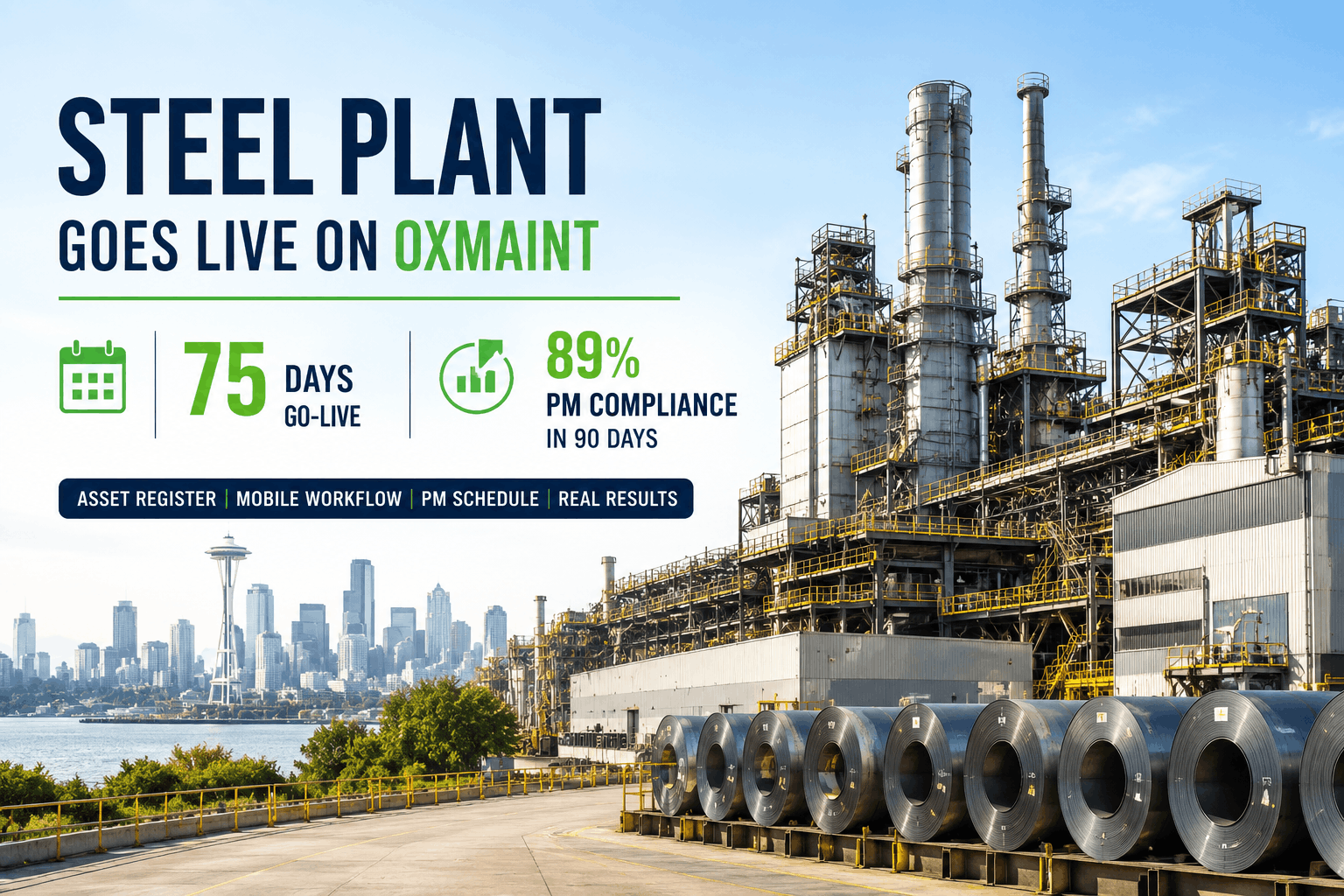
Steel Plant Goes Live on Oxmaint in 75 Days - PM Compliance 89% in 90 Days
By Alex Jordan on June 8, 2026
A medium-sized integrated steel plant operating a meltshop, caster, and rolling mill had no centralized maintenance system. Work orders were handwritten on paper logs. Preventive maintenance existed only as calendar reminders on supervisors' phones. Equipment history was scattered across spreadsheets, notebooks, and tribal knowledge. The plant was running at 42% PM compliance, with emergency repairs consuming 58% of the maintenance budget. After deploying Oxmaint, the plant went live in 75 days with a complete asset register, mobile workflow, automated PM schedules, and achieved 89% PM compliance within 90 days — reducing emergency repairs by 31% and cutting unplanned downtime by $420,000 annually. Start free — deploy your steel plant CMMS in 75 days.
CMMS DEPLOYMENT · CASE STUDY · STEEL PLANT · 2026
Steel Plant Goes Live on Oxmaint in 75 Days — PM Compliance 89% in 90 Days
Case study: a medium-sized integrated steel plant deploys Oxmaint CMMS in 75 days — asset register, mobile workflow, PM schedule, and achieves 89% PM compliance within 90 days of go-live.
75 daysFrom contract signing to full CMMS go-live — asset register, mobile workflow, PM schedules active
42% → 89%PM compliance improvement — from reactive emergency-driven maintenance to scheduled preventive execution
2,800+Assets registered in Oxmaint — equipment, spare parts, tools, and inspection points across meltshop, caster, and rolling mill
$420KAnnual unplanned downtime reduction achieved through systematic PM and work order tracking
The Challenge — No Centralized Maintenance System
The steel plant operated three production areas: a 150-ton AC EAF meltshop, a six-strand billet caster, and a bar rolling mill. Annual production was 450,000 tons. Maintenance was managed through a combination of paper logs, supervisor memory, and informal communication. Work orders were handwritten on paper forms that were often lost before completion. Equipment breakdowns were the primary trigger for maintenance — reactive, not preventive.
PM schedules existed only as mental notes or calendar reminders. If a supervisor was absent, PM tasks were often missed entirely. Emergency repairs consumed 58% of the maintenance budget, with unplanned downtime averaging 8-12 hours per week across the plant. The maintenance manager had no way to track work order completion, measure PM compliance, or analyze recurring failure patterns. The plant needed a CMMS — but the team feared a lengthy, disruptive implementation. Book a demo to see the 75-day deployment roadmap.
Before Oxmaint
Reactive
Paper work orders. No PM schedule. 42% PM compliance. 58% budget on emergency repairs. 8-12 hrs/week unplanned downtime. Scattered equipment history.
After Oxmaint (90 Days)
Predictive
Digital work orders. Automated PM scheduling. 89% PM compliance. 31% emergency repair reduction. 5-7 hrs/week downtime. Centralized asset history.
The Deployment Roadmap — 75 Days to Go-Live
The plant followed a structured four-phase deployment plan designed for steel mill environments. Oxmaint's implementation team worked alongside plant maintenance leadership to ensure the system reflected actual operations, not generic templates. Each phase had clear deliverables, success criteria, and stakeholder sign-off.
Phase 1: Days 1-30
Asset Register & Work Order Template
✓ 2,800+ assets entered into Oxmaint
✓ Equipment tagged with QR codes for scanning
✓ Work order templates configured by trade (mechanical, electrical, instrumentation)
✓ User roles and permissions established
✓ 15 maintenance technicians trained on mobile app
Phase 2: Days 31-45
Preventive Maintenance Scheduling
✓ 340 recurring PM tasks created across all departments
✓ PM schedule reviewed and approved by department supervisors
Phase 3: Days 46-60
Mobile Rollout & User Testing
✓ Mobile app deployed to all 28 field technicians
✓ QR code labels printed and applied to 800+ critical assets
✓ Work order creation from mobile tested and validated
✓ PM task assignment and completion workflows tested
✓ Photo documentation and signature capture tested
Phase 4: Days 61-75
Go-Live & Hypercare
✓ Full system go-live across all three production departments
✓ Paper work orders discontinued; all work in Oxmaint
✓ Daily leadership dashboard reviews established
✓ 2-week hypercare support with daily check-ins
✓ PM compliance metrics visible to all supervisors
The Stepped Impact — 90-Day PM Compliance Improvement
The plant's PM compliance did not jump from 42% to 89% overnight. It improved through five distinct stages as the team adopted new workflows and the system generated trust in the process. The stepped chart below shows how compliance improved week by week during the 90-day post go-live period — each stage representing a specific adoption milestone.
PM Compliance Improvement — Week by Week After Go-Live
PM compliance tracking: 340+ recurring PM tasks across meltshop, caster, and rolling mill. 90-day post go-live measurement period.
Key Success Factors — What Made the 75-Day Deployment Work
The plant's rapid deployment was not accidental. Six factors contributed to the successful 75-day go-live and rapid PM compliance improvement. First, executive sponsorship from the plant manager ensured resources were available and accountability was clear. Second, a dedicated project lead from the maintenance department coordinated all activities and served as the primary point of contact for Oxmaint's implementation team.
Third, the plant used Oxmaint's pre-configured steel mill templates rather than building from scratch — reducing configuration time by 60%. Fourth, QR code asset tagging was completed in parallel with data entry, not sequentially. Fifth, mobile-first training focused on field technicians' actual workflows, not generic software training. Sixth, leadership dashboards were configured before go-live, so supervisors could see adoption metrics from Day 1. Start free — use steel mill templates for rapid deployment.
Executive Sponsorship
100%
Plant manager accountability
Weekly steering committee reviews. Resources allocated immediately when gaps identified. No delays for approval.
Dedicated Project Lead
FTE
Maintenance department owner
Single point of contact. Coordinated data collection, user training, and issue resolution.
Steel Mill Templates
60%
Reduced configuration time
Pre-built asset categories, PM frequencies, and work order types for meltshop, caster, and rolling mill.
Parallel QR Tagging
800+
Assets tagged during data entry
QR labels printed and applied to critical assets while asset data was being entered — no sequential delay.
"
I was skeptical about a 75-day CMMS deployment. Our plant had no central system — paper work orders, scattered equipment lists, no PM tracking. The Oxmaint implementation team worked alongside our maintenance supervisors every day. By Day 30, all 2,800 assets were in the system. By Day 60, 28 technicians were using mobile apps. We went live on Day 75. Within 90 days, our PM compliance went from 42% to 89%. The result: emergency repairs dropped 31%, and unplanned downtime fell from 12 hours per week to 5 hours. The $420,000 annual saving exceeded our ROI projection. The deployment was on time, on budget, and delivered exactly what was promised.
Maintenance Manager — Integrated Steel Plant, 450,000 tpy, Southeast USA
CMMS Deployment Maturity — Where Does Your Plant Stand?
CMMS deployment maturity exists on a spectrum from no system to fully integrated predictive maintenance. The scoring framework below lets steel plant leaders assess their current maintenance management posture and identify the specific gaps that are costing money. The plant in this case study moved from Level 1 to Level 4 within 90 days of go-live.
Steel Plant CMMS Deployment Maturity Scoring
Score 5 = fully integrated, predictive · Score 1 = no system, reactive only
5
Integrated · Predictive · Condition-Based
CMMS linked to PLC/sensor data. AI-driven predictive maintenance. Real-time OEE tracking. Automated work orders from condition thresholds. 95%+ PM compliance.
Profile: Maximum reliability. Lowest unplanned downtime. Predictive failure prevention.
4
Digital · Scheduled PM · Mobile Work Orders
Full asset register. Automated PM scheduling. Mobile work order execution. 80-90% PM compliance. Centralized equipment history. This plant achieved Level 4 in 90 days.
PM schedules in spreadsheets. Work orders on paper. Limited mobile use. Equipment history scattered. 40-60% PM compliance. Reactive repairs dominate.
Gap: Digitize work orders. Implement mobile app. Automate PM scheduling. Centralize asset register.
2
No PM Schedule · Reactive Only
No formal preventive maintenance. Work orders verbal or not tracked. Equipment history tribal knowledge. 20-40% PM compliance. High emergency repair ratio.
No work order tracking. No equipment records. PM non-existent. Run-to-failure operations. Emergency repairs only. This plant started at Level 1.
Risk: Maximum downtime. Unsafe conditions. Insurance non-compliance. Immediate action required.
Technology Integration: Asset Register, Mobile Workflow, PM Automation
The plant's rapid deployment was enabled by three core technology layers working together. The asset register provided a single source of truth for all equipment, including make, model, location, criticality, and spare parts. The mobile workflow allowed field technicians to view assignments, log work, attach photos, and capture signatures from any location. PM automation generated work orders at configured intervals, assigned them to the right technicians, and tracked completion in real time. Start free — deploy all three layers in your steel plant.
Asset Register
2,800+
Assets registered in 30 days
Equipment, spare parts, tools, and inspection points. QR codes applied to 800+ critical assets for instant mobile access.
Mobile Workflow
28
Field technicians trained
Mobile app deployed across meltshop, caster, and rolling mill. QR code scanning for instant asset lookup. Photo documentation of completed work.
PM Automation
340+
Recurring PM tasks
Daily, weekly, monthly, quarterly, annual frequencies. Auto-assignment to technicians. Checklists and spare parts linked to each PM.
Leader Dashboards
Real-time
PM compliance visibility
Supervisors see PM completion rates, overdue tasks, and technician performance live. Weekly review meetings informed by data, not memory.
How long does it take to deploy Oxmaint in a steel plant?
Typical deployment: 60-90 days for a medium-sized integrated steel plant. The case study plant went live in 75 days with full asset register (2,800+ assets), mobile workflow, and PM automation. Larger plants may take 90-120 days. Start free — get a deployment timeline estimate.
What is a realistic PM compliance target for a steel plant?
World-class steel plants achieve 90-95% PM compliance. The case study plant reached 89% within 90 days of go-live, up from 42% baseline. Typical Year 1 target: 85% with steady improvement to 92%+ in Year 2.
Does Oxmaint provide pre-configured steel mill templates?
Yes. Oxmaint includes steel mill templates for meltshop, caster, rolling mill, and finishing equipment — asset categories, PM frequencies, work order types, inspection checklists, and spare parts hierarchies. Templates reduce configuration time by 60%.
How does Oxmaint handle spare parts inventory for steel mills?
Spare parts are registered as assets with min/max levels. PM tasks link to required parts, auto-reserving inventory when work orders are generated. Reorder alerts trigger when stock falls below minimum levels — no stockouts for critical spares.
Can Oxmaint integrate with existing ERP systems like SAP?
Yes. Oxmaint integrates with SAP, Oracle, Infor, and Microsoft Dynamics. Work order costs post to GL codes. Purchase requisitions auto-create from min/max triggers. Maintenance budgets sync with financial systems.
What is the typical ROI for steel plant CMMS deployment?
Case study plant achieved $420,000 annual unplanned downtime reduction — 31% emergency repair reduction. Typical steel plant ROI: 3-6 months payback through reduced downtime, extended equipment life, and lower emergency repair spend.
Deploy Oxmaint in Your Steel Plant — 75 Days to Go-Live
Asset register, mobile workflow, PM automation, and leader dashboards — deployed in 75 days with steel mill templates. Free to start.
.png)