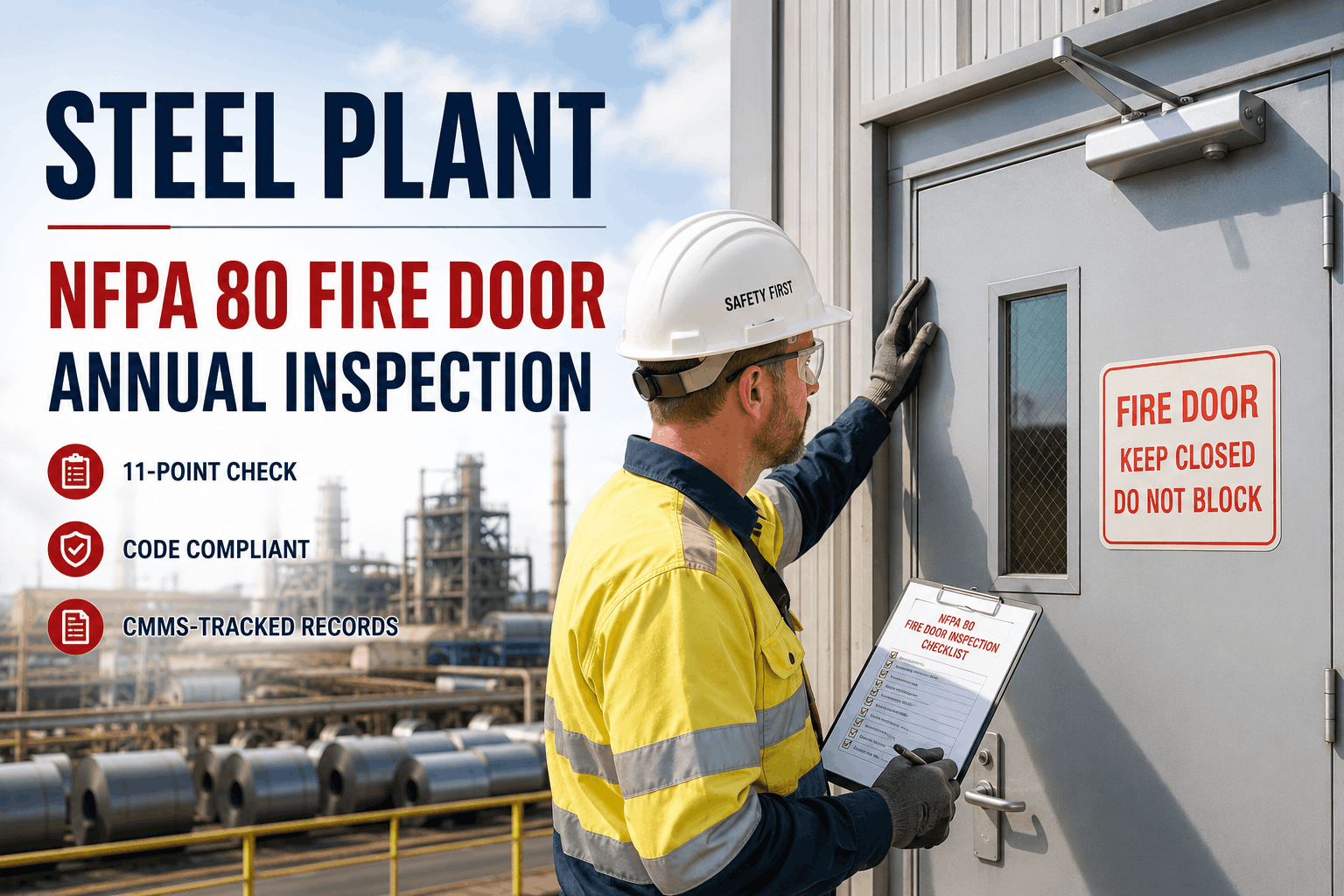
Fire doors compartmentalize steel plants by creating rated barriers that contain fire and smoke within specific operational zones. NFPA 80 mandates annual inspections and functional testing to confirm that fire door assemblies remain capable of maintaining their rated fire protection level. Steel plants with failed fire door latching mechanisms, damaged seals, or misaligned frames allow fire and smoke to spread uncontrolled into adjacent areas, bypassing the passive fire protection system designed to contain loss. Annual NFPA 80 inspection violations result in citations, insurance denial of fire losses, and operational shutdowns. Comprehensive fire door management through digital inspection scheduling, condition tracking, and corrective action enforcement maintains compartmentalization integrity. Oxmaint automates NFPA 80 annual inspections, documents 11-point functional testing requirements, tracks hardware condition, and ensures audit-ready compliance for all fire door assemblies across the facility.
Manage NFPA 80 Fire Doors SystematicallyAnnual inspection scheduling, 11-point functional testing checklists, hardware condition tracking, and regulatory audit documentation for fire door compliance.
Fire doors are passive fire protection components that must function automatically during fires without occupant intervention. NFPA 80 requires that every fire-rated door assembly be inspected annually by a qualified person to verify that the door remains capable of performing its fire-resistance function. This includes inspection of the door leaf, frame, hinges, hardware, seals, and all components that enable the door to close, latch, and maintain its fire rating under high-temperature exposure.
2. Fire Door Seals, Hardware, and Clearance Verification
Intumescent seals and edge seals are critical components that expand when exposed to fire, blocking smoke and hot gases from entering the rated opening. Hardware must be fire-rated and correctly installed. Clearances must be within strict tolerances to allow seals to function properly. Many fire door failures occur because seals have deteriorated, hardware is wrong, or clearances have drifted out of tolerance.
3. Functional Testing and Annual Inspection Documentation
NFPA 80 annual inspection requires functional testing — not just visual inspection. The door must be tested under conditions simulating actual use to confirm that all components operate correctly. Inspection documentation must be comprehensive and made available to fire marshals and insurance auditors on demand.
4. Rolling Steel Doors and Specialty Fire Door Systems
Steel plants commonly use rolling steel fire doors (overhead doors, curtain-style doors) and sliding fire doors in addition to traditional swinging fire doors. NFPA 80 annual inspection requirements apply to all fire-rated door types. Specialty door systems have unique components and failure modes requiring specialized inspection procedures.
Annual NFPA 80 Fire Door Inspection Timeline
30 Days Before Due Date
CMMS generates work orders for all fire doors requiring annual inspection. Facility manager schedules qualified inspectors and coordinates facility access.
Inspection Day
Technician inspects all 11 points: label, door condition, frame alignment, hinges, closer, seals, hardware, glazing, panic devices, functional testing, and documentation.
Deficiency Documentation
Any non-compliant findings are photographed and documented with corrective action recommendations and priority levels (immediate, 30-day, 90-day).
Corrective Action Execution
Maintenance or fire door contractors execute repairs. Follow-up functional testing confirms restoration. Work completion is documented in CMMS.
AHJ Compliance Verification
Complete inspection records and any follow-up documentation are made available to fire marshal if requested. Digital records in CMMS are audit-ready.
Next Year Scheduling
CMMS automatically schedules next annual inspection. Facility maintains continuous compliance documentation for regulatory defense.
Systematize Fire Door Compliance ManagementScheduled annual inspections, 11-point functional testing checklists, deficiency tracking, corrective action management, and AHJ-ready documentation.
"We had over 80 fire doors across our facility and were tracking inspections on paper. Three doors failed inspections two years running without corrective action — we didn't realize they were non-compliant until the fire marshal visited. After moving to Oxmaint, we automated the inspection schedule, tracked all 80 doors individually, and ensured corrective actions were completed before follow-up inspections. Now our fire door program is systematic and auditable."
— Michael L., Operations Manager, Detroit Steel Facility, USA
Frequently Asked Questions — NFPA 80 Fire Door Compliance
1. Can in-house maintenance staff perform NFPA 80 annual inspections or must a certified fire door inspector conduct the inspection?
NFPA 80 requires inspection by a "qualified person" — some jurisdictions interpret this as any trained technician; others require professional certification (NFPA 80 training, DHI certification, or fire protection license). Check your local AHJ requirements and insurance policy for specific qualification requirements. Many facilities use professional fire door inspectors for complex systems and in-house staff for routine checks.
2. If a fire door fails the NFPA 80 annual inspection, can the facility continue using the door or must it be taken offline immediately?
NFPA 80 requires that non-compliant fire doors be immediately reported as system impairments. The door can remain in service during repair if the building's emergency action plan is updated to notify occupants that the compartment is impaired. Most fire codes and insurance policies require that major deficiencies be corrected within 24-48 hours of discovery.
3. How long should NFPA 80 fire door annual inspection records be retained for compliance?
NFPA 80 does not specify retention period, but the International Fire Code and most AHJ standards recommend retaining records for the life of the building plus 5 years post-decommissioning. Electronic storage costs are negligible, so retaining all records indefinitely is practical and defensible.
4. Can painted-over fire door labels be restored or must the entire door be replaced if the label is illegible?
Fire door labels can sometimes be restored by careful paint removal, but do not scrape or sand harshly as this may damage the label. The door manufacturer can supply replacement labels if the original is damaged. Replace the label rather than discarding the door. If no documentation exists proving the door's original fire rating, the door may need to be reclassified as non-rated until proof of rating is obtained.
5. What is the typical cost of NFPA 80 fire door annual inspections for a facility with multiple doors?
Annual fire door inspections typically cost $150-$400 per door depending on complexity and geographic location. A steel plant with 50-100 fire doors would expect $7,500-$40,000 in annual inspection costs. This is a small percentage of overall fire protection costs and insignificant compared to the value of compartmentalization protection.
6. Are fire doors required on all openings in a steel plant compartment wall or only on certain critical openings?
Building code and design standards determine which openings require fire doors based on compartment purpose and occupancy type. Typically, all openings in a rated fire wall require fire doors unless the opening can be permanently sealed. Consult the original building design documents or hire a fire protection engineer to verify fire door requirements for specific compartments.
7. Do fire doors on non-rated interior walls within a compartment require NFPA 80 annual inspections or only fire-rated compartment wall doors?
NFPA 80 applies to all fire-rated door assemblies regardless of location. Any door with a fire rating (including interior partition doors rated for fire) requires annual inspection. Only non-rated interior doors are exempt from NFPA 80 requirements.
8. Can fire-rated door hardware be substituted with standard hardware if the fire-rated version is unavailable or cost-prohibitive?
No. NFPA 80 specifically requires that all hardware on fire-rated doors match the fire-rating specification. Using non-rated hardware voids the fire rating and creates regulatory non-compliance. If fire-rated hardware is unavailable, order from the door manufacturer or authorized fire door suppliers. Cost-saving hardware substitutions are never acceptable for fire-rated assemblies.
Transform Fire Door Compliance into Systematic PracticeOxmaint automates NFPA 80 fire door annual inspections, tracks all 80+ doors systematically, manages corrective actions, and ensures audit readiness.

.png)