How a Cement Plant Reduced Kiln Downtime by 52% Using Predictive AI Maintenance

By Josh Turly on May 20, 2026

how-a-cement-plant-reduced-kiln-downtime-by-52-percent-using-predictive-ai-maintenance

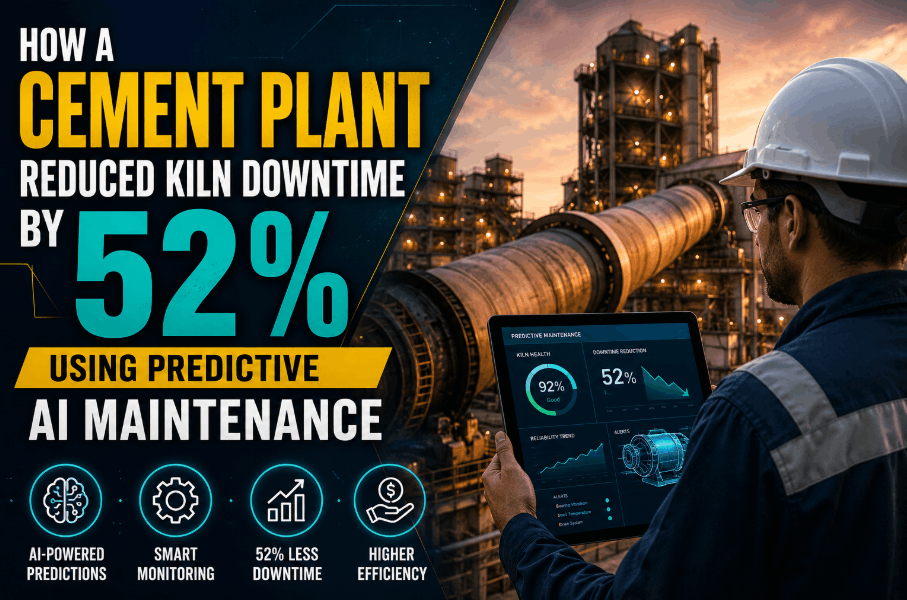
A mid-sized cement manufacturer operating a single integrated plant in the U.S. South was losing an estimated $2.9 million annually to unplanned kiln shutdowns and rotating equipment failures. Cement kilns — the thermal core of every clinker production line — are among the most maintenance-intensive assets in heavy industry. At this facility, reactive maintenance consumed 61% of all work orders, vibration anomalies on critical rotating equipment were discovered only after failure, and no structured digital maintenance process existed for the kiln drive, preheater fan train, or raw mill circuits. Within eight months of deploying Oxmaint's AI-powered predictive maintenance and CMMS platform across the plant's critical asset base, the manufacturer reduced unplanned kiln downtime by 52%, cut mean time to repair by 38%, and moved from majority-reactive to majority-planned maintenance operations. Book a Demo to see how Oxmaint structures predictive maintenance deployments for cement and heavy process industries.

Cut Kiln Downtime Before It Cuts Your Output
Oxmaint gives cement plant reliability teams AI-powered failure prediction, structured PM workflows, and real-time asset health dashboards — built for rotating equipment, kilns, mills, and the full clinker production line.
The Challenge

Reactive Kiln Maintenance Was Costing More Than the Equipment Was Worth to Run

$2.9M
Estimated annual production loss from unplanned kiln shutdowns and emergency rotating equipment failures
61%
Of all maintenance work orders were reactive — triggered by failure events rather than scheduled intervention
Zero
Predictive monitoring on critical rotating assets — kiln drive, preheater fans, raw mill, and cement mill
9.2 hrs
Average mean time to repair on kiln and mill circuit failures — driven by parts unavailability and undocumented procedures

The facility ran a two-kiln line with a combined clinker capacity of 3,400 TPD. Asset criticality was understood intuitively by senior technicians but had never been formally documented, and no CMMS governed work order flow or parts consumption tracking. Preventive maintenance schedules existed on paper but compliance was unverifiable. When rotating equipment faults surfaced — bearing failures on the kiln thrust roller, imbalance on the preheater ID fan, or gearbox wear on the raw mill — the team responded without diagnostic history, without staged parts, and without structured repair procedures. Capital budget requests went unsupported because no failure history existed to justify replacement timelines. Sign Up Free to explore how Oxmaint structures asset management for cement plant rotating equipment.

The Solution

AI Predictive Maintenance and Digital CMMS Built Around the Cement Production Line

01
Critical Asset Registry With Kiln-Specific Criticality Classification
Oxmaint's implementation team catalogued 340 assets across the plant — kilns, preheater towers, raw mills, cement mills, clinker coolers, and supporting utilities. Each asset was classified by criticality tier, linked to OEM specs, and assigned a structured maintenance profile. For the first time, plant leadership had a single source of truth for every maintainable asset on site.
02
Vibration and Thermal Monitoring on Rotating Equipment
Oxmaint's predictive maintenance layer was deployed on 48 critical rotating assets — kiln drive assemblies, thrust rollers, preheater fan trains, raw mill gearboxes, and cement mill main bearings. Condition data fed into Oxmaint's AI models, which were trained on equipment failure signatures to generate early fault alerts with actionable lead time before failure propagation.
03
Standardized PM Templates and Digital Work Order Workflow
A complete library of preventive maintenance templates was built for all kiln and mill circuit asset classes — calibrated to OEM service intervals and adapted to the plant's actual operating duty cycles. Work orders were digitized with pre-staged parts lists, step-by-step procedures, and mandatory completion checkpoints — replacing verbal handoffs and paper-based maintenance logs. Book a Demo to see Oxmaint's work order workflow for cement plant maintenance.
04
Spare Parts Inventory Linked to Critical Asset Profiles
The plant's spare parts stockroom was inventoried and mapped to critical asset profiles within Oxmaint. Minimum stock thresholds for kiln-critical components — thrust roller assemblies, preheater fan bearings, raw mill pinion gears — were established based on lead time data and failure frequency. Emergency procurement events dropped as planned replenishment replaced reactive purchasing.
Implementation

Phased Deployment — From Kiln Asset Registry to Live Predictive Monitoring in 10 Weeks

Phase 1 — Weeks 1–3
Asset Registry and Criticality Mapping
Full plant asset census completed. 340 assets catalogued, criticality-ranked, and entered into Oxmaint's CMMS. Kiln drive train and preheater fan circuits prioritized for predictive monitoring based on failure impact analysis. Baseline maintenance metrics established for pre-deployment benchmarking. Sign Up Free to start your cement plant asset registry.
Phase 2 — Weeks 4–7
PM Templates, Work Orders, and Technician Onboarding
Digital PM templates built for all critical asset classes. Work order workflows activated across kiln, mill, and utility circuits. Maintenance supervisors and technician crews trained on Oxmaint's mobile-first interface. Legacy paper logs and spreadsheet PM records migrated into the platform without production interruption.
Phase 3 — Weeks 8–10
Predictive Monitoring and Plant Dashboard Go-Live
Condition monitoring activated on 48 rotating assets. AI failure prediction models trained on plant-specific operating data. Plant manager dashboard launched with real-time OEE, PM compliance rate, open work order aging, and asset health index for kiln and mill circuits. Book a Demo to see the cement plant reliability dashboard live.
Measured Results

52% Kiln Downtime Reduction and $1.6M in Recoverable Value Within Eight Months

52%
Reduction in unplanned kiln downtime — achieved through predictive fault detection averaging 13 days of lead time on critical rotating equipment
38%
Reduction in mean time to repair — from 9.2 hours average to 5.7 hours, driven by structured work orders and pre-staged parts availability
61% → 22%
Reactive work order rate — shifted from majority-reactive to majority-planned maintenance across kiln and mill circuits
$1.6M
Total recoverable value in year one — from avoided downtime costs, labor efficiency gains, and spare parts optimization
+19 pts
OEE improvement across monitored kiln and mill assets — from 71% to 90% average by month eight
91%
PM compliance rate achieved by month six — up from an untracked baseline where fewer than half of scheduled PMs were verifiably completed
Investment and Return Summary
Implementation Cost
$148,000
Platform licenses, sensor integration, asset migration, and full-site onboarding over 10 weeks
Annual Value Recovered
$1.6M
$1.1M downtime avoidance + $280K labor efficiency + $220K spare parts cost reduction
Payback Period
5.5 months
Full implementation cost recovered through avoided production losses and maintenance savings
Three-Year ROI
2,140%
Net benefit of $4.65M against $148K implementation cost projected over 36 months
Key Business Impact

How Predictive AI Maintenance Changed Reliability Operations at the Cement Plant

Kiln Reliability
Unplanned Kiln Shutdowns Reduced From 14 to 6 Per Year
Before Oxmaint, the plant averaged 14 unplanned kiln shutdowns annually — each costing an average of $82,000 in lost production and emergency repair. Predictive monitoring on the kiln drive, thrust roller assembly, and main gearbox reduced unplanned events to six in the first year, recovering over $650,000 in avoided production loss.
Rotating Equipment
Early Fault Detection Averaging 13 Days Before Failure
Oxmaint's AI models — trained on vibration, temperature, and operating load data from 48 critical rotating assets — now generate actionable failure alerts with an average lead time of 13 days. Four major bearing failures on the preheater fan train and raw mill were detected and addressed during planned windows in year one, preventing an estimated $390,000 in combined downtime and secondary damage costs.
Labor Efficiency
Technician Wrench Time Up 29% With Structured Digital Work Orders
Digital work orders with pre-populated fault diagnostics, required parts lists, and step-by-step repair procedures reduced average diagnostic time per job by 2.4 hours. Technicians completed 29% more verified work orders per shift without additional headcount — and every completed work order now generates a timestamped compliance record linked to the specific asset.
Capital Planning
Data-Backed Equipment Replacement Roadmap Built for First Time
With eight months of structured failure history, the plant's maintenance leadership built the facility's first quantitative asset replacement roadmap. Two kiln shell sections previously flagged for capital replacement were deferred based on actual condition data — avoiding $340,000 in premature capital spend while scheduling planned replacement within a defined future window.
Spare Parts
Emergency Procurement Fees Cut 58% Through Planned Replenishment
Before Oxmaint, the plant's spare parts process was entirely reactive — critical components ordered only after failure, at premium expedite costs. Oxmaint's inventory module, linked to asset failure predictions, enabled planned replenishment cycles that cut emergency procurement events from 94 per year to 39, reducing emergency parts premium costs by 58% in year one.
Compliance
Audit-Ready Maintenance Records on Every Critical Asset
All 340 plant assets now carry automatically timestamped digital maintenance histories tied to specific work orders and technician assignments. Regulatory and environmental compliance documentation — previously assembled manually before every audit — is now generated on demand from Oxmaint's records. Audit preparation time dropped from 4 days to under 6 hours. Sign Up Free to activate audit-ready compliance tracking for your cement plant.
Plant Reliability Manager Perspective

What AI-Powered Predictive Maintenance Changed at the Operational Level

"
We were running two kilns on institutional knowledge and paper schedules. Every major failure cost us days of production we could never recover, and we had no visibility into what was about to break until it already had. Oxmaint gave us predictive alerts with real lead time — not next-day warnings, but 10 to 14 days ahead. The first time we pulled a preheater fan bearing on a planned shutdown because the system told us it was degrading, and we found it was two days from catastrophic failure — that changed how the entire team thinks about maintenance. Within eight months we had moved from firefighting to actual reliability engineering. For any cement plant still running reactive, this is the platform that closes the gap between knowing a machine is failing and having time to do something about it.
Before vs After

Cement Plant Maintenance Performance — Eight-Month Comparison

Performance Metric Before Oxmaint After 8 Months Improvement
Unplanned Kiln Shutdowns / Year 14 events 6 events -57% reduction
Reactive Work Order Rate 61% 22% -64% reduction
Mean Time to Repair 9.2 hours 5.7 hours -38% reduction
PM Compliance Rate Untracked / ~45% est. 91% +46 percentage points
Network-Average OEE (Kiln + Mill) 71% 90% +19 percentage points
Emergency Parts Orders / Year 94 events 39 events -58% reduction
Predictive Fault Lead Time None Avg. 13 days New capability
Audit Preparation Time 4 days manual Under 6 hours -85% reduction
Give Your Cement Plant the Visibility to Predict Failures Before They Stop the Line
Oxmaint's AI-powered predictive maintenance and CMMS platform is built for the reliability demands of cement kilns, rotating equipment, and integrated clinker production. Real-time asset health, structured PM workflows, and failure prediction with actionable lead time — all in one platform. Book a Demo and start your enterprise trial with dedicated cement plant onboarding included.
Common Questions

What Cement Plant Maintenance Teams Ask Before Deploying Oxmaint

Can Oxmaint integrate with existing vibration sensors and condition monitoring hardware already installed on our kiln and rotating equipment?
Yes. Oxmaint integrates with standard industrial condition monitoring hardware via API and OPC-UA. Data from existing vibration, temperature, and load sensors feeds directly into Oxmaint's predictive models — no need to replace installed equipment to activate AI-powered failure detection.
How long does it take to see measurable results from predictive maintenance on cement plant rotating equipment?
Most cement plants see the first predictive fault alerts within 6–8 weeks of sensor activation. Measurable downtime reduction typically appears in months 3–5 as AI models train on plant-specific operating signatures and early fault patterns accumulate.
Does Oxmaint support cement-specific assets like kiln drive systems, preheater fan trains, and raw mill gearboxes?
Yes. Oxmaint's asset registry and PM template library are configurable for all major cement plant asset classes — kilns, preheater towers, raw mills, cement mills, clinker coolers, and balance-of-plant utilities — with criticality classification built for process industry reliability engineering.
Can Oxmaint replace our current paper-based or spreadsheet-driven maintenance process without disrupting ongoing plant operations?
Yes. Oxmaint's phased onboarding is designed for continuous production environments. Asset migration, PM template builds, and technician training are completed without requiring any production shutdowns. Most cement plant deployments complete full go-live within 10–12 weeks.
What ROI can a cement plant realistically expect from deploying Oxmaint's predictive maintenance CMMS?
Cement plants typically recover implementation costs within 5–7 months through avoided kiln downtime, spare parts savings, and labor efficiency gains. Annual value recovery in year one commonly ranges from $1M to $2.5M depending on facility size and baseline reactive maintenance spend.
How does Oxmaint help cement plant leadership track compliance and prepare for environmental or safety audits?
Every work order and inspection completed in Oxmaint generates a timestamped, asset-linked digital record automatically. Compliance reports and maintenance histories are available on demand — reducing audit preparation from days of manual assembly to hours of system-generated documentation.
Stop Letting Unplanned Kiln Failures Set Your Production Schedule
Cement plants using Oxmaint's AI predictive maintenance platform detect critical rotating equipment faults weeks before failure, shift from reactive to planned operations, and recover millions in previously unavoidable downtime costs. Your kiln is already generating the data — Book a Demo and let Oxmaint turn it into reliable, continuous production. Free trial includes asset registry setup, PM template build, and predictive monitoring activation for your critical asset base.

Share This Story, Choose Your Platform!