A plant maintenance audit is one of the most decisive tools a reliability manager can deploy — yet most manufacturing facilities conduct them reactively, after a compliance failure or a costly breakdown. A structured maintenance audit evaluates your entire maintenance program against established standards: PM compliance rates, asset records, workforce competency, spare parts adequacy, documentation quality, and CMMS utilization. Whether you're preparing for an ISO 55001 assessment, a regulatory inspection, or simply benchmarking your maintenance department's performance, understanding how to conduct a plant maintenance audit effectively is critical. Sign Up Free to start generating audit-ready maintenance reports from your asset and work order data today.
What is a Plant Maintenance Audit?
Definition, Scope, and Purpose for Manufacturing Operations
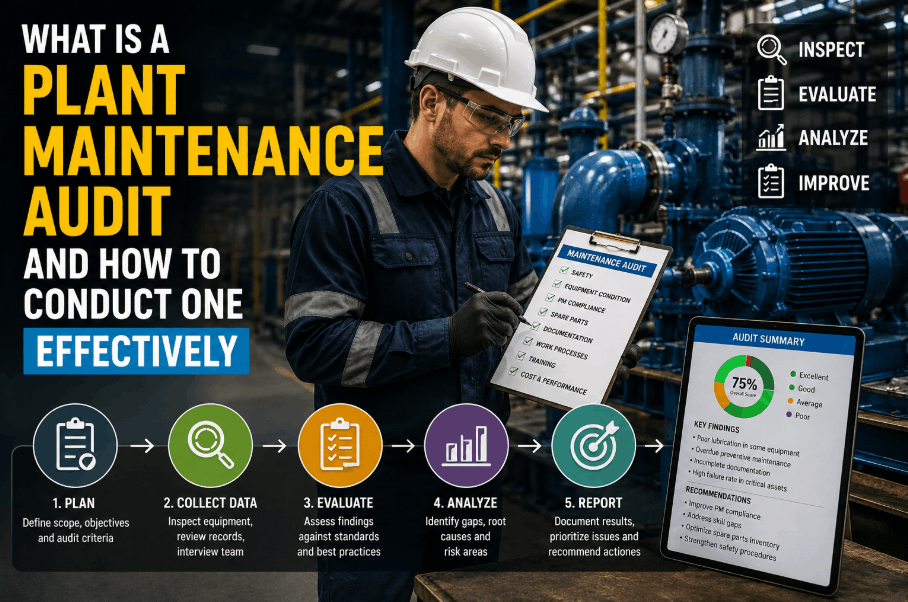
A plant maintenance audit is a systematic, documented examination of a facility's maintenance management practices, asset care standards, and operational reliability outcomes. It measures the gap between how maintenance is being performed and how it should be performed — identifying deficiencies in scheduling, documentation, resource allocation, and compliance before they create equipment failures or regulatory exposure. A maintenance program audit covers both the technical side (asset condition, lubrication practices, inspection frequencies) and the managerial side (CMMS utilization, KPI tracking, technician competency, work order closure rates). Book a Demo to see how OxMaint structures maintenance data to support audit readiness at any time.
Types of Plant Maintenance Audits
Choosing the Right Audit Scope for Your Facility
How to Conduct a Plant Maintenance Audit: Step-by-Step
A Practical Audit Process for Reliability and Maintenance Managers
Plant Maintenance Audit Checklist: Key Assessment Areas
What a Comprehensive Maintenance Audit Must Cover
- PM completion rate vs. scheduled tasks (target: >90%)
- Average days overdue on open PM work orders
- PM task adequacy vs. OEM recommendations
- Frequency review cadence — last updated date per asset class
- Asset records completeness — nameplate data, criticality ratings
- Work order closure rate and documentation quality
- Failure code usage consistency across technicians
- Spare parts linkage to asset records
- MTBF and MTTR trends by asset class over last 12 months
- Planned vs. unplanned maintenance ratio by department
- Recurring failure mode identification — assets with 3+ repeat events
- Condition monitoring coverage on critical rotating equipment
- Critical spares availability vs. asset criticality register
- Stockout incidents over last 6 months by part category
- Reorder point coverage for top 20 consumed parts
- Obsolete inventory identification and disposal status
- LOTO procedure availability for all energy-isolation assets
- Statutory inspection currency — lifts, pressure vessels, fire systems
- Completed safety check records per maintenance task type
- Non-conformance logs from previous audits — closure status
- Training records currency for all maintenance technicians
- Competency gaps vs. critical asset maintenance requirements
- Contractor oversight protocols and documentation
- Technician-to-asset ratio benchmarked against sector averages
Maintenance Audit Scoring and Findings Management
How to Rate, Prioritize, and Close Audit Findings Effectively
A maintenance audit without a disciplined findings management process produces reports that sit on desks rather than driving operational change. Effective audit scoring uses a severity classification system — typically a four-tier model — to distinguish between immediate safety risks and long-term improvement opportunities. Every finding must be linked to a corrective action with a named owner and a defined closure date. Book a Demo to see how OxMaint's work order and inspection modules support audit corrective action tracking from initial finding to verified closure.
| Severity Level | Definition | Response Timeline | CMMS Action |
|---|---|---|---|
| Critical | Immediate safety risk or compliance breach | Within 24 hours | Emergency work order — immediate escalation |
| Major | Significant gap with high failure or regulatory risk | Within 7 days | Priority corrective work order with manager sign-off |
| Minor | Procedural gap or documentation deficiency | Within 30 days | Standard work order — included in next PM cycle |
| Observation | Best-practice recommendation, no immediate risk | Next audit cycle | Logged as improvement opportunity in CMMS notes |
How OxMaint Supports Plant Maintenance Audit Readiness
From CMMS Data Quality to Audit-Ready Reporting
Frequently Asked Questions: Plant Maintenance Audit
What is a plant maintenance audit and what does it cover?
A plant maintenance audit is a structured review of a facility's maintenance program — covering PM compliance, asset records, CMMS data quality, spare parts management, workforce competency, and safety documentation. Its goal is to identify gaps before they produce equipment failures or compliance violations.
How often should a manufacturing plant conduct a maintenance audit?
Most manufacturing facilities conduct formal maintenance audits annually, with lighter-touch internal reviews quarterly. High-criticality environments — pharmaceutical, food processing, or regulated utilities — typically require semi-annual or more frequent assessment cycles.
What is included in a maintenance audit checklist?
A comprehensive maintenance audit checklist covers PM schedule compliance, work order documentation quality, asset condition, spare parts availability, safety and compliance records, CMMS data completeness, and reliability KPIs such as MTBF and planned-to-unplanned maintenance ratio.
How does a CMMS improve maintenance audit performance?
A CMMS centralizes maintenance records, PM schedules, failure data, and inspection logs — making audit evidence immediately retrievable rather than manually compiled. Plants using OxMaint can generate audit-ready reports on PM compliance, downtime, and corrective action status in minutes. Book a Demo to see these reports live.
What is the difference between a maintenance audit and a maintenance inspection?
A maintenance inspection evaluates the physical condition of specific equipment at a point in time. A maintenance audit evaluates the entire maintenance management system — processes, records, compliance, and performance — across the facility as a whole.
How are maintenance audit findings managed and closed?
Findings are classified by severity — critical, major, minor, or observation — and converted into corrective actions with assigned owners and closure deadlines. Managing findings inside a CMMS ensures accountability and provides verified closure evidence for the next audit cycle.