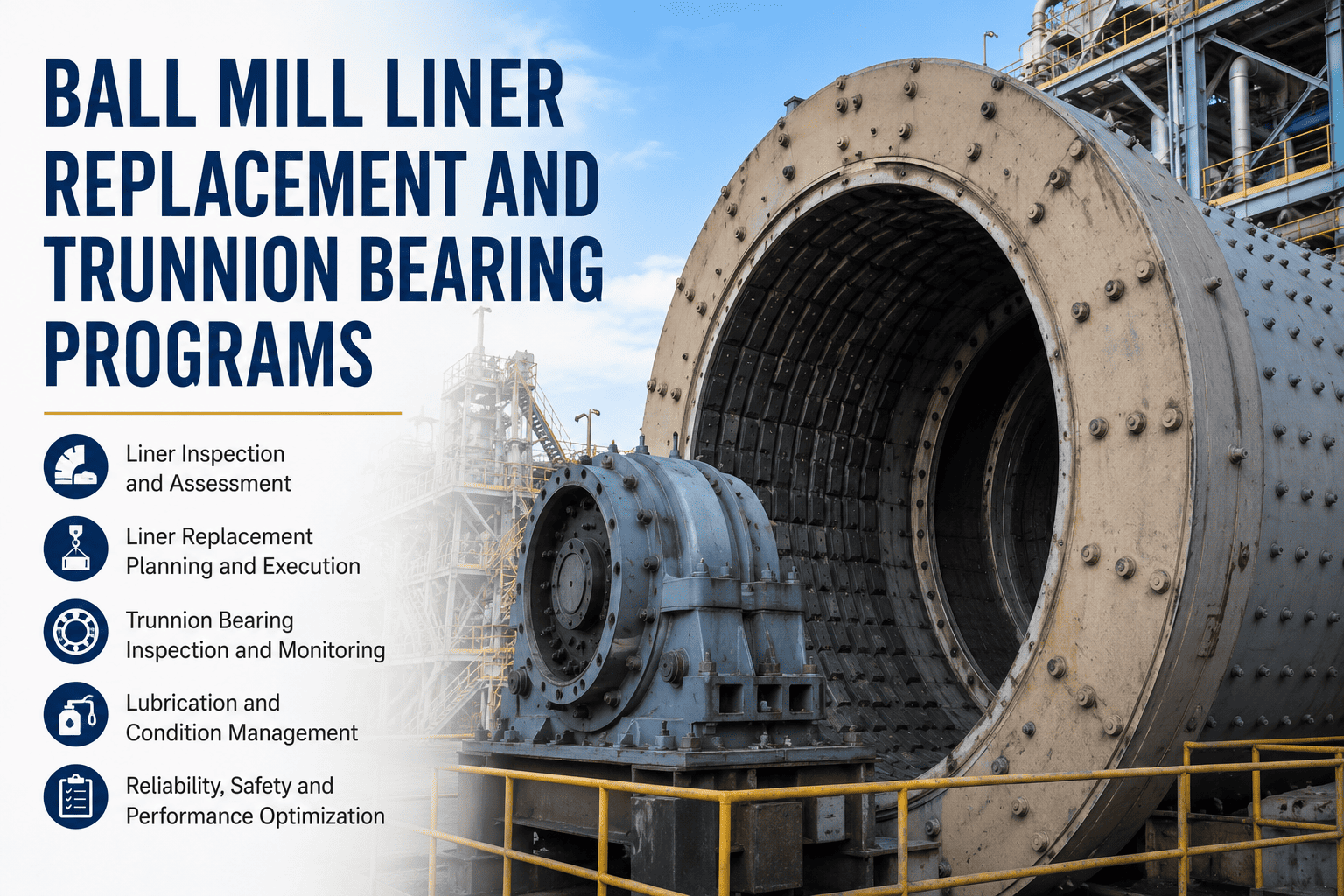
A cement ball mill does not fail because of one big thing — it fails because of dozens of small things that nobody connected to each other. Liner bolts loosen by 4 Nm a week. Oil cleanliness drifts from ISO 18/16/13 to ISO 22/20/17 across a quarter. Trunnion bearing temperature climbs 0.4°C per month. Lifter bar profiles wear unevenly between chambers. Each signal sits in a different system — the lubricator's logbook, the lab's oil report, the operator's shift handover — and by the time someone notices the pattern, a 36-hour planned relining has become a 120-hour emergency event, or a $400 oil filter change has become a $2 million trunnion bearing replacement. Cement plants that keep their ball mills running at peak for 25,000 hours and beyond all run their liner programs, lifter bar tracking, and trunnion bearing oil analysis through one connected maintenance system, and you can see what that looks like inside the OxMaint platform.
Ball Mill Liner Replacement & Trunnion Bearing Programs
Liner wear tracking, lifter bar profile records, trunnion bearing oil analysis, and CMMS-driven relining campaigns for raw mills, cement mills, and coal grinding circuits.
Inside a Cement Ball Mill — The Four Wear Zones That Decide Mill Life
A cement ball mill is not one asset — it is roughly forty interlinked components that wear, loosen, and degrade on entirely independent timelines. The anatomy map below shows the four wear zones that decide whether a mill makes its 25,000-hour target, and what gets measured inside each one. Plants that treat the mill as one big rotating drum miss 60 percent of the warning signals it gives them.
Coarse Grinding — Lifter Bars & Shell Liners
Lifter bars throw the ball charge into the impact zone. Wear here decides crushing efficiency and chamber-1 throughput. Profile loss accelerates the moment lifter height drops below 60 percent of original.
Material Transfer — Diaphragm & Slot Plates
Diaphragm controls flow from chamber 1 to chamber 2. Slot blinding cuts throughput. Structural failure lets media migrate between chambers and destroys product fineness inside a single shift.
Fine Grinding — Classifying Liners
Classifying liners sort ball charge by size, keeping smaller balls near the discharge end. Profile loss disrupts the size gradient and pushes specific energy consumption up 1.8 to 3.2 kWh per tonne before anyone sees it on a report.
Load Carrying — Trunnion Bearings
Two hydrodynamic white metal bearings carry the entire mill weight, often hundreds of tonnes per side. The single most expensive failure mode in the mill — a seized bearing can park a 5,000 tpd line for 10 to 21 days.
The Liner Wear Progression — Five Stages From Baseline to Condemn
Liner wear is a continuous progression, but the intervention windows are not. Each stage carries a different cost, a different lead time, and a different decision — and plants that misread the stage end up either retiring serviceable liners 15 to 22 percent early or running them past safe wear limits into shell damage territory.
Just-installed liner thickness recorded as reference. Lifter profile mapped against design template at 12 fixed positions. Becomes the benchmark for every future inspection.
Predictable thickness loss across the contact band. Specific energy consumption flat. Quarterly mapping confirms uniform wear pattern. No action required beyond monitoring.
Lifter height starts losing throw efficiency. kWh per tonne creeps up 0.5 to 1.0. Bolt torque audit due. Begin spare liner plate procurement against 90-day lead time.
Wear allowance below 50 percent. Formal relining shutdown work order issued. Crane availability confirmed. Contractor scope locked. Liner batch number reserved.
Below 25 percent residual triggers replacement. Past this point, bolt heads expose, plates risk dropping into the charge, and shell damage becomes a real possibility within a single campaign.
Trunnion Bearing Oil Analysis — The ISO 4406 Code That Predicts Bearing Life
Eighty percent of trunnion bearing failures begin not with fatigue but with oil contamination — water ingress, process dust, wear particles, viscosity loss from overheating. The ISO 4406 cleanliness code is the single most predictive parameter on the entire mill, more reliable than operating hours for forecasting remaining bearing life. The contamination ladder below is what disciplined plants actually act on.
Offline filtration running, water content under 100 ppm, particle count well below threshold. Bearing life projection at or above design. No corrective action needed.
Industry-recommended minimum for cement mill trunnion bearings. Sample monthly. Trend particle count and water content rolling-month. Acceptable for continuous operation.
Cleanliness drifting. Investigate root cause — filter bypass, breather contamination, seal degradation. Increase sampling to bi-weekly. Begin filtration cycle to recover cleanliness.
Bearing life shortened measurably. White metal fatigue accelerated. Wear particles in suspension. Schedule oil drain, system flush, and full filtration recovery before next 168-hour run.
What the Liner Bolt Torque Audit Actually Measures — And Why It Matters
Liner bolts are the most overlooked component in the entire mill. They are the largest single source of secondary damage when a relining program goes wrong, and the failure pattern is almost always the same — a few bolts loosen, the plate shifts, neighbouring bolts take cyclic load, and an avoidable inspection finding turns into a plate-drop event that scores the shell, damages the diaphragm, and contaminates the ball charge.
Pre-Operation Torque Lock
Every bolt torqued to OEM specification before the mill starts. Torque value, bolt batch, and wrench calibration ID logged in the CMMS against the specific liner plate location.
72-Hour Re-Check
After first 72 hours of operation, every bolt re-torqued. Initial seating losses are unavoidable on new liners. Skipping this single step is the most common root cause of plate drops in chamber 1.
Monthly Sample Audit
Statistical sample of 10 percent of bolts re-torqued monthly. Any bolt requiring more than 15 percent torque addition flags a wider audit on the surrounding plates and chambers.
Full Audit Per Outage
Every accessible bolt verified during planned outages. Loose-bolt count trended over time. Rising trend points to liner profile loss creating unbalanced load distribution across the plates.
One System for Every Liner, Every Bolt, Every Oil Sample, Every Trunnion Reading
OxMaint registers each liner plate, lifter bar, diaphragm slot, and trunnion bearing as an individual asset with its own thickness history, oil analysis record, and lifecycle forecast.
Live Ball Mill Health Snapshot — What Connected Asset Tracking Shows
The asset feed below is what a CMMS-driven ball mill program looks like mid-cycle. Every reading sits against a named component, every threshold breach produces a work order, and the maintenance scheduler sees everything from one screen — instead of chasing condition signals across a lubricator's logbook, an oil report from the lab, and a vibration spreadsheet that nobody opened last week.
Reactive vs Scheduled vs Tracked — The Three Programs and What They Actually Cost
Most cement plants believe they run a scheduled liner program. In practice the work splits across three categories — reactive (something broke), scheduled (calendar said it was time), and tracked (data said it was time). The cost gap between these three is not what most maintenance budgets reflect, because the hidden costs of reactive and scheduled work never make it onto the same line as the parts invoice.
| Program Element | Reactive | Scheduled (Calendar) | Tracked (CMMS-Linked) |
|---|---|---|---|
| Liner Life Utilisation | Run-to-failure risk | 60–78% of available life | 82–94% captured |
| Relining Shutdown Duration | 72–120 hours (overrun) | 48–72 hours | 30–48 hours |
| Trunnion Bearing Failures | 1–2 events / 3 years | 0–1 events / 3 years | Near-zero post Year 1 |
| Oil Cleanliness Discipline | Sample on suspicion | Quarterly fixed sampling | Monthly + trend-triggered |
| Specific Energy Drift | +2.5–4.0 kWh/t pre-event | +0.8–1.5 kWh/t between cycles | Held within 0.3 kWh/t band |
| Per-Event Cost Range | $140K – $2M+ | $80K – $180K | $50K – $120K |
| Spare Parts Lead-Time | Air freight, expedited | Calendar-driven, mismatched | 90-day forecast, sea freight |
The Six Practices That Hold Ball Mill Programs Together
Cement plants that consistently push liner and trunnion bearing life past their original design targets are not running secret technology. They are running these six routine practices through their CMMS — every week, every month, every outage — without skipping the ones that feel less urgent. The discipline is in the consistency, not the complexity.
Trunnion Bearing Oil Temperature
Bearing oil temperature logged daily. Threshold alerts at +5°C above baseline. Trending above 65°C is the earliest signal of film breakdown, weeks before particle counts catch it.
Listening Round
Operator round inside the mill enclosure during operation. Liner bolt looseness produces audible signatures before vibration sensors register it. Findings logged against plate location, not just the mill.
Oil Sampling & ISO 4406 Test
Sample drawn from bearing housing, lab tested for particle count, water content, and viscosity. ISO code trended rolling-three-month. Trend reversal triggers filtration cycle automatically.
Lifter Height Profile Check
Lifter bars measured at 12 fixed circumferential positions. Height plotted against cumulative tonnes processed. RUL engine projects relining window 90 days ahead of trigger.
Bolt Torque Sample Audit
10% statistical sample of liner bolts re-torqued. Audit results trended for loosening rate. Rising trend triggers full audit during next planned outage.
Liner Thickness Ultrasonic Map
Full thickness map across both chambers using ultrasonic gauge. Data plotted against the wear-rate model. Replacement window confirmed or revised against current throughput rate.
What 12 Months of Tracked Ball Mill Programs Actually Return
The figures below come from cement plants that moved ball mill program data out of spreadsheets and into a connected CMMS. These are not aspirational projections — they are documented outcomes from the first full operating cycle after deployment, and they compound from year two onward.
Versus 60–78% on calendar-based programs. Captures the wear allowance that gets thrown away when liners are changed too early.
Down from 72–120 hours when scope gaps, missing tooling, and contractor handover create overruns and add expedited freight cost.
After Year 1. Driven by monthly ISO 4406 discipline, oil temperature trending, and bolt torque audit running through the same system.
Single avoided emergency relining or seized trunnion bearing pays back the entire deployment program many times over.
Frequently Asked Questions
Liners Wear, Bolts Loosen, Oil Degrades. The Question Is Whether Anyone Sees It Before the Mill Stops.
Cement plants that hold ball mills at peak for 25,000 hours and beyond all run their liner programs, lifter bar tracking, and trunnion bearing oil analysis through one connected maintenance system.