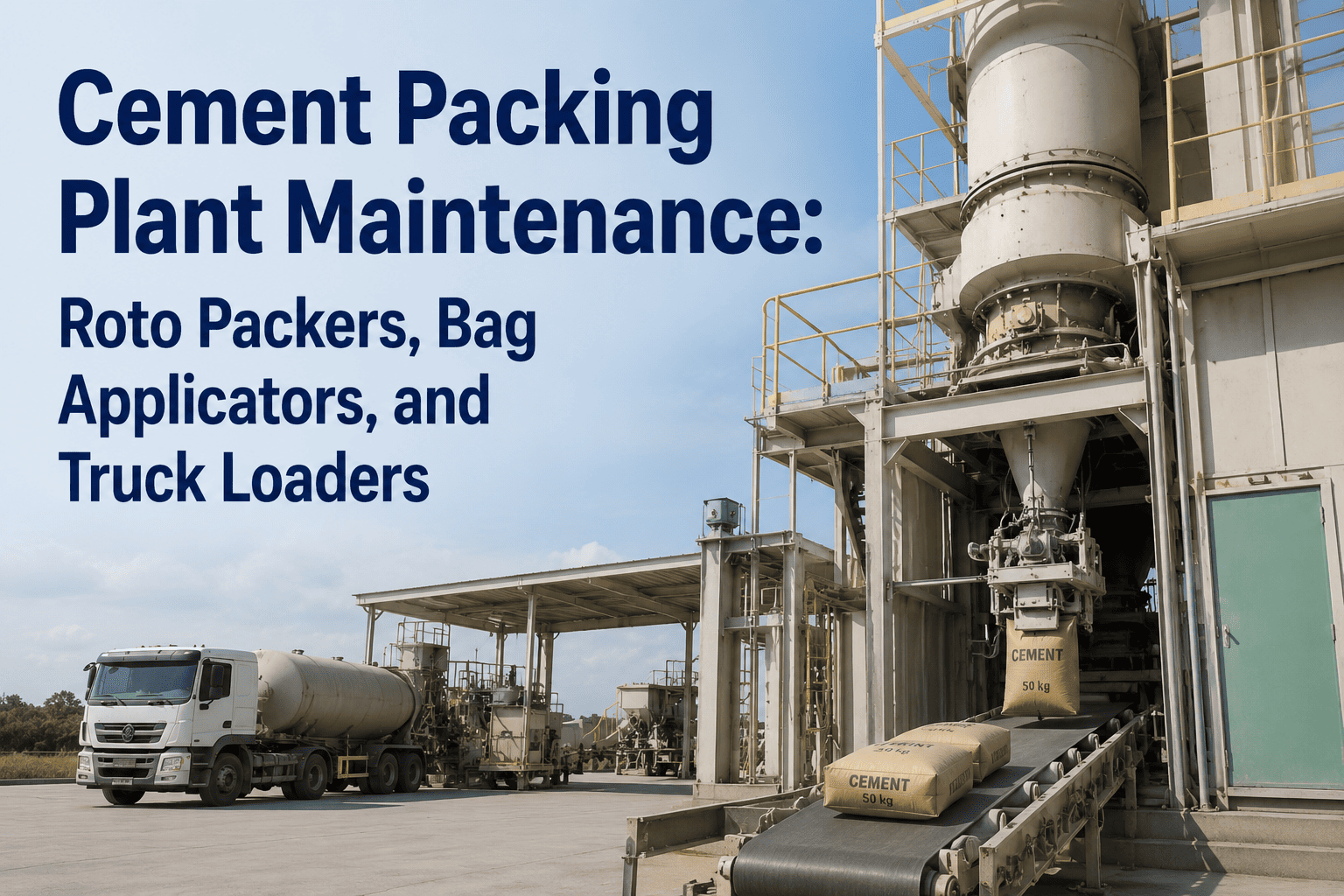
The cement packing plant is where the entire operation either makes its dispatch numbers or quietly bleeds them away. A roto packer spout that has drifted 200 grams over weight loses a bag's worth of cement on every 24th fill. A bag applicator shooting at 96 percent instead of its 99.7 percent design rate stops the line 100 times a shift for misfeeds. A truck loader spout with a torn dust skirt fails the emission test at the next environmental audit. A ship loader telescopic chute sleeve worn past its limit costs the company demurrage at $8,000 to $15,000 per day. These are not separate problems — they are one connected chain from silo to vehicle, and the plants that hit their dispatch tonnage every shift run that entire chain through one maintenance system. You can see what that looks like inside the OxMaint platform.
Cement Packing Plant Maintenance — Roto Packers, Bag Applicators & Loaders
Roto packer PM records, bag applicator shot-rate tracking, truck/ship/wagon loader audits, and CMMS-tracked maintenance across the entire dispatch chain.
The Dispatch Chain — Five Stations Where Tonnage Either Moves or Stops
Most plants treat packing as one big black box. In practice it is five distinct stations, each with its own wear pattern, failure modes, and PM schedule. A delay at any one of them throttles every station downstream of it. The chain below is how disciplined packing plant maintenance teams actually structure their work — station by station, with CMMS records that connect what happened at station 2 to what failed at station 4.
Silo Discharge & Feed Control
Vibrating screen removes oversize and tramp metal. Screw gate and impeller feeder regulate flow into the intermediate bin. Worn impeller blades or stuck flap valves throttle every roto packer downstream simultaneously.
Roto Packer (RV / RS)
8 to 16 rotating spouts, each weighing and filling a bag in 0.6 to 1.0 seconds. Spout wear, weighing cell drift, and turbine impeller degradation each silently shift accuracy. Speed range 0.45–4.5 rpm under frequency control.
Automatic Bag Applicator
Robotic arm pulls empty valve bags from the magazine and applies them to the packer spout. Target shot rate 99.7 percent. Below 97 percent the manual reject rate compounds quickly and the entire line throughput collapses by 8 to 15 percent.
Conveyor & Reject Station
Underweight, overweight, and torn bags rejected at the rejector. Conveyor belt tracking, brush cleaners, and inkjet date-coder all wear independently. Reject rate above 1.5 percent points to upstream packer issues, not conveyor problems.
Loader (Truck / Ship / Wagon)
Bagged loaders palletise and load up to 3,000 bags/hr per loader. Bulk loaders run telescopic spouts with dust skirts and bag filters. Dust emission above 20 mg/m³ is a regulator-visible failure. Spout sleeve replacement is a planned 3-minute task on modern systems.
The Four Loader Types — What Each One Maintains and Why
"Loader" is not one piece of equipment. Truck loaders, ship loaders, wagon loaders, and bag pallet loaders each carry different wear patterns, regulatory exposures, and PM requirements. Plants that lump them all under one PM schedule miss the specific failure modes that take each one offline. The breakdown below is how each loader differs at the maintenance level.
Bulk Truck Loader
Telescopic dust-controlled spout with skirt seal against the tanker hatch. Loading rates 150–750 m³/hr. Bag filter on the spout exhausts displaced air. Failure modes: skirt seal wear, hoist cable fray, fill-level sensor drift, filter cartridge blinding.
Ship Loader (Bulk Cement)
Large boom or telescopic chute reaching to vessel hold. Loading rates 1,600–2,000 MTPH. Boom slewing motor, luffing cylinder, weighing system, dust suppression, and chute liner all critical. Demurrage exposure makes uptime non-negotiable.
Railway Wagon Loader
Telescopic loading hood covering full wagon profile during clinker or cement load. On-track scale weighing. Continuous-load configurations work without stopping the train. Failure modes: hood actuator wear, on-track scale drift, hood seal degradation.
Bag Pallet Loader (Autopac)
Automated palletiser + truck/wagon loader. 2,400–3,000 bags/hr. Robot arm handles palletising; conveyor delivers stacks to vehicle. Failure modes: gripper wear, pallet stacker alignment, conveyor tracking, palletising program faults.
Roto Packer Anatomy — Eight Components That Decide Bag Accuracy & Speed
A roto packer is not one machine. It is eight interlinked subsystems rotating together, and bag accuracy plus filling speed depends on every one of them staying within its wear envelope. The component map below is what disciplined packing engineers walk through every shift inspection.
One Connected System for Every Packer Spout, Every Bag Reject, Every Loader Shift
OxMaint registers each filling spout, load cell, bag applicator, conveyor section, and loader as an individual asset — with its own PM schedule, calibration record, and lifecycle forecast.
Live Packing Plant Status — What CMMS-Connected Dispatch Looks Like
The status feed below is what a CMMS-led packing program shows mid-shift. Every reading sits against a named station or component, every threshold breach produces a work order, and the dispatch supervisor sees the entire chain from silo to truck on one screen — instead of chasing it across the lab's weight log, the loader operator's shift book, and the maintenance team's email.
The Cost Anatomy — Why Packing Plant Failures Hide in Plain Sight
The published cost of a packing line stoppage is rarely the real cost. What does not appear on the invoice is the overweight giveaway from drifted load cells, the customer claims from bag bursts, the demurrage on cement vessels waiting to load, and the regulator fines from dust emission failures. The cost map below is where the money actually leaks across a typical 1.2 Mt dispatch year.
Drifted load cells and worn spouts overfilling by 100–300 g per bag. Across millions of bags per year this is the single largest invisible cost.
Bag applicator misfires, conveyor jams, rejector misalignments. Each minute of stoppage at 80 bags/min loses 80 sale units.
Burst bags, weak seals, missing date codes, contaminated product. Recurring claims damage relationships beyond the unit cost.
Ships and trucks waiting because the loader is down or the dust filter blinded. Cement vessel demurrage runs $8K to $15K per day.
Dust emission failures during audits, operator exposure compliance, fines from environmental regulator inspections.
The Six PM Routines That Hold Packing Plants Together
Cement plants that hold packing capacity at 92 percent or better of design through the full year run these six routines through their CMMS — each tied to operating hours, bag count, or shift schedule rather than left to operator memory. The discipline is not in the complexity of each task but in the consistency of running all six together.
Spout Seal & Cone Inspection
Visual check of every filling spout cone for product residue, valve seal integrity, and any visible wear. Findings logged against the specific spout number, not the parent packer.
Load Cell Calibration
Test weights run through each load cell against a master reference. Drift above 50 g triggers recalibration work order. Calibration certificate logged to the asset record.
Bag Applicator Shot Rate Audit
Shot rate tracked per shift. Drop below 98 percent triggers gripper, suction cup, and magazine alignment audit. Trend rolling-week to catch slow decay.
Turbine Impeller & Roto-Lock
Impeller blade thickness measured. Roto-Lock dosing valve seal verified. Both directly affect bag weight accuracy and ambient dust around the packer.
Dust Filter Cartridge & Bearing Lube
Filter cartridges replaced on schedule. Loader bearings lubricated every 500 hours. Differential pressure post-replacement verified against design.
Slewing Ring & Boom Cylinder Audit
Ship and wagon loader slewing rings inspected for play. Hydraulic cylinders pressure-tested. Telescopic cable wear mapped — sleeve replacement is a 3-minute task on modern systems if scheduled.
What 12 Months of Tracked Packing Plant Programs Actually Return
The results below come from cement plants that moved their packing and loader maintenance records out of disconnected paper systems and into a connected CMMS. These are documented outcomes from the first full year, and they compound from there as historical data deepens the wear projections.
Weight giveaway eliminated by disciplined load cell calibration and worn-spout replacement programs.
Bag applicator shot rate held at design through scheduled gripper and magazine maintenance.
Compliant dust emission maintained on all bulk loaders through scheduled cartridge replacement on the design interval.
Annual packing line capacity utilisation held above 92 percent versus 78–84 percent on reactive programs.
Frequently Asked Questions
Every Bag Reject, Every Spout Drift, Every Loader Stoppage Should Live in One System
The cement plants that hit their dispatch tonnage every shift all run their packing chain — silo to vehicle — through one connected maintenance system. Not five spreadsheets, not a logbook nobody opens.