Cement plants managing spare parts inventory without a criticality matrix face a $400K+ annual problem — critical kiln bearings and refractory bricks stockout while low-value consumables fill 40% of storeroom space. A properly structured spare parts criticality matrix cuts emergency procurement by 65%, reduces total inventory value by 20-30%, and ensures zero stockouts on production-critical components. OxMaint's CMMS automates criticality-based min/max levels, vendor-managed inventory routing, and predictive reorder alerts so your high-criticality spares are always in stock when kiln shutdowns demand them. Start your free trial and digitize your spare parts classification in under 60 minutes.
Cement Plant Inventory · Free Template · 2025
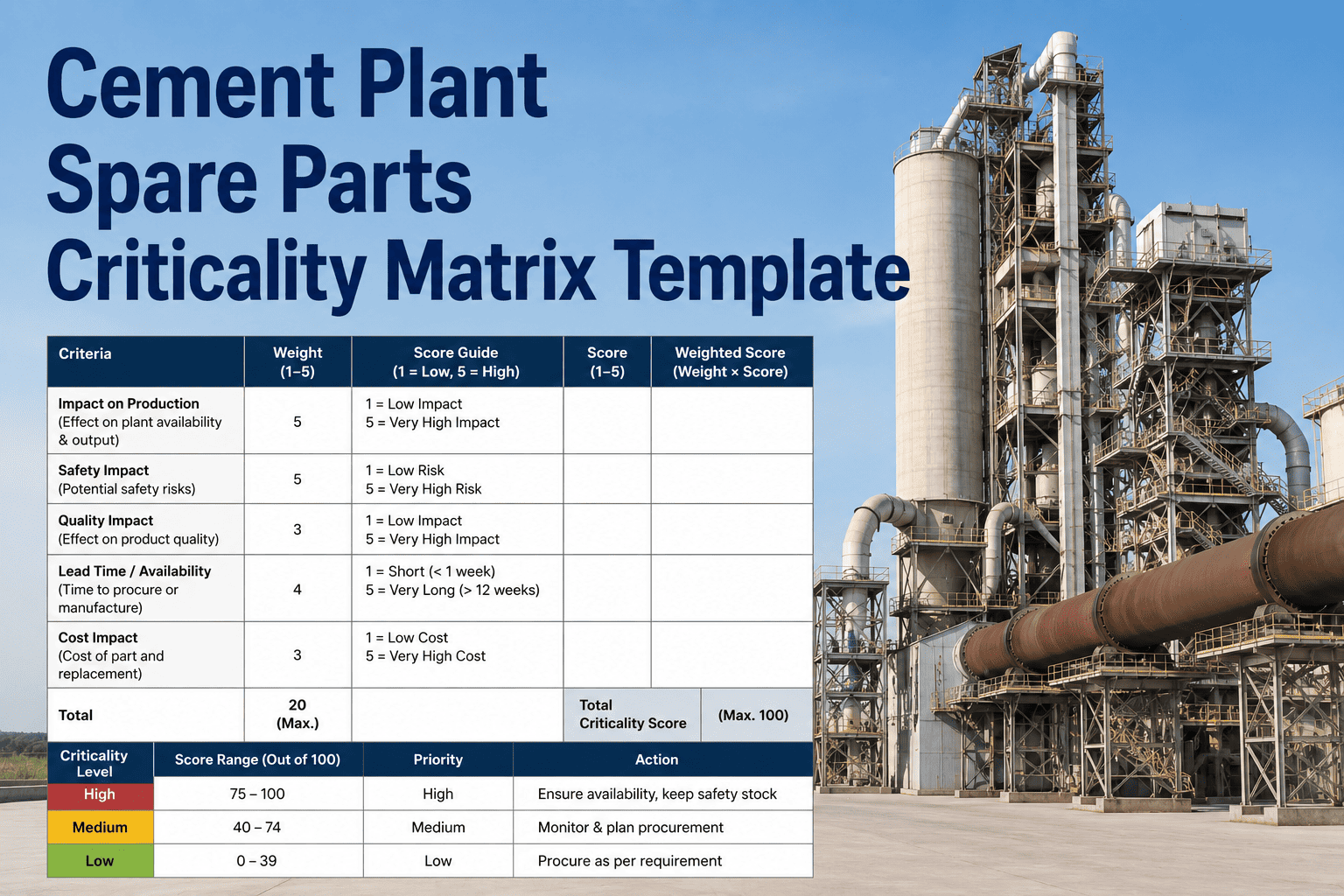
Cement Plant Spare Parts Criticality Matrix Template: Stop Guessing, Start Classifying
Your storeroom carries $3M-$8M in spare parts. Without a criticality matrix, you are overstocking low-impact items and gambling on kiln uptime with critical components. This template gives you the classification framework that separates production-critical spares from routine consumables — and a clear path to automate it inside a CMMS.
65%
Reduction in emergency procurement with criticality-based stock
20-30%
Decrease in total inventory carrying costs
Zero
Stockouts on A-class critical spares
The Inventory Problem
Why Cement Plants Need Spare Parts Criticality Classification
Without a structured criticality matrix, storeroom decisions default to gut feeling and historical ordering patterns. The result is predictable: low-value consumables treated like critical assets, high-value critical spares managed with inadequate safety stock, and emergency procurement becoming the norm instead of the exception.
Stockouts on Critical Spares
Kiln main bearing fails. Lead time is 90 days. Part not in stock. Plant runs at 60% capacity for three months. Lost production value exceeds $2M.
Impact: Production Loss
Overstocking Low-Criticality Items
Storeroom carries 18 months of consumable fasteners, gaskets, and generic bearings because they are cheap to buy in bulk. Capital tied up in non-critical inventory.
Impact: Cash Flow Drain
Emergency Procurement Costs
Crusher liner wears through unexpectedly. Expedited shipping and rush manufacturing add 300% premium. Part that should cost $12K becomes $48K emergency buy.
Impact: Budget Overruns
Obsolete Inventory Writeoffs
Equipment upgrades make 120 SKUs obsolete. Storeroom writes off $180K in stranded inventory because no systematic review process identified slow-moving non-critical items.
Impact: Inventory Loss
Free Downloadable Template
What's Inside the Spare Parts Criticality Matrix Template
This Excel-based template provides the complete framework cement plants need to classify every spare part by criticality level, failure impact, lead time, and recommended stocking strategy. Use it for manual classification or as a migration guide when implementing CMMS-automated criticality management.
Part Number & Description
Equipment Criticality (A/B/C)
Failure Impact Score (1-5)
Supplier Lead Time (Days)
Annual Consumption Rate
Unit Cost & Extended Value
Criticality Classification
Stocking Strategy (VMI/Min-Max/JIT)
Recommended Min/Max Levels
Current Stock Status
Critical A-Class
Refractory bricks, kiln bearings, crusher liners, gearbox components, high-voltage motors
Important B-Class
Conveyor belts, hydraulic pumps, PLC modules, moderate-wear components, instrumentation
Routine C-Class
Fasteners, gaskets, filters, lubricants, general consumables, office supplies
Classification Framework
The ABC-XYZ Criticality Matrix: How Cement Plants Classify Spare Parts
Effective criticality classification combines two dimensions: equipment criticality (ABC) based on failure impact and consumption pattern (XYZ) based on usage predictability. This creates a 9-cell matrix that assigns the right stocking strategy to every spare part category.
A-Critical Equipment
AX
Strategy: High Min-Max Stock
Example: Refractory bricks, kiln roller bearings
AY
Strategy: Moderate Stock + VMI
Example: Crusher mantles, gearbox seals
AZ
Strategy: Single Unit + Expedited Supplier Agreement
Example: Main drive motors, specialty gears
B-Important Equipment
BX
Strategy: Lean Stock Levels
Example: Conveyor idlers, pump impellers
BY
Strategy: Min Stock Only
Example: PLC modules, sensor replacements
BZ
Strategy: Order on Demand
Example: Specialty fasteners, low-use actuators
C-Routine Equipment
CX
Strategy: Bulk Order Quarterly
Example: Filters, lubricants, cleaning supplies
CY
Strategy: Order as Needed
Example: Generic gaskets, low-use consumables
CZ
Strategy: No Stock - Direct Purchase
Example: One-time project materials, trial supplies
Criticality Scoring
How to Score Spare Parts Criticality: The 5-Factor Method
Criticality is not subjective opinion. It is a calculated score based on quantifiable factors that determine the true business impact of a spare part stockout. The template includes a weighted scoring model that converts these five factors into an objective criticality rating.
1
Production Impact
Does failure stop the kiln, reduce capacity, or cause minor inconvenience? Score 5 for full production stop, 1 for negligible impact.
Weight: 35%
2
Lead Time
How long to procure if out of stock? Score 5 for 90+ days, 1 for same-day availability from local supplier.
Weight: 25%
3
Supplier Availability
Single source or multiple vendors? Score 5 for OEM-only parts, 1 for commodity items with 10+ suppliers.
Weight: 20%
4
Safety Risk
Does failure create personnel hazard? Score 5 for high-temperature pressure vessel components, 1 for non-safety items.
Weight: 15%
5
Financial Cost
Emergency procurement premium plus downtime losses. Score 5 for $100K+ total impact, 1 for under $5K.
Weight: 5%
Scoring Example: Rotary Kiln Main Bearing
Production Impact
5/5 (Full kiln shutdown)
× 35% = 1.75
Lead Time
5/5 (120+ days custom manufacturing)
× 25% = 1.25
Supplier Availability
5/5 (Single OEM source)
× 20% = 1.00
Safety Risk
4/5 (High load rotating component)
× 15% = 0.60
Financial Cost
5/5 ($500K+ emergency buy + downtime)
× 5% = 0.25
Total Criticality Score
4.85 / 5.00
Classification: A-Critical
CMMS Automation
From Static Spreadsheet to Dynamic CMMS: Automate Your Criticality Matrix
Excel matrices capture classification at a single point in time. CMMS-based criticality management updates min/max levels automatically as consumption patterns change, triggers reorder alerts based on lead time and current stock, and routes high-criticality parts to vendor-managed inventory programs without manual intervention.
Criticality Assignment
Manual one-time classification
Min/Max Updates
Quarterly spreadsheet reviews
Reorder Alerts
Storeroom clerk visual inspection
Consumption Tracking
Separate inventory log
VMI Routing
Manual vendor notification
Criticality Assignment
Automated scoring from work order data
Min/Max Updates
AI-adjusted based on consumption trends
Reorder Alerts
Auto-generated at lead time threshold
Consumption Tracking
Linked to work orders in real time
VMI Routing
Auto-notification to vendor portal
Free Trial · No Credit Card · Spare Parts Module Included
Stop Managing Critical Spares on Spreadsheets. Start Automating Stock Levels That Prevent Downtime.
OxMaint transforms your spare parts criticality matrix from a static classification document into a dynamic inventory intelligence system. See how cement plants use CMMS-automated min/max levels to eliminate stockouts on A-class spares while cutting total inventory value by 25%.
Real-World Classification
Cement Plant Spare Parts by Criticality: Examples from Every Category
A-Critical Spares
Production-Stopping Components
Rotary kiln main bearings and thrust rollers
Refractory bricks (burning zone, transition zone)
Crusher mantles and concaves (primary, secondary)
Kiln gearbox pinion and bull gear components
High-voltage motors (kiln drive, raw mill, cement mill)
Preheater cyclone castable refractories
Stock Strategy: Full safety stock, VMI agreements, expedited supplier contracts
B-Important Spares
Capacity-Reducing Components
Conveyor belt sections and splicing materials
Hydraulic pumps and cylinders
PLC modules and control system components
Dust collector bags and filter media
Elevator buckets and chains
Wear liners for chutes and hoppers
Stock Strategy: Moderate min/max levels, quarterly reviews, regional warehouse backup
C-Routine Spares
Consumables and General Maintenance
Fasteners (bolts, nuts, washers)
Gaskets and seals (generic sizes)
Filters (air, oil, hydraulic)
Lubricants and greases
Welding consumables and cutting discs
Safety equipment and PPE
Stock Strategy: Bulk quarterly orders, local supplier agreements, no emergency stock
OxMaint Platform
CMMS Built for Cement Plant Spare Parts Intelligence
OxMaint is not generic inventory software repurposed for industrial maintenance. Every feature is designed around the realities of cement plant storeroom management: multi-site stock visibility, criticality-based reorder automation, and vendor-managed inventory integration for your highest-impact spares.
Automated Criticality Scoring
AI analyzes work order history, downtime costs, and supplier lead times to assign objective criticality scores. No manual spreadsheet maintenance — the system updates classifications as usage patterns evolve.
Predictive Min/Max Levels
Machine learning forecasts consumption 60-90 days ahead based on seasonal patterns, planned outages, and historical usage. A-class spares get protective stock buffers, C-class items get lean just-in-time levels.
Lead Time Alerts
Reorder alerts trigger when current stock drops below the quantity needed to cover supplier lead time plus safety margin. Critical 90-day lead time parts alert at 100+ days remaining stock.
VMI Portal Integration
High-criticality parts auto-route to vendor-managed inventory suppliers. When stock hits reorder point, the system notifies the vendor directly — no manual PO creation for mission-critical items.
Multi-Site Stock Visibility
Real-time inventory across all plant locations. Before emergency procurement, the system checks sister plants for available stock and generates internal transfer requests when parts exist elsewhere in the network.
Work Order Consumption Tracking
Every spare part issue links to the work order that consumed it. Actual usage data feeds back into criticality scoring and consumption forecasting — the loop closes automatically.
Frequently Asked Questions
Spare Parts Criticality Matrix Questions Cement Plants Ask Most
What is the difference between ABC classification and criticality scoring?
ABC classification ranks parts by annual consumption value (Pareto analysis). Criticality scoring evaluates failure impact, lead time, and supplier availability. A low-cost bearing can be A-critical if it stops the kiln and has 90-day lead time. High-value consumables can be C-routine if readily available. Use both methods together for complete classification.
See how OxMaint automates both classification methods.
How often should cement plants update spare parts criticality classifications?
Manual Excel matrices require quarterly reviews to stay current. CMMS-based systems update continuously as work order data accumulates. A part that was C-routine becomes B-important when consumption spikes or a supplier goes out of business. Automated systems detect these changes without scheduled reviews.
Can OxMaint import existing spare parts criticality data from Excel?
Yes. OxMaint accepts CSV or Excel imports with part numbers, current classifications, and historical stock levels. The system validates your existing criticality assignments against actual work order consumption data and flags discrepancies where manual classification may not match real-world usage patterns.
Discuss your data migration in a demo call.
What is vendor-managed inventory and which cement plant spares qualify?
VMI transfers stocking responsibility to the supplier. The vendor monitors your inventory levels and automatically replenishes stock before you run out. Best for A-critical spares with predictable consumption like refractory bricks, crusher wear parts, and high-use bearings where stockouts are unacceptable.
How does criticality-based stocking reduce total inventory value?
Plants carrying equal safety stock across all SKUs overinvest in low-criticality items. Criticality matrices cut C-class stock to minimum levels or zero stock with rapid supplier agreements, freeing capital to increase A-class safety stock. Total SKU count may stay constant while inventory value drops 20-30% and stockout risk plummets.
Cement Plant CMMS · Spare Parts Intelligence · Free Trial
Your Storeroom Carries Millions in Spare Parts. Classify Them Like the Assets They Are.
Download the free Excel template for manual classification — or skip straight to CMMS-automated criticality management with OxMaint. See how cement plants eliminate A-class stockouts while cutting total inventory carrying costs by 25% through intelligent, data-driven spare parts classification.