Cement plants operating under NESHAP Subpart LLL face EPA enforcement actions when emissions monitoring records contain gaps, uncalibrated CEMS data, or missing exceedance documentation — violations that trigger penalties starting at $55,808 per day. A structured NESHAP emissions log ensures every PM, SO2, NOx, and mercury reading is captured, every calibration event is documented, and every exceedance triggers the required corrective action protocol before EPA auditors request your records. OxMaint's CMMS transforms spreadsheet emissions tracking into automated CEMS data logging with real-time exceedance alerts, calibration reminders, and audit-ready compliance reports that prove continuous monitoring compliance to EPA inspectors. Start your free trial and digitize your NESHAP emissions logging in under 60 minutes.
Cement Plant Compliance · Free Template · 2025
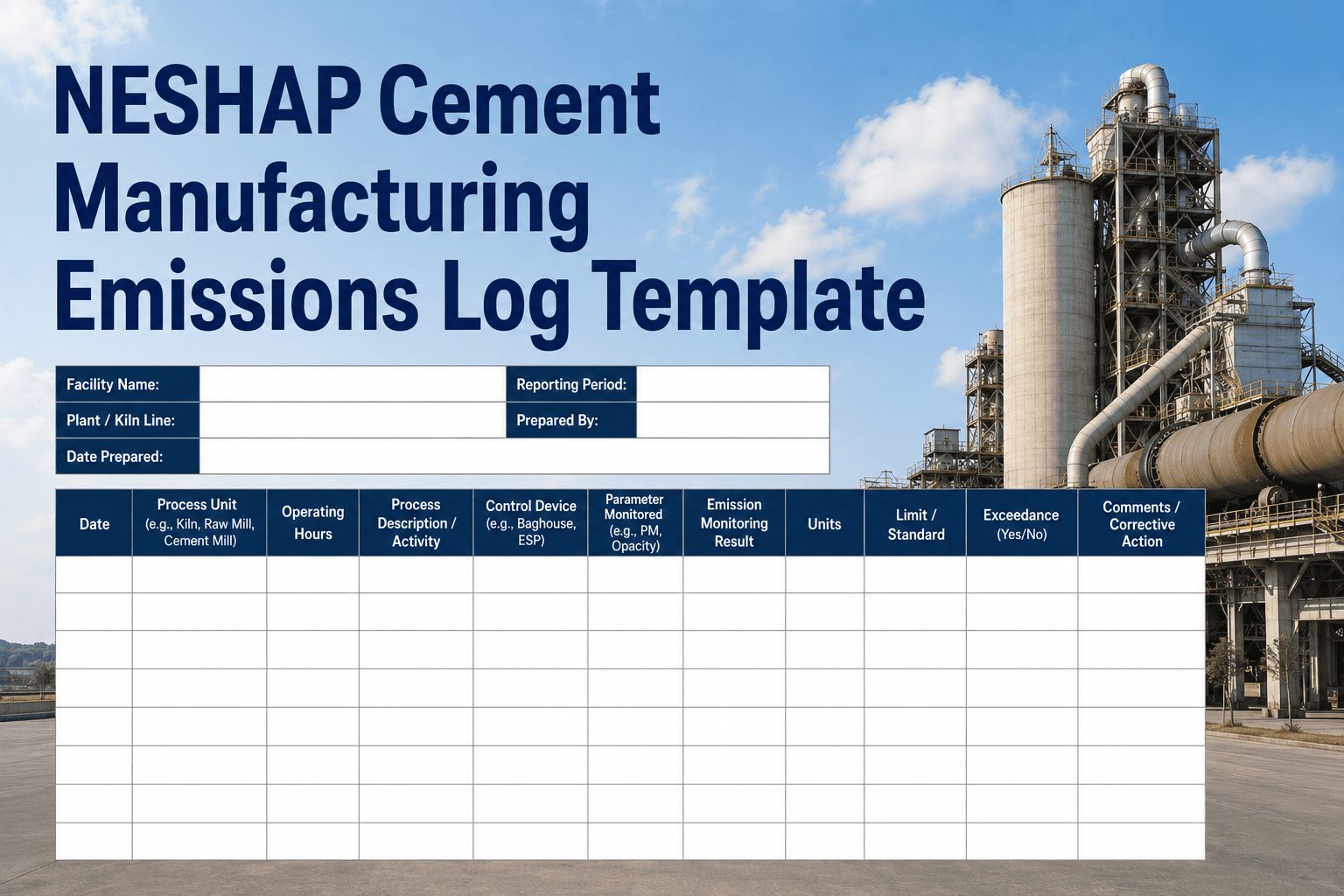
NESHAP Cement Manufacturing Emissions Log Template: Track Every Reading, Avoid Every Penalty
EPA's NESHAP Subpart LLL requires continuous emissions monitoring with documented readings, calibration verification, and exceedance response protocols. Missing data, uncalibrated CEMS, or delayed corrective actions create civil penalty exposure exceeding $50K per violation per day. This template gives you the logging framework that satisfies EPA recordkeeping requirements — and a clear path to automate it inside a compliance-driven CMMS.
$55,808
EPA civil penalty per day per violation
5 Years
Required record retention period for NESHAP
24/7
Continuous emissions monitoring requirement
Regulatory Framework
What NESHAP Subpart LLL Requires for Cement Plant Emissions
NESHAP Subpart LLL establishes National Emission Standards for Hazardous Air Pollutants for Portland Cement Manufacturing. The regulation mandates continuous emissions monitoring systems for particulate matter, sulfur dioxide, nitrogen oxides, mercury, and total hydrocarbon emissions with strict documentation, calibration, and exceedance response requirements that EPA audits during facility inspections.
Particulate Matter
Kiln Limit: 0.07 lb/ton clinker (30-day rolling avg)
CEMS Required: Continuous opacity or PM monitor
Sulfur Dioxide
Kiln Limit: 400 ppm (30-day rolling avg)
CEMS Required: Continuous SO2 analyzer
Nitrogen Oxides
Kiln Limit: Varies by process (SNCR/SCR compliance)
CEMS Required: Continuous NOx analyzer
Mercury Emissions
Kiln Limit: 21 lb/million tons clinker (annual avg)
CEMS or Performance Testing: Quarterly sampling
Free Downloadable Template
What's Inside the NESHAP Emissions Log Template
This Excel-based template includes pre-structured columns for every data point EPA expects to see in NESHAP Subpart LLL compliance records. Use it for manual CEMS data logging or as a migration guide when implementing CMMS-automated emissions tracking with real-time exceedance alerts and automatic calibration scheduling.
Daily Monitoring
CEMS Data Logging
Date and time stamp (hourly intervals)
Pollutant concentration readings (PM, SO2, NOx, THC)
CEMS operational status and downtime log
Kiln production rate (tons clinker per hour)
Emission rate calculation (lb/ton clinker)
30-day rolling average tracker
Quality Assurance
Calibration Documentation
Daily zero and span calibration checks
Quarterly cylinder gas audits
Annual relative accuracy test audit (RATA)
Calibration drift documentation
Out-of-specification corrective actions
Technician sign-off and certification
Exceedance Response
Limit Violation Tracking
Exceedance date, time, and duration
Pollutant type and measured concentration
Root cause analysis findings
Immediate corrective actions taken
Long-term prevention measures implemented
EPA notification timeline compliance
Performance Testing
Mercury and HAP Sampling
Test date and EPA Method reference
Stack testing company and technician
Mercury concentration results (μg/dscm)
Emission rate calculation (lb/million tons clinker)
Quality assurance documentation
Compliance determination and certification
CEMS Requirements
Continuous Emissions Monitoring System Documentation Standards
EPA requires cement plants to install, calibrate, maintain, and operate CEMS according to Performance Specification 1 and 2 in 40 CFR Part 60, Appendix B. Every aspect of CEMS operation must be documented with audit-quality records that prove continuous monitoring compliance, calibration accuracy, and data validity throughout the five-year retention period.
1
Daily Zero and Span Calibration
CEMS calibrated daily using certified reference gases. Zero check confirms baseline accuracy. Span check verifies high-range measurement accuracy. Both readings must fall within ±2.5% of reference value.
Frequency: Every 24 hours
2
Quarterly Cylinder Gas Audit
Independent audit gas cylinder from EPA Protocol 1 supplier introduced to CEMS. Measured concentration compared to certified value. Audit passes if difference is within ±10% or 5 ppm, whichever is greater.
Frequency: Once per calendar quarter
3
Annual RATA Performance Test
Third-party stack testing company conducts Relative Accuracy Test Audit using EPA Reference Methods. Nine test runs compare CEMS readings to laboratory analysis. Relative accuracy must be ≤10% to pass.
Frequency: Annually or after major CEMS repair
4
Data Validation and QA/QC
All CEMS data reviewed for missing intervals, calibration drift, and out-of-range values. Data substitution procedures applied for valid equipment downtime. Invalid data flagged and excluded from compliance calculations per 40 CFR Part 60.
Frequency: Continuous review with monthly reporting
Exceedance Protocol
How to Document and Respond to NESHAP Emission Limit Violations
Exceedances are not automatic violations if documented and addressed correctly. EPA distinguishes between exceedances (readings above limits) and violations (failure to take required corrective action or report properly). The key to avoiding penalties is immediate documentation, root cause analysis, corrective action implementation, and timely EPA notification when required.
Single Hourly Exceedance
One reading above limit, 30-day avg still compliant
Log reading, identify cause, document operational adjustment
Not required if 30-day avg remains compliant
Immediate operational correction
30-Day Rolling Average Exceedance
Compliance limit exceeded on rolling average basis
Full root cause analysis, corrective action plan, management review
Report in semi-annual compliance report
Return to compliance within 30 days
Repeated Exceedances
Three or more violations in any 12-month period
Comprehensive facility review, process modifications documented, long-term prevention plan
EPA Region notification within 48 hours
Submit prevention plan within 45 days
CEMS Downtime Exceeding 5%
Monitor unavailable more than 5% of operating hours in quarter
Document all downtime causes, repair logs, vendor service records
Report in quarterly CEMS performance report
Minimize downtime, use backup monitoring if available
CMMS Automation
From Manual Spreadsheet Logs to Automated NESHAP Compliance Tracking
Excel-based emissions logging creates compliance risk through manual data entry errors, missed calibration schedules, and delayed exceedance response. CMMS-integrated emissions tracking automates CEMS data import, triggers calibration reminders before due dates, generates real-time exceedance alerts, and produces audit-ready EPA reports covering the entire five-year retention period with zero manual assembly time.
⚠️
Data entry errors in hourly readings
⚠️
Missed daily calibration schedules
⚠️
Exceedances detected hours or days late
⚠️
30-day rolling averages calculated manually
⚠️
Quarterly reports assembled from scattered files
⚠️
Five-year record retention requires file cabinets
✓
Direct CEMS data integration eliminates manual entry
✓
Automatic calibration work orders before due date
✓
Real-time alerts when readings exceed thresholds
✓
Automatic rolling average calculation and trending
✓
One-click EPA report generation for any date range
✓
Cloud storage with searchable five-year archive
Free Trial · No Credit Card · NESHAP Compliance Module
Stop Risking $55K+ Daily Penalties on Manual Emissions Logs. Automate NESHAP Compliance Today.
OxMaint transforms NESHAP Subpart LLL compliance from spreadsheet tracking into automated CEMS data integration with real-time exceedance alerts, automatic calibration scheduling, and audit-ready EPA reports that prove continuous monitoring compliance across the entire five-year record retention period.
OxMaint Platform
CMMS Built for Cement Plant Environmental Compliance
OxMaint is not generic environmental software adapted for manufacturing. Every feature is designed around cement plant NESHAP requirements: CEMS data integration, automatic rolling average calculations, exceedance alert workflows, calibration management, and EPA reporting that satisfies auditors without manual data assembly.
CEMS Data Integration
Direct connection to continuous emissions monitoring systems imports PM, SO2, NOx, and opacity readings automatically. No manual data entry, no transcription errors, no missing hourly intervals.
Real-Time Exceedance Alerts
Threshold monitoring triggers instant email and SMS alerts when pollutant readings approach or exceed NESHAP limits. Environmental team notified immediately, not hours later during manual spreadsheet review.
Automatic Rolling Averages
System calculates 30-day rolling averages continuously for all regulated pollutants. Compliance status visible in real-time dashboard with trend charts showing proximity to regulatory limits.
Calibration Management
Automated work orders for daily zero/span checks, quarterly cylinder gas audits, and annual RATA testing. Calendar integration ensures no calibration deadline is missed. All QA/QC documentation stored with CEMS records.
Exceedance Workflow Automation
When limits are exceeded, system auto-generates corrective action work order, assigns root cause investigation, tracks resolution to completion, and flags EPA notification requirements based on exceedance type and frequency.
EPA Audit Report Generation
One-click compliance reports for any date range spanning the five-year retention period. Reports include all CEMS data, calibration records, exceedance documentation, and corrective actions in EPA-standard format ready for inspection.
Frequently Asked Questions
NESHAP Cement Manufacturing Compliance Questions Plant Managers Ask Most
What triggers an EPA NESHAP enforcement action at a cement plant?
EPA enforcement actions typically result from three scenarios: repeated exceedances of emission limits without adequate corrective action, failure to maintain and calibrate CEMS according to Performance Specifications, or incomplete recordkeeping that prevents compliance determination. Civil penalties start at $55,808 per day per violation.
Prevent enforcement exposure with automated NESHAP compliance tracking.
How long must cement plants retain NESHAP emissions records?
EPA requires five years of record retention for all NESHAP Subpart LLL documentation including CEMS data, calibration records, performance test results, exceedance logs, and corrective action documentation. Records must be available for EPA inspection within reasonable timeframe, typically 24-48 hours of request.
Can CMMS digital emissions records satisfy EPA documentation requirements?
Yes. EPA accepts electronic records if they are tamper-proof, contain required data elements, and are retained for the full five-year period. Digital systems must ensure data integrity through audit trails, backup systems, and access controls. Cloud-based CMMS platforms typically exceed EPA electronic recordkeeping standards.
Review EPA-compliant digital recordkeeping in a demo.
What is the difference between an exceedance and a violation under NESHAP?
An exceedance occurs when measured emissions exceed regulatory limits. A violation occurs when the facility fails to take required corrective action, notify EPA as required, or maintain compliant operations. Single exceedances with proper documentation and response typically do not result in enforcement. Repeated exceedances or inadequate response trigger violations and penalties.
Can OxMaint integrate with existing CEMS hardware and data acquisition systems?
Yes. OxMaint integrates with all major CEMS manufacturers and data acquisition platforms through standard protocols including OPC, Modbus, and direct database connections. Historical CEMS data can be imported to create a complete compliance record covering periods before CMMS implementation, eliminating gaps in the five-year retention archive.
Cement Plant CMMS · NESHAP Compliance · Free Trial
Your EPA Operating Permit Depends on Documented Emissions Compliance. Make Your Records Audit-Proof.
Download the free template for manual emissions logging — or skip straight to CMMS-automated NESHAP compliance with OxMaint. See how cement plants eliminate EPA enforcement risk while reducing environmental staff workload through integrated CEMS data tracking, automatic exceedance alerts, and one-click audit report generation.