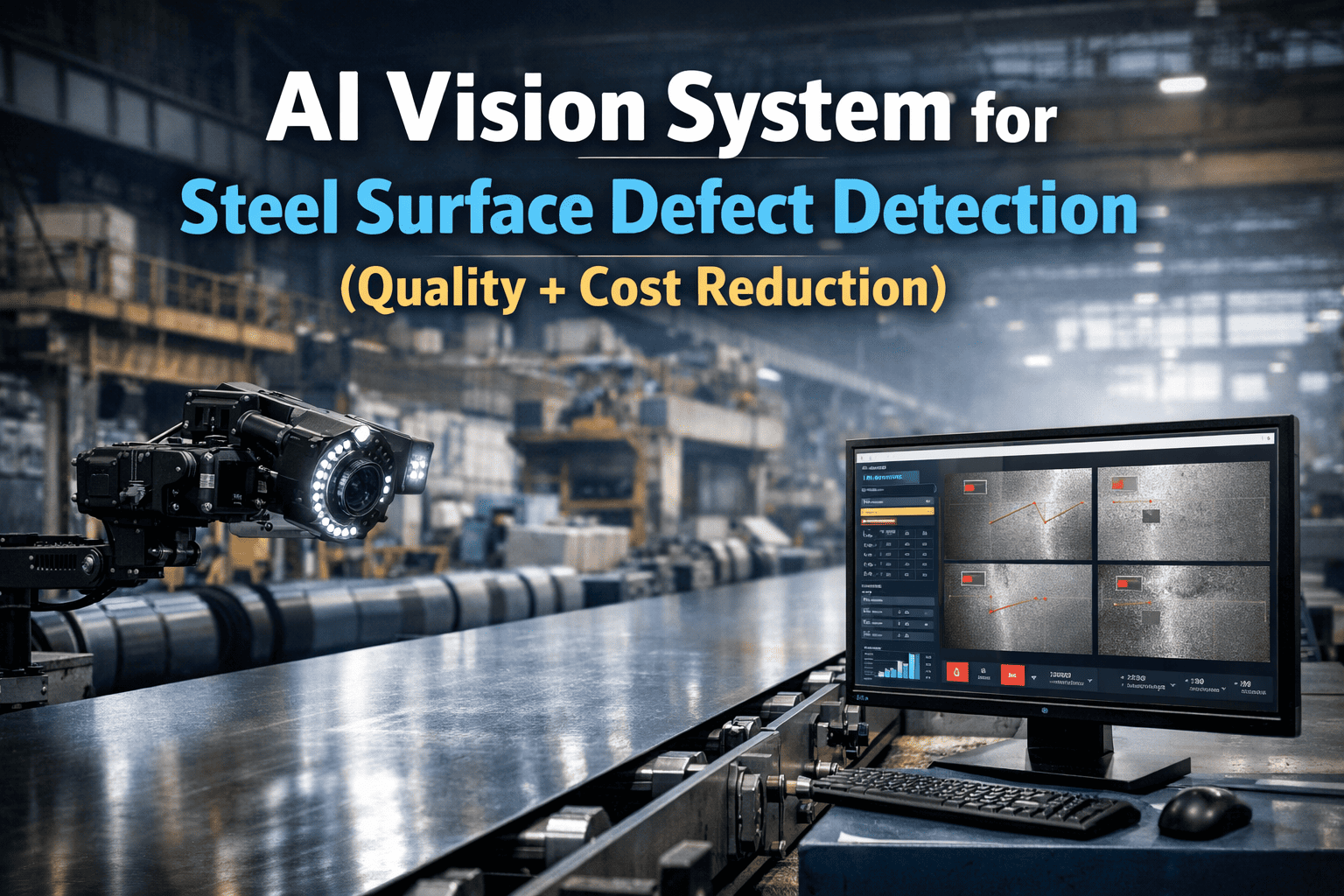
A human inspector stationed at a hot strip mill exit catches between 45% and 65% of surface defects at line speed. The defects he misses — the 0.1mm inclusion that causes paint adhesion failure at an automotive stamping plant, the periodic roll mark appearing every 3.2 metres from a worn bearing, the subtle crazing that downgrades a prime coil to structural grade — don't disappear. They ship. At $5,000–$25,000 per quality claim and with automotive customers increasingly requiring IATF 16949-level defect traceability, the cost of that 35–55% miss rate is not abstract. OxMaint's AI Vision Inspection module connects deep learning defect detection to your CMMS — so every identified defect triggers the right quality hold, and every defect pattern triggers the right maintenance work order on the upstream equipment causing it.
Steel Industry · AI Vision · Quality + Cost Reduction · 2026
AI Vision System for Steel Surface Defect Detection — Quality & Cost Reduction
How deep learning vision systems replace manual inspection in steel strip mills — detecting 95–99.5% of surface defects at full production speed, closing the loop from defect detection to root cause maintenance, and protecting premium contracts with complete inspection traceability.
Human Inspection
Detection rate45–65% at line speed
End-of-shift accuracyDrop of 25–40%
Inspector agreement55–70% on same defect
CoverageSample-based
Speed limit≤5 m/s effective
VS
AI Vision System
Detection rate95–99.5% at any speed
ConsistencyIdentical — shift 1 = shift 3
Classification agreement<1% inter-inspection variance
Coverage100% surface — every coil
Speed limit15+ m/s — no degradation
The Cost of What Manual Inspection Misses
Surface quality defects in flat-rolled steel drive 2–5% of total production to secondary or reject status. On a 2 million tonne per year facility, that means 40,000–100,000 tonnes annually of downgraded material. The financial impact compounds across the quality chain — from in-plant downgrade losses to customer claims, sorting costs at service centres, and the contract risk when a tier-one automotive OEM experiences a quality escape traced back to your mill.
Where Quality Escape Costs Accumulate — From Missed Defect to Contract Risk
Stage 1
In-Plant Downgrade
$50–200/tonne margin loss on prime-to-secondary
Stage 2
Customer Quality Claim
$5,000–$25,000 per incident — transport, reinspection, credit
Stage 3
Field Recall (Automotive)
$1M–$100M+ — automotive recalls traced to steel defects
Stage 4
Lost Contract
Long-term revenue loss — OEM contract rebid typically takes 18+ months to recover
Documented case: flat-rolled steel quality escape — $3.8M in claims, returned material, re-inspection labour, and 18 months to recover tier-one automotive account
Steel Surface Defect Types — What AI Detects and Why Each Matters
Critical
Surface Cracks
Longitudinal, transverse, or corner cracks from solidification, thermal shock, or mechanical stress. Cause structural failure in end use. Automotive and structural customers require zero tolerance.
Root cause: Mold level instability · Thermal cycling · Roll surface damage
Critical
Inclusions
Alumina, silica, or slag particles trapped in the steel matrix. Cause paint adhesion failures, stamping cracking, and fatigue failure. Tundish nozzle erosion is a common root cause.
Root cause: Tundish nozzle erosion · Slag carry-over · Ladle refractory wear
Major
Roll Marks
Periodic impressions from damaged or contaminated roll surfaces — appear at predictable intervals equal to roll circumference. AI detects periodicity pattern and triggers roll inspection before additional coils are processed.
Root cause: Roll surface damage · Bearing wear · Scale pickup on roll
Major
Scale Pits
Rolled-in oxide scale causing surface pitting — result of inadequate descaling pressure or blocked descaler headers. Most visible on cold-rolled exposed automotive grades.
Root cause: Descaler pressure loss · Nozzle blockage · Inadequate slab temperature
Major
Scratches
Linear marks from mechanical contact — guides, deflectors, coiler equipment, or handling. Variable severity: deep scratches are critical for exposed automotive; superficial scratches acceptable for structural.
Root cause: Guide wear · Coiler equipment misalignment · Handling damage
Monitor
Crazing / Orange Peel
Network of fine surface cracks or texture irregularity from thermal fatigue or roll surface condition. Affects surface finish grades — drives prime-to-secondary downgrade rather than reject.
Root cause: Roll thermal fatigue · Cooling pattern non-uniformity
The Closed Loop — From Defect Detection to Root Cause Maintenance
Detection alone is valuable. Prevention is what makes AI vision a strategic investment. When the AI detects a pattern of periodic roll marks, it is not just classifying a coil — it is identifying that a specific work roll has surface damage that will produce the same defect on every subsequent coil until the roll is changed. OxMaint's AI vision integration connects defect pattern data directly to CMMS work orders — so the quality system and the maintenance system work as one.
1
AI Detects Defect Pattern
Periodic roll mark identified at 3.2m intervals — consistent with J5 work roll circumference. Defect classified, severity scored, coil flagged for quality hold.
→
2
Root Cause Correlation
OxMaint correlates defect periodicity against roll register — J5 work roll identified. Last roll change and campaign length retrieved from asset history automatically.
→
3
Automatic CMMS Work Order
Work order generated: J5 roll inspection and early change. Assigned to rolling mill maintenance team. Parts reservation triggered. All before the next coil enters the mill.
→
4
Defect Elimination Verified
Post-maintenance, AI vision confirms defect pattern absent on subsequent coils. Work order closed with quality verification evidence. Correction confirmed — not assumed.
Real-World Results from Steel Plants Using AI Vision
Detection Rate Improvement
70%
→
98.5%
Asian integrated mill — hot-rolled coil · 7-month payback
Customer Complaints
Baseline
→
65% fewer
Following AI vision deployment across 3 inspection stations
Defect Rate (Voestalpine)
Pre-AI
→
20%+ reduction
AI vision deployment across surface quality inspection
Annual Quality Savings
Status quo
→
$3M–$12M
Downgrade loss reduction per mill — industry documented range
Every defect your inspector misses is a quality claim in your customer's receiving dock — not a missed defect on your inspection report.
"
I spent 20 years in strip mill quality management before moving into AI vision deployment, and the biggest misconception I encounter is that these systems eliminate the quality team. They don't. They eliminate the impossible task we were asking the quality team to perform — visually inspecting every square metre of steel at 15 metres per second with accuracy sufficient to satisfy automotive customers who measure defects in microns. What AI vision actually does is free your quality engineers from repetitive visual screening — where they were losing — and redeploy them to root cause analysis, process improvement, and customer technical service — where they win. The defect data AI generates also makes root cause work more rigorous than it has ever been. You stop guessing which roll caused which defect and start knowing.
Head of Quality Technology, Strip Mill Operations
20 years strip mill quality management · AI vision deployment lead across 4 integrated mills · IATF 16949 certified lead auditor
Frequently Asked Questions
How does OxMaint connect AI defect detection to maintenance work orders — and what prevents the loop from being a manual step?
When OxMaint's AI vision module detects a defect pattern correlated with equipment root causes — periodic roll marks matching a specific roll circumference, increasing scale pit density indicating descaler nozzle blockage, edge crack frequency correlated with guide wear — the CMMS generates a maintenance work order automatically with the equipment asset, defect evidence, and recommended action pre-populated. There is no manual escalation step. The quality system and maintenance system share the same data platform, so detection is simultaneously a maintenance trigger.
See how computer vision data integrates with maintenance workflows in steel plants.
What is the minimum dataset required to train an AI model for a new defect type in a steel plant?
Modern AI vision platforms for steel surface inspection can achieve production-ready accuracy with as few as 50–100 labelled images per defect class for common defect types (cracks, inclusions, roll marks). For rare defect types or novel failure modes, synthetic data generation and active learning techniques reduce the labelling burden while maintaining accuracy. Initial model training typically requires a 2–4 week image collection period. After deployment, models improve continuously as quality engineers validate edge cases and new defect examples are added to the training set.
See the full AI vision implementation guide for steel mills.
Can AI vision inspection satisfy the traceability requirements of automotive customers under IATF 16949?
Yes. AI vision inspection generates a complete defect record for every coil — defect type, severity, exact spatial coordinates, images, timestamp, and quality disposition decision — stored permanently in the CMMS quality record for that coil. IATF 16949 requires documented evidence that inspection was performed with defined acceptance criteria and traceability to individual coil records. AI-generated inspection reports satisfy these requirements more completely than manual inspection logs because they provide 100% coverage, objective classification, and photographic evidence.
See how AI eliminates human bias and provides audit-ready quality documentation for steel inspection.
Your Defects Don't Stop at Your Inspection Point. Your Detection Should.
OxMaint AI Vision detects 95–99.5% of steel surface defects at full production speed, traces defect patterns to equipment root causes, and generates automatic CMMS work orders that prevent the next thousand metres of defective steel — before it ships.