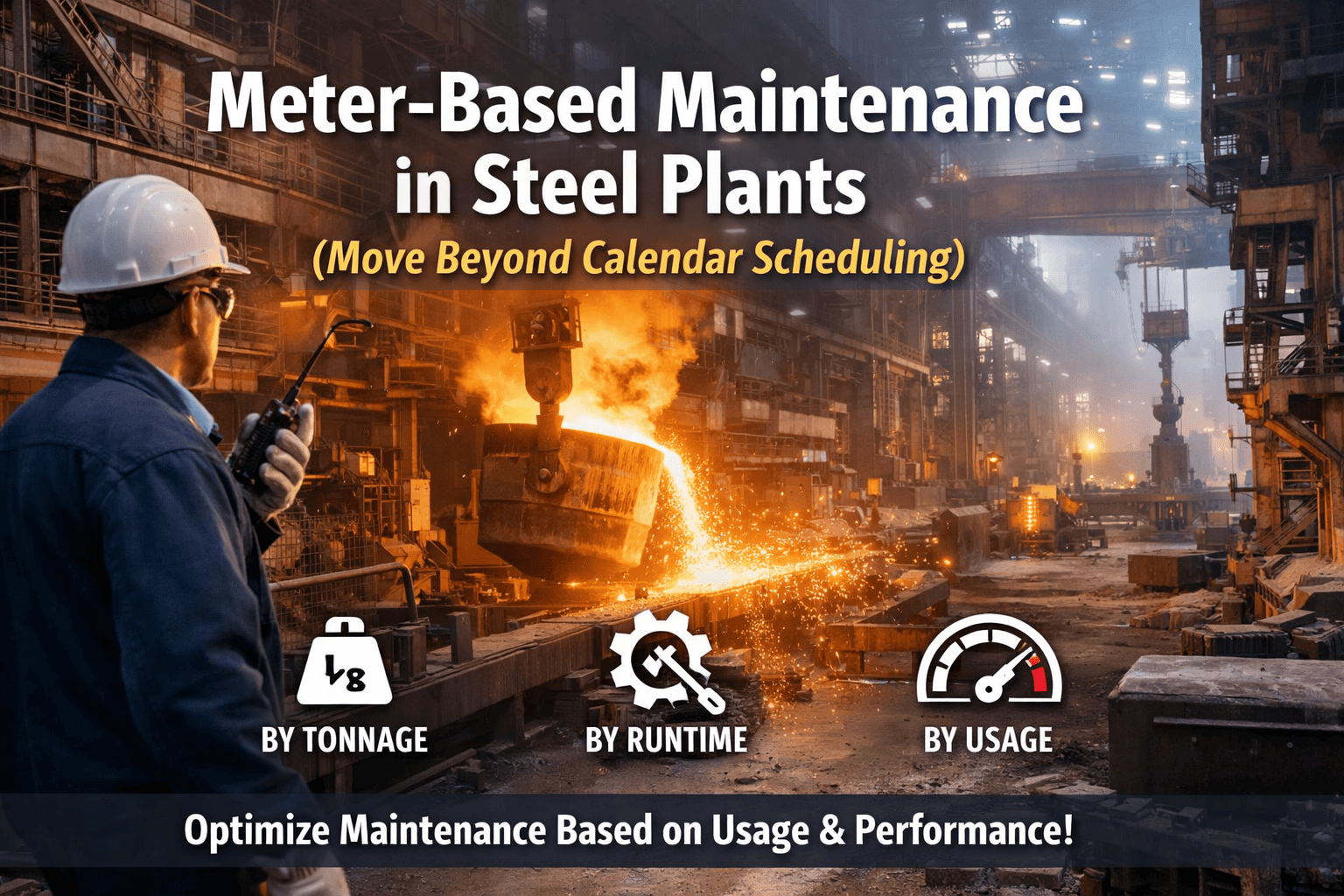
A blast furnace that completed 4,200 heats in the last 90 days and a standby BOF that ran 400 heats over the same period are not the same asset. Their refractory wear profiles are not the same. Their tuyere failure risk is not the same. Their maintenance needs are not the same. Calendar scheduling treats them identically — generating the same work order on the same date regardless of how hard each asset has actually worked. In a steel plant where a single unplanned blast furnace outage costs $50,000–$125,000 per hour, that structural mismatch between calendar dates and actual equipment wear is not a minor inefficiency. It is the root cause of most avoidable breakdowns. OxMaint's meter-based PM engine triggers maintenance from heats processed, tonnes cast, rolling hours, and production cycles — aligning every work order with the actual wear state of the asset, not an arbitrary date on a shared calendar.
Steel Industry · Meter-Based Maintenance · Smart Scheduling 2026
Meter-Based Maintenance in Steel Plants — Move Beyond Calendar Scheduling
How integrated steel plants use tonnage, heat counts, operating hours, and production cycles to trigger maintenance — eliminating the over-maintenance of idle assets and under-maintenance of heavily-loaded ones that calendar schedules structurally cannot prevent.
Maintenance Scheduling Maturity — Where Is Your Plant?
Level 1
Calendar-only PM. Fixed intervals, no usage data. Over-maintains idle assets, under-maintains heavily-used ones.
Level 2
Calendar + manual meter readings. Spreadsheet-tracked. Thresholds set but work orders still generated manually.
Level 3
CMMS-integrated meter triggers. Auto work order on threshold. PLC/IoT data fed directly. Most plants should be here.
Level 4
Hybrid meter + predictive. First trigger fires the WO — meter OR condition data. Continuous threshold refinement from failure history.
Why Calendar Scheduling Fails Steel Plant Equipment
The structural problem with calendar-based PM is simple: it treats all assets identically regardless of how hard they have actually worked. A machine that ran 24/7 for 90 days gets the same service date as a backup unit that ran 10 hours. In steel plants — where blast furnace campaign intensity varies by iron grade, EAF heats per shift fluctuate with order mix, and rolling mill throughput changes weekly with product programme — calendar intervals are fundamentally wrong for the majority of production-critical assets.
Asset: Blast Furnace Tuyere Cooling System
The PM schedule says: inspect tuyere coolers every 90 days. Month 1 runs at 95% capacity — 1,600 heats processed. Months 2–3 run at 60% due to a market slowdown — 1,900 heats total. At the 90-day mark, the PM fires — but the tuyere system has experienced 3,500 heats of wear, well beyond the inspection threshold that should have been 2,800 heats. Two weeks later: unplanned tuyere burnout. Emergency repair: $340,000 in downtime plus repair cost. Root cause: the PM interval was correct for average utilisation, but actual utilisation ran 25% above average during the critical campaign period.
Outcome: Avoidable failure. Emergency spend. Lost production.
Asset: Blast Furnace Tuyere Cooling System
The PM trigger is set at 2,800 heats processed — not 90 days. OxMaint reads cumulative heat count from the BF Level 2 system in real time. When the high-intensity campaign pushes the tuyere system to 2,800 heats at day 67 — 23 days ahead of the calendar date — the work order generates automatically. The inspection is performed during a planned 4-hour tap window. A cooling channel showing early-stage erosion is identified and relined. The tuyere system runs the next 3,100-heat campaign without incident. Cost of planned intervention: $22,000. Cost of the avoided emergency: $340,000+.
Outcome: Planned intervention. $318,000+ cost avoidance. Zero unplanned downtime.
Steel Plant Meter Types — Which Asset Uses Which Trigger
Not all steel plant equipment wears at the same rate or against the same usage metric. Blast furnace refractory degrades per heat processed. Caster segments wear per tonne cast. Rolling mill work rolls consume their surface life per tonne rolled. Configuring PM triggers against the correct usage metric for each asset class is the most important implementation decision in a meter-based maintenance programme.
⚙
Tonnage-Based
Trigger on material processed
Caster Segments
Every 50,000 t cast
Roll contact wear driven by cast tonnage — not calendar time
Work Rolls (HSM)
Per campaign tonne limit
Surface profile degrades per tonne rolled — grade-mix dependent
BF Refractory
Per 10,000 t hot metal
Hearth wear tracked per tonnage for reline budget accuracy
Descaler Headers
Per million tonnes rolled
Nozzle erosion tied to throughput — not inspection date
⏱
Runtime Hours
Trigger on operating hours
Rolling Mill Stands
Every 4,000 rolling hours
Bearing and gearbox wear accumulates per operating hour
Cooling Pumps
Every 2,000–4,000 hrs
Seal and impeller wear proportional to runtime
Turbo Blowers (BF)
Every 8,000 hrs
Compressor oil, bearings, and seals on runtime schedule
BOF Gas Fans
Every 3,000 hrs
Impeller imbalance from scale buildup — runtime triggered
?
Heat / Cycle Count
Trigger on process cycles
BF Tuyere Coolers
Every 2,800 heats
Thermal cycling fatigue — each heat cycle = measurable wear increment
EAF Electrodes/Roof
Per heat count
Refractory wear on EAF roof directly proportional to heats tapped
BOF Lance
Per heat count
Lance tip erosion tracked per heat — replacement timed to heat threshold
Hydraulic Systems
Per 100,000 cycles
Seal wear in oscillation/clamping systems driven by cycle count
Asset-by-Asset Meter Reference — Steel Plant PM Triggers
| Asset |
Process Area |
Correct Meter Type |
Typical PM Threshold |
Calendar PM Risk |
| BF Refractory / Tuyere |
Ironmaking |
Heats processed |
2,500–3,200 heats per inspection |
Under-maintenance during high campaigns → burnout risk |
| Caster Segment Rolls |
Continuous Casting |
Tonnes cast |
40,000–60,000 t per rebuild |
Over/under maintenance — grade mix changes actual wear rate |
| EAF Electrode Arms |
EAF Steelmaking |
Heats tapped |
Per OEM spec / heat count |
Tap-to-tap time varies — calendar misses actual thermal fatigue |
| Rolling Mill Work Rolls |
Hot Strip Mill |
Tonnes rolled |
Campaign-specific tonne limit |
Surface wear depends on grade/width mix — calendar is blind to this |
| Rolling Mill Gearboxes |
Hot/Cold Rolling |
Operating hours |
4,000–6,000 hrs per overhaul |
Overmaintains if utilisation drops — wastes labour and parts |
| Process Cooling Pumps |
All areas |
Operating hours |
2,000–4,000 hrs per service |
Standby pumps calendar-serviced unnecessarily — introduces wear on assembly |
| BOF Lance / Vessel |
Steelmaking |
Heats processed |
Per heat count per OEM |
Calendar interval ignores heat intensity — under-maintenance at high throughput |
| Compressors / Blowers |
Gas / Utilities |
Operating hours |
8,000 hrs (major), 2,000 hrs (minor) |
Calendar works for standby — meter essential for continuously-running units |
Calendar dates don't know your blast furnace ran an extra 800 heats this month. Your maintenance triggers should.
Case Study: 3.5 MTPA Integrated Steel Plant — PM Compliance 54% → 84%
When this plant's maintenance director rebuilt its PM programme on OxMaint, the most important configuration change was not the CMMS platform itself — it was replacing calendar triggers with usage-based ones on every critical production asset. Blast furnace maintenance budgets tracked per campaign tonnage replaced department-level flat allocations. Caster segments moved to tonnage triggers. Rolling mill stands moved to operating hours. The results after 12 months:
84%
PM Compliance
Up from 54% baseline — meter triggers auto-generate WOs at the right time, not a missed calendar date
41%
Emergency WO Reduction
Fewer unplanned breakdowns when maintenance aligns with actual equipment wear state
34%
Maintenance Cost / Tonne
Lower cost per tonne by eliminating unnecessary servicing of underutilised assets
20%
EAF Equipment Life Extension
EAF maintenance on heat-count triggers — extended equipment life, reduced emergency repairs
The Hybrid Trigger — The Right Safety Net for Steel Plant Conditions
Pure meter-based scheduling carries one risk: if a meter fails, a sensor goes offline, or PLC data stops flowing, assets can run past their maintenance threshold undetected. The hybrid trigger solves this. OxMaint allows any PM task to be configured with both a meter threshold and a calendar backstop — whichever fires first generates the work order. In high-utilisation periods the meter fires early, ensuring timely maintenance. In low-utilisation periods or during production stoppages, the calendar backstop ensures nothing is silently missed. Predictive maintenance systems in 2026 extend this further — adding condition-based triggers (vibration anomalies, temperature deviation, oil particle counts) as a third lane alongside meter and calendar, with the first trigger to fire generating the work order.
Hybrid Trigger Logic — How OxMaint Fires the Work Order
Meter Trigger
Usage threshold reached — heats, hours, tonnes, or cycles. Fires early during high-utilisation campaigns.
OR
Calendar Backstop
Time-based safety net. Fires if meter data is unavailable or utilisation was low. No service window ever missed.
OR
Condition Alert
Vibration, temperature, or oil analysis threshold exceeded. Fires ahead of both meter and calendar when degradation detected early.
→
Work Order Generated
First trigger fires → automatic WO with asset, task, parts, and technician assignment. Nothing slips through.
"
The meter-based maintenance scheduling transformed how we manage our EAF operations. We now trigger maintenance based on heats processed rather than arbitrary calendars — extending equipment life by 20% while reducing emergency repairs significantly. The change sounds simple, but it required discipline: going asset by asset, identifying the correct usage metric for each one, setting the right threshold, and connecting it to live production data. Once that was done, the CMMS did the rest. Our maintenance team stopped reacting to breakdowns on assets that had run well past their threshold and started intervening at exactly the right moment. The financial impact showed up in the first quarter — fewer emergency callouts, less overtime, and a measurable drop in maintenance cost per tonne of steel produced.
Maintenance Director, Integrated EAF + Rolling Mill Operation
2.1 million tonne annual capacity · OxMaint deployed across EAF, continuous caster, and 3-stand rolling mill · Meter-based triggers live on 140+ critical assets
Frequently Asked Questions
How does OxMaint connect to PLC and SCADA systems to read live meter data — without a long IT integration project?
OxMaint supports multiple integration paths for live meter data: direct API connection to Level 2 SCADA systems, OPC-UA and MQTT protocols for PLC data feeds, IoT sensor connections via wireless mesh, and manual meter reading entry through the mobile app for assets without digital connectivity. Most steel plants start with a hybrid approach — PLC integration on the 15–20 highest-criticality assets and mobile-entered readings on the rest — and expand IoT coverage over time. The first meter-based work orders typically go live within two weeks of deployment, using existing PLC data that was already available but not connected to maintenance scheduling.
See how production scheduling and meter-based PM integrate in a steel plant CMMS.
How do you set the correct meter threshold for an asset with no historical failure data?
For assets without failure history, the starting point is the OEM recommended service interval — converted from calendar time to usage units based on the asset's average utilisation rate. For example, if the OEM recommends inspection every 6 months and the asset runs at 70% utilisation, the starting meter threshold is set at 70% of the maximum possible cycles in 6 months. As the CMMS accumulates maintenance history against usage data, thresholds are refined — extended if inspections consistently show no degradation, tightened if early-stage wear is regularly found. OxMaint's PM optimisation module tracks clean inspection cycles and suggests threshold adjustments automatically.
See how threshold calibration drove 34% maintenance cost reduction at a 3.5 MTPA steel plant.
Can a steel plant run meter-based and calendar-based PM in parallel during the transition period?
Yes — and this is the recommended approach. OxMaint supports calendar, meter, and condition-based triggers simultaneously on the same platform. During transition, critical assets switch to meter triggers first while lower-criticality assets remain on calendar schedules. The platform makes both visible on the same dashboard, so planners can compare which trigger fires first, validate the meter thresholds against actual inspection findings, and gradually migrate remaining assets as confidence in the usage data builds. Most steel plants complete the transition for their top 50 critical assets within the first 90 days.
See how usage-based scheduling improves maintenance budget accuracy in steel plants.
Your Blast Furnace Doesn't Wear Down by the Calendar. Your PM Schedule Shouldn't Either.
OxMaint's meter-based PM engine triggers maintenance from heats, tonnes, and runtime hours — auto-generating work orders at the right threshold, on every shift, across every asset class in your steel plant.