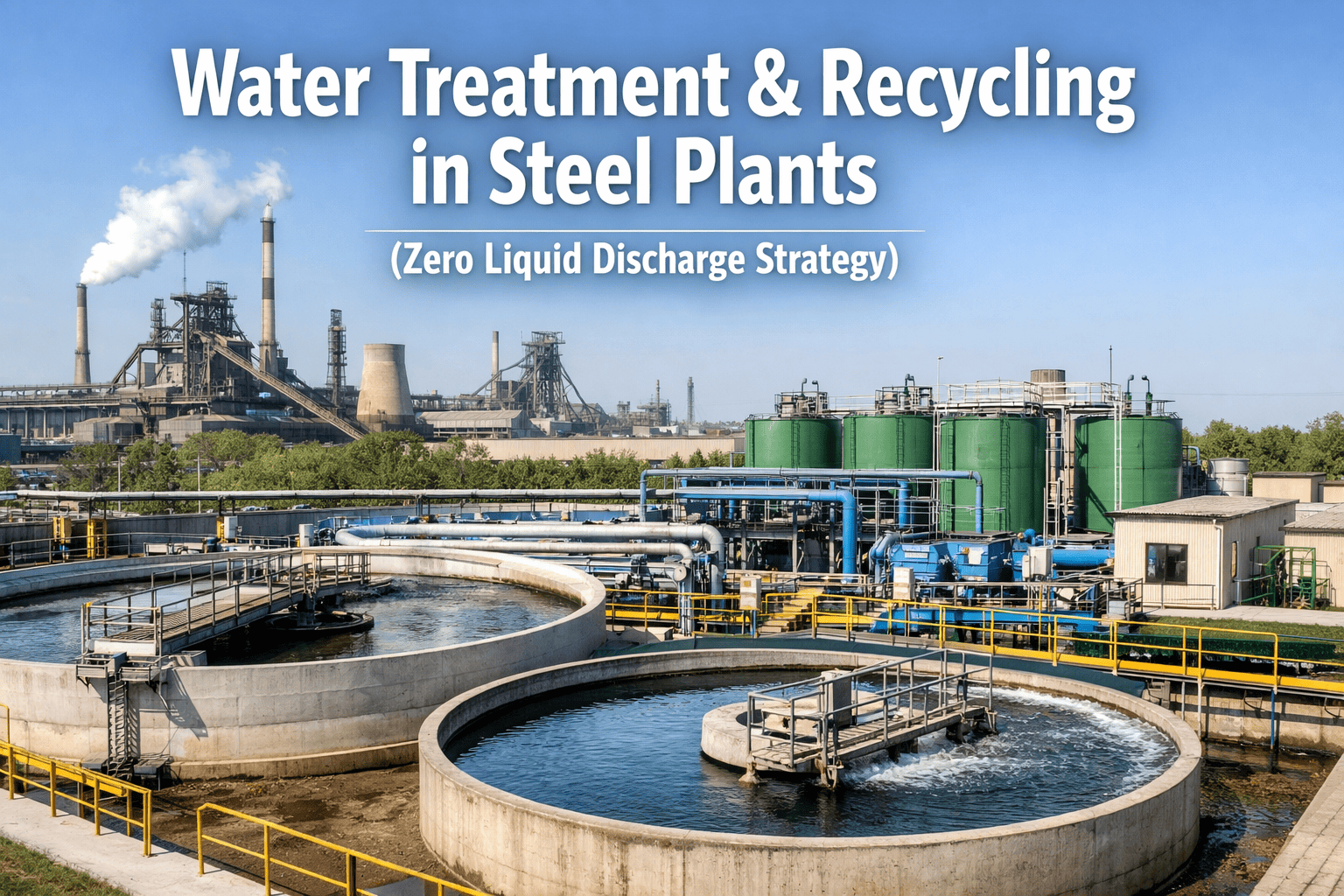
An integrated steel plant takes in 28.6 m³ of water per tonne of steel produced — but only consumes 1.6 to 3.3 m³. The rest circulates, cools, carries contamination, and must be treated before it re-enters the circuit or leaves the fence. What sits between intake and discharge is one of the most complex and chronically undermaintained utility systems in heavy industry: clarifiers, thickeners, biological reactors, scale pits, cooling towers, and ZLD membranes — each with its own failure mode, each capable of triggering a regulatory discharge event that costs more in penalties and permit review than the asset itself is worth. OxMaint's asset monitoring and compliance logging treats every water treatment circuit as a production-critical asset — with predictive maintenance, real-time chemistry alerts, and discharge compliance documentation built into the same CMMS your maintenance team already uses.
Steel Industry · ESG Compliance · Water Systems 2026
Water Treatment & Recycling in Steel Plants — Zero Liquid Discharge Strategy
How steel plants manage 28+ m³/tonne of water intake across cooling, process, and treatment circuits — and how a CMMS-driven maintenance programme keeps recycling rates above 90%, treatment assets in spec, and discharge compliance intact.
28.6 m³
Water intake per tonne of steel — integrated route (World Steel Association)
90%+
Water discharged after cooling and treatment — recirculated to process or utilities
95–98%
Water recovery achievable with ZLD systems in modern steel plant operations
$7B+
Global ZLD systems market in 2024 — growing at 5.6% CAGR through 2033
Where Steel Plant Water Goes — and What Contaminates It
Water in a steel plant is not a single stream — it is a collection of 30+ separate recirculating circuits, each serving a different process unit, each with a different contamination profile, and each requiring treatment tailored to its specific pollutant load before water can be recycled or discharged. Understanding this map is the foundation of a structured utilities maintenance programme for water systems.
Steel Plant Water Circuits — Sources and Key Contaminants
Coke Oven
~0.4 m³/t
Phenols · Cyanide · Ammonia · Benzene · H₂S · Thiocyanate
Most complex wastewater in the plant — requires biological treatment + tertiary polishing
Blast Furnace
7.6 m³/t (ingot)
Suspended solids (SS) · Zinc · Lead · Fluoride · Cyanide · Thermal load
BF gas scrubbing: 500 m³/h — chemical treatment with lime for alkaline oxidation + settling
BOF / EAF Steelmaking
~1,000–5,000 mg/L SS
Fine suspended solids · High thermal load · Dust from gas cleaning
Wet scrubbing generates sludge reused in sinter plant — closed-loop is achievable
Hot & Cold Rolling
High volume — indirect cooling dominant
Mill scale · Hydraulic oil · Lubricants · Fine suspended solids
82% of total plant water use — cooling towers and closed-loop systems; scale pit critical
Continuous Casting
Critical — caster cooling
Thermal load · Scale · Low contamination if closed loop maintained
Loss of mold cooling triggers automatic caster shutdown in 2–5 minutes — highest criticality
Pickling / Cold Finishing
Acid rinse water
Residual acid · Heavy metals (Fe, Cr, Ni, Zn) · Chlorides
Acid recovery and rinse water reuse reduces fresh water consumption by up to 20%
The ZLD Strategy — Technology Stack and What It Demands from Maintenance
Zero liquid discharge is not a single technology — it is a treatment train that begins with clarification and ends with crystallisation or evaporation, with membrane concentration stages between. Each stage has distinct PM requirements, failure modes, and monitoring parameters. Water treatment assets in steel plants generate abundant process data — flow rates, pressures, temperatures, chemical dosing rates, and quality parameters — that reveal asset health long before failure occurs. The challenge is connecting that data to a CMMS that acts on it.
ZLD Treatment Train — Steel Plant Wastewater
1
Pre-Treatment & Clarification
Coagulation, flocculation, and sedimentation to remove suspended solids. Scale pit removal for mill scale. pH adjustment for heavy metal precipitation.
PM focus: Clarifier rake mechanism · Chemical dosing pumps · Flocculant feed systems
→
2
Biological Treatment
Activated sludge or SBR systems for coke oven effluent — phenol, ammonia, and cyanide degradation by microbial communities. Most sensitive stage to process upsets.
PM focus: Aeration blowers · Mixed liquor DO monitoring · Sludge return pumps
→
3
Membrane Pre-Concentration
Ultrafiltration (UF) followed by reverse osmosis (RO) to remove dissolved salts. Recovers 60–80% of water. RO concentrate feeds crystalliser stage.
PM focus: Membrane fouling index · Differential pressure monitoring · CIP cycle frequency
→
4
Evaporation / Crystallisation
Mechanical vapour recompression (MVC) or multi-effect evaporators concentrate brine to solid salt. Water vapour condensed and returned to process. ZLD complete.
PM focus: Heat exchanger scaling · Compressor efficiency · Vapour body level control
The Three Water Treatment Failures That Trigger Regulatory Events
01
Upstream Treatment Stage Failure — No Emergency Diversion
When a clarifier overflows, a dosing pump fails, or a biological system crashes, the consequence arrives at the final discharge point with very little warning. Facilities without automated effluent monitoring and emergency diversion capability must discharge non-compliant water — triggering enforcement actions and permit reviews that can halt production for months. A CMMS with real-time chemistry alerts and automatic work order generation is the difference between a maintenance event and a compliance incident.
02
Membrane Fouling Without Condition-Based PM
RO and UF membranes in steel plant water treatment foul faster than almost any other industrial application — mill scale carryover, iron precipitation, and biological growth combine to degrade performance over weeks. Calendar-based cleaning intervals miss the actual fouling rate, which varies with feed water quality and production load. Differential pressure trending is the correct PM trigger — not a fixed schedule.
Predictive maintenance driven by process data replaces reactive emergency cleaning events.
03
Cooling Tower Legionella Risk — Compliance Gap Without Digital Records
Cooling towers fall under Legionella control legislation in most developed markets — requiring documented risk assessments, registered water treatment schemes, biocide dosing logs, and regular monitoring records. Paper-based records fail audits not because the work was not done, but because documentation is incomplete, inconsistent, or stored in a format no inspector can navigate in real time. A CMMS that timestamps every chemistry check and dosing event is not optional — it is the compliance infrastructure the regulation requires.
Regulatory Discharge Limits — Key Parameters Steel Plants Must Track
| Parameter |
Source / Circuit |
Typical Limit (NPDES/EU) |
Steel Plant Risk Level |
OxMaint Monitoring Trigger |
| Suspended Solids (SS) |
BF gas scrubbing · BOF / EAF · Rolling |
30–50 mg/L |
High — 1,000–5,000 mg/L in raw BOF water |
Turbidity sensor threshold alert → WO |
| Oil and Grease |
Rolling mills · Hydraulic systems |
10–20 mg/L |
Medium — contained with scale pit and DAF |
Weekly grab sample WO + continuous OilSpy |
| Phenol |
Coke oven effluent |
0.5–1.0 mg/L |
High — biological treatment essential |
Biological system DO alert → dosing WO |
| Cyanide (total) |
Coke oven · Blast furnace |
0.1–1.0 mg/L |
High — ozonation or alkaline chlorination required |
Ozone generator PM + effluent sampling WO |
| Zinc |
Blast furnace gas scrubbing |
1.0–2.0 mg/L |
Medium — hydrocyclone separation effective |
Monthly effluent chemistry WO |
| Ammonia-N |
Coke oven effluent |
5–15 mg/L |
High — nitrification/denitrification required |
Nitrifier activity monitoring → aeration adjustment WO |
| Temperature |
All cooling circuits |
≤35°C at discharge point |
Medium — cooling tower performance dependent |
Continuous outlet temp monitoring → CT PM trigger |
Water treatment asset failures don't announce themselves. They show up as compliance violations after the fact.
How OxMaint Manages Steel Plant Water Treatment Assets
Water treatment infrastructure in steel plants is systematically undermaintained — treated as a background utility rather than the production-critical asset it is. Environmental compliance automation for steel plants requires the same digital infrastructure as production asset monitoring: continuous chemistry data, automatic work order generation on threshold breaches, and audit-ready compliance records on demand.
01
Chemistry Threshold Alerts → Automatic Work Orders
Online pH, TSS, DO, and temperature sensors connected to OxMaint generate work orders automatically when parameters breach predefined limits — so treatment responses happen within hours of a chemistry deviation, not days after a manual review finds the log entry.
02
Asset Register for All Water Treatment Equipment
Every clarifier, pump, dosing unit, biological reactor, membrane skid, cooling tower cell, and monitoring instrument registered as a CMMS asset with maintenance history, PM schedule, and spare parts links. Water treatment assets get the same operational visibility as production equipment — including production-impact scoring based on circuit criticality.
03
Discharge Compliance Documentation — Export in Minutes
Every chemistry sample, maintenance action, dosing event, and instrument calibration is timestamped and archived against the relevant asset. NPDES Discharge Monitoring Reports, EU IED compliance records, and cooling tower Legionella documentation generated from live operational data — not manually compiled from paper files under audit pressure.
04
Predictive Membrane and Clarifier PM
Differential pressure trending on RO/UF membranes triggers cleaning before performance degrades to the point of requiring emergency replacement. Clarifier rake torque trends detect sludge blanket buildup before overflow. Condition-based PM schedules replace fixed calendar intervals — maintaining treatment performance without unnecessary maintenance spend.
"
Most steel plants I audit have comprehensive PM programs for their rolling mills, blast furnaces, and continuous casters. When I ask about their water treatment assets, I usually get a folder with a contractor's annual visit report and a cooling tower biocide dosing log that hasn't been updated in three months. The water treatment circuit in a steel plant is not a support system — it is a regulated discharge point where failure creates regulatory enforcement events that can cost more in permit review, fines, and production restrictions than a blown caster roll. Building your water treatment assets into the same CMMS as your production equipment — with the same PM rigour, the same condition monitoring, and the same compliance documentation — is not optional in 2026. It's what the regulations already require and most facilities haven't yet delivered.
Senior Environmental Engineer, Integrated Steel Operations
21 years water systems design and compliance · NPDES permit holder experience across 7 integrated steel facilities · ESG reporting specialist for Scope 3 water intensity metrics
Frequently Asked Questions
How does OxMaint handle the complexity of 30+ separate water circuits in an integrated steel plant?
OxMaint structures water treatment assets in a hierarchical register — plant → utility system → circuit → individual asset — so every clarifier, membrane skid, cooling tower cell, and dosing pump sits within the correct operational context. PM schedules, monitoring thresholds, and compliance requirements are configured at the circuit level, not generically. When a chemistry threshold breaches in the BF gas scrubbing circuit, the work order routes to the correct technician for that specific system with the relevant discharge limit context pre-populated.
See how OxMaint manages all steel plant utility systems.
Can OxMaint generate the discharge monitoring reports (DMRs) required for NPDES permits automatically?
Yes. When online monitoring instruments are integrated with OxMaint via sensor API, all compliance parameter readings are timestamped and stored against the relevant outfall asset record. Monthly DMR reports are generated from this data automatically — with all required parameters, measurement dates, exceedance flags, and corrective action records included. The same infrastructure supports EU IED compliance reporting and national equivalent frameworks.
See the full water treatment maintenance framework for steel plants.
What is the typical first step for a steel plant that wants to improve water treatment asset maintenance?
The most impactful first step is building a complete asset register of all water treatment equipment — not just the large visible assets like clarifiers and cooling towers, but the dosing pumps, monitoring instruments, control valves, and sample points that are often invisible to the CMMS but responsible for the majority of treatment upsets. Once registered, attaching manufacturer-recommended PM schedules and linking any existing online monitoring data creates the condition-based maintenance foundation. Most steel plants complete this for their primary water circuits within the first two weeks of OxMaint deployment.
See how environmental compliance automation connects to CMMS in steel operations.
Your Water Treatment Circuit Is a Regulated Discharge Point. Treat It Like One.
OxMaint connects chemistry monitoring, predictive maintenance, and compliance documentation for every water treatment asset in your steel plant — in the same CMMS your maintenance team already uses for production equipment.