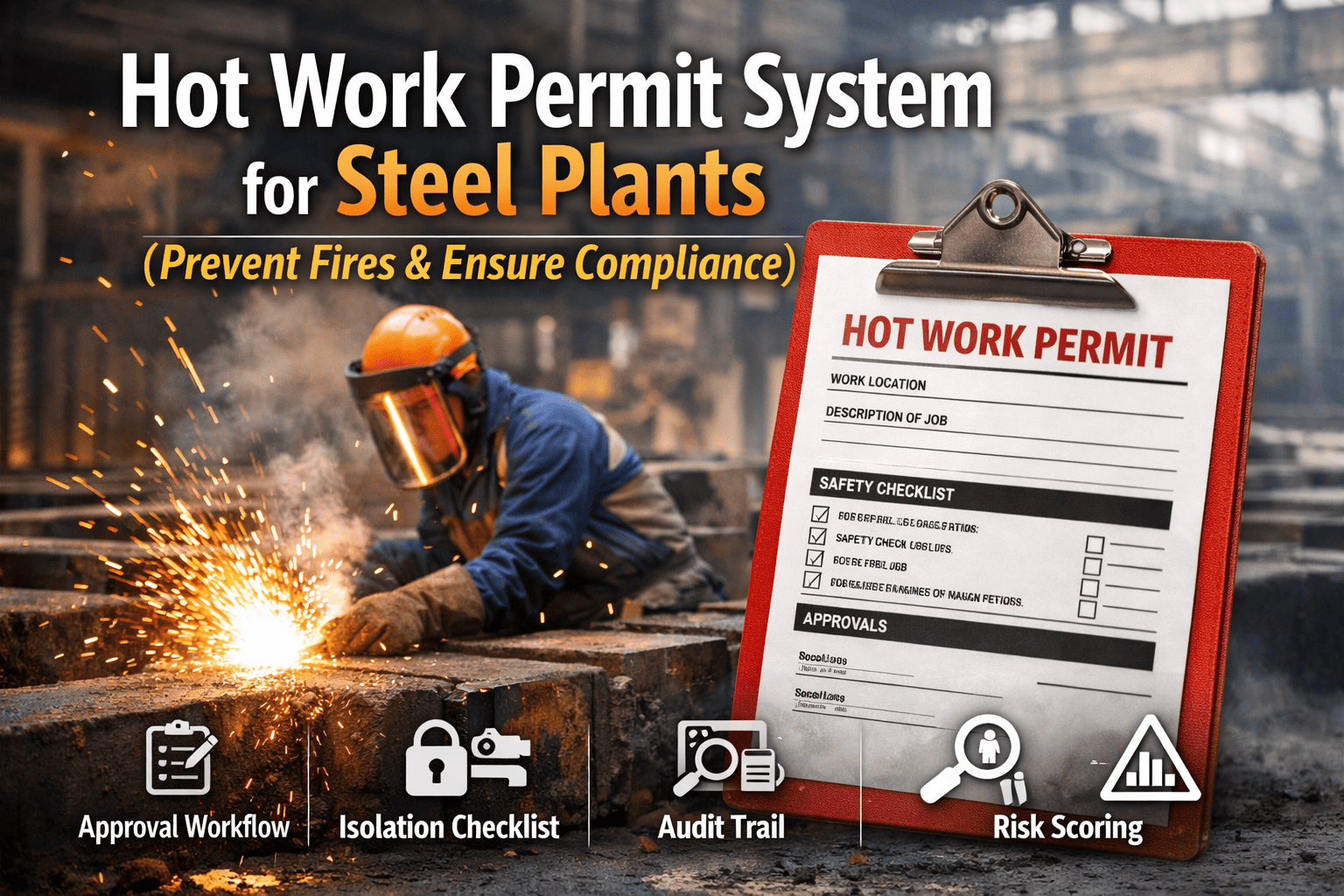
In 2024, survivors and families of workers killed in a welding-triggered explosion were awarded $141 million in damages — not because the welding was wrong, but because no one had assessed the flammable vapours in the tank before the permit was issued. Hot work fires follow the same pattern in every post-incident investigation: the permit existed, but the hazard assessment was superficial, the fire watch left early, or nobody checked whether adjacent operations had changed conditions since the permit was issued. Steel plants perform 50 or more hot work tasks daily in environments where lubricant vapours, conveyor system residues, and hydraulic fluid lines sit within the 35-foot clearance radius of nearly every maintenance task. OxMaint's digital hot work permit system enforces the complete permit lifecycle — hazard-linked approval workflows, isolation checklists, digital signatures at every handoff, and an immutable audit trail that satisfies OSHA 1910.252, NFPA 51B, and 29 CFR 1910.119(k) simultaneously.
Prevent Fires & Ensure Compliance
Steel plants perform welding, cutting, torch brazing, and abrasive grinding daily — in areas where scale dust, lubricant residues, hydraulic lines, and gas pipes sit within arm's reach of every spark. A paper permit system that issues authorization in 45 minutes with no real-time hazard visibility is not a safety system. It is documentation of what you hoped was safe at the time the permit was issued.
Paper permits document conditions at issuance time. When an adjacent work crew introduces a fuel source 20 minutes after your permit was signed — a hydraulic line break, a fuel oil spill, a gas cylinder moved into the clearance zone — the permit does not update. The fire watch is looking at the original permit, not current conditions. This is the failure pattern in most multi-trade hot work incidents.
A steel plant with 50+ daily hot work tasks in adjacent zones cannot track spatial permit conflicts on paper. When three welding crews operate across a boiler bay and each holds a permit covering their immediate zone, nobody has a consolidated view. OxMaint's conflict checking catches overlapping permits automatically at issuance — before work begins, not after an incident.
OSHA 1910.252 requires fire watch for at least 30 minutes after hot work ends; NFPA 51B requires 60 minutes minimum — and the permit authorizing individual may require up to 3 hours in high-risk areas. Paper permits cannot verify that the fire watch stayed on station. Digital fire watch timer enforcement with mobile sign-off every 15 minutes is the only mechanism that actually proves the watch was held.
Contractors bring their own forms, their own habits, and their own interpretation of the 35-foot clearance rule. Host sites that allow contractor-managed hot work permits without digital enforcement of the host site's hazard standards are transferring liability to a form that may not match your actual risk profile. OxMaint enforces one standard for employees and contractors alike.
Insurance carriers and regulators request the permit, the hazard assessment, the fire watch log, and the close-out signature. Paper systems routinely produce incomplete records. In the $141M damages case, the permit existed but the hazard assessment section was not completed for the specific tank. A digital system makes blank fields impossible — every section is mandatory before the next step unlocks.
Technician submits request via mobile — selecting work location on plant schematic, specifying hot work type, and estimated duration. System automatically surfaces all combustible materials, fuel lines, electrical systems, and gas pipes within the clearance radius.
System calculates risk score from work type, location, identified hazards, and active adjacent permits. Spatial conflicts with existing hot work zones are flagged automatically. High-risk score triggers escalated approval pathway requiring safety officer co-sign.
Supervisor completes the isolation checklist on-site — mandatory photo upload confirming combustible clearance, fire blanket placement, and extinguisher placement within 35 feet. Checklist cannot be completed remotely. Atmospheric gas test result entered and time-stamped.
Permit Authorizing Individual (PAI) reviews the completed hazard assessment and clearance photos remotely, then issues digital authorization with personal PIN signature. Permit is time-bound — the system blocks re-use of an expired permit. Concurrent permits in adjacent zones are visible to the PAI at authorization.
Fire watch personnel receive a mobile countdown timer — 30-minute minimum per OSHA 1910.252, 60-minute default per NFPA 51B. Check-in prompts every 15 minutes require active response; no response triggers supervisor alert. Multi-level watch assignments (for elevated platform work above floor grates) assigned and tracked separately.
Close-out inspection photo confirms area returned to service condition. Authorizing supervisor signs closeout digitally. Complete permit record — request, hazard map, photos, risk score, approvals, fire watch log, closeout — archived permanently. Retrievable in seconds for any OSHA inspection or insurance audit.
Fire hazard controls documented before work begins. Fire watch minimum 30 minutes post-work. Equipment condition verified. OxMaint enforces all items as mandatory fields — no authorization until complete.
60-minute minimum fire watch. PAI designation required. Area clearance within 35 feet confirmed by photo. OxMaint's fire watch countdown timer defaults to NFPA 51B's stricter standard, not OSHA minimum.
Written hot work permit mandatory for work on or near covered processes. Documentation of fire prevention controls required. OxMaint auto-tags permits issued near PSM-designated areas and routes them through the elevated approval path.
Documented hazard identification and control verification required for high-risk operations. OxMaint's immutable audit trail satisfies ISO 45001 permit-to-work documentation requirements across all hot work activities.
The fundamental problem with hot work permit systems in steel plants is not that people don't understand the risk — they do. The problem is that the permit system creates a false impression of control when the actual hazard state has changed since the permit was issued. I have investigated incidents where the permit was correctly completed, the fire watch was assigned, and the work was authorized by a qualified person — and still resulted in a fatality. In each case, a dynamic change between permit issuance and work commencement introduced a hazard that the static paper record could not capture. Sparks reached a fuel source that was not there when the permit was issued. A digital system that links permits to real-time plant hazard maps and flags concurrent permit conflicts as they develop — not just at issuance — is the only mechanism that closes this gap. The 12-minute digital permit is not a convenience. It is the only system fast enough to be reissued when conditions change, which in a steel plant they do, multiple times per shift.