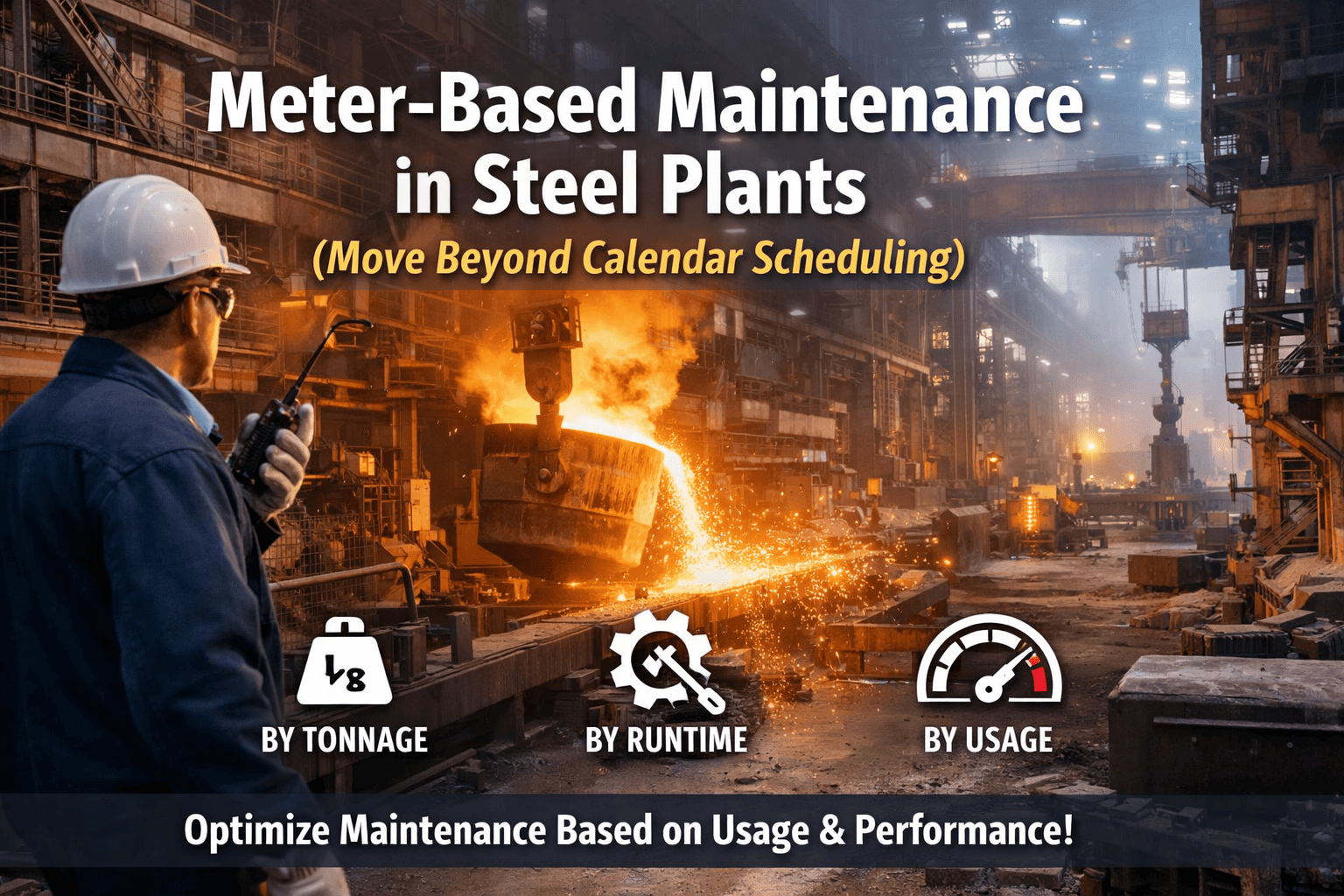
A ladle crane dropping 280 tonnes of liquid steel at 1,600°C is not a crane incident — it is a catastrophe. Steel plants operate the world's most consequence-critical lifting equipment under the world's most demanding conditions: radiant heat that degrades wire rope lubrication within days, shock loading from scrap grabs that compresses years of fatigue into weeks, and production schedules that create pressure to skip the pre-shift checks that prevent the failures that end careers and lives. In 2025, a review of 249 overhead crane incidents identified 838 OSHA violations — 133 of which resulted in fatalities. The majority were preventable with documented inspections that were either not done, not recorded, or not acted on. OxMaint's AI inspection checklist module puts ASME B30.2-compliant crane inspection forms on your operators' mobile devices, enforces photo evidence on safety-critical items, auto-creates corrective work orders on every finding, and keeps a tamper-evident digital record that survives audits, insurance reviews, and incident investigations.
2026 Guide · Steel Industry
Crane Safety Checklist for Steel Plants (2026 Guide)
ASME B30.2 · OSHA 1910.179 · 4 steel crane types · Pre-shift to annual tiers · AI-powered digital inspections with mobile photo sign-off and auto work orders.
Steel Plant Crane — Risk by Type
Risk rating based on load consequence, thermal exposure, and cycle frequency
42–44
Crane fatalities per year in the US — majority preventable with documented inspections
838
OSHA violations found in review of 249 overhead crane incidents (Crane Training Universities)
Class F
ASME B30.2 service classification for ladle cranes — highest duty, strictest inspection frequency
125% SWL
Proof load test required on commissioning and after major repairs under ASME B30.2
Why Standard Crane Checklists Are Not Enough in Steel
01
Radiant Heat Degrades Faster
Charging cranes above furnace openings expose wire rope, electrical cables, and brake linings to heat that accelerates wear 3–5× beyond standard environments. Standard quarterly inspection intervals are insufficient — weekly cable inspection and monthly brake assessment are the correct frequencies for heat-classified crane positions.
02
Shock Loading on Scrap Cranes
Scrap grab-and-drop operations apply dynamic impact factors of 2–4× the stated load on structural connections and hoist ropes. A connection rated for monthly inspection in a standard environment requires weekly inspection on a scrap crane. Fatigue cracks accumulate invisibly between underfrequent inspection cycles.
03
Zero-Tolerance for Ladle Crane Defects
Any structural crack, wire rope broken wire, or anti-drop device failure on a ladle crane is an immediate out-of-service condition — no deferral, no risk assessment, no "fix it this weekend." ASME B30.2 Class F designation means the consequence of a failure event is catastrophic and irreversible. A missed defect becomes a mass casualty event.
04
Paper Records Don't Survive Investigations
When a serious incident occurs, the first document requested is the pre-shift inspection record from the shift before the event. Paper records are lost, incomplete, or show ticked boxes with no photo evidence of the actual condition. Digital inspection records with timestamped photos and named signatories are the only records that withstand legal and regulatory scrutiny.
Crane Type 01 — Ladle Cranes · ASME B30.2 Class F
Pre-Shift — Every Lift with Liquid Metal · OSHA 1910.179(j)(2)
Anti-drop safety device function-tested with inert load before first lift — no lift with liquid metal until test passed and loggedASME B30.2 Class F · Test certificate per shift · Role: Operator
Main and auxiliary hoist brake hold test — apply and hold under rated load simulation; any drift requires immediate out-of-serviceOSHA 1910.179(j)(2)(i) · Photo of load position · Role: Operator
Hook condition — no cracks, deformation; throat opening not exceeded 15% of normal per ASME B30.10; twist not exceeding 10° from hook planeASME B30.10 / OSHA 1910.179(j)(2) · Close-up photo of hook · Role: Operator
Hoist rope — zero broken wires (zero-tolerance policy above liquid metal); no kinking, crushing, or birdcaging; rope lays straight on drumASME B30.2 Class F zero-tolerance · Rope photo per drum section · Role: Operator
Ladle trunnion and trunnion pins — no cracks, erosion, or deformation; pins secured; condition visible from cab confirmed before each liftOEM specification / Risk assessment · Photo of trunnion assembly · Role: Operator + Metallurgical Supervisor
Weekly — Maintenance Technician
Wire rope full-length inspection — count broken wires per lay length; measure diameter for reduction from nominal; check lubrication adequacy along full rope pathASME B30.2 Table 2-1 rejection criteria · Diameter measurements logged · Role: Maintenance Technician
Main girder and end truck structural visual — no cracks at welded joints; no visible deformation; connection bolts checked for looseness; runway rail joints checked for gap or stepASME B30.2 / OSHA 1910.179(j)(3)(i) · Structural photo log · Role: Maintenance Technician
Crane Type 02 — Charging & Scrap Cranes · Accelerated Inspection Intervals
Pre-Shift — Every Charge / Scrap Cycle
Thermal shielding on bridge understructure — no missing or deformed shield panels; no heat discolouration on primary structural members indicating shield failureOEM thermal spec · Photo of shield panels · Role: Operator (charging cranes)
Magnet drop prevention circuit — function test magnet hold under simulated power interruption; confirm fail-safe hold on power cut; log test time and resultASME B30.20 / OEM spec · Circuit test record · Role: Operator (scrap / magnet cranes)
Electromagnet cable and charging crane trailing cable — visual check for heat damage, abrasion, exposed conductors; any exposed conductor: out of service immediatelyOSHA 1910.179(g) / NFPA 70B · Cable photo inspection · Role: Operator
Weekly — Structural Fatigue (Scrap Cranes)
Structural connection inspection — all welded joints at main girder-to-end-truck connections; mark any crack indication with paint pen and tag crane for engineering reviewASME B30.2 periodic structural requirements · Joint photo log · Role: Maintenance Technician
Monthly — Structural NDT (Charging Cranes)
Main girder NDT check at critical weld joints within thermal influence area — magnetic particle or dye penetrant inspection; any crack indication: crane out of serviceASME B30.2 / EN 13001-3 structural assessment · NDT report with photo mapping · Role: Certified NDT Technician
Paper Inspection Records Don't Survive Incident Investigations. OxMaint's Do.
Timestamped, photo-verified, digital-signed crane inspection records — retrievable in 30 seconds for any audit, insurance review, or regulatory inquiry.
All Steel Plant Cranes — Universal Inspection Requirements
Monthly — Documented Inspection · OSHA 1910.179(j)(2) — Retain 3 Months
Brake system — lining thickness measured and recorded; drum surface condition noted; brake adjustment verified within OEM specification; service and emergency brakes independently checkedOSHA 1910.179(j)(3)(ii) · Measurement record with signatures · Role: Competent Person
Hoist drum — rope groove wear; minimum rope wraps at full lower limit (minimum 2 per ASME B30.2); drum flange condition; rope fleet angle within OEM limitsASME B30.2 · Drum inspection photo · Role: Competent Person
Electrical apparatus — check for wear, deterioration, or damage; inspect control panel for loose connections, overheating marks, or moisture ingress in high-humidity steel environmentsOSHA 1910.179(j)(3)(vii) · Electrical inspection report · Role: Electrical Maintenance
Deformed, cracked, or corroded structural members — main girder, end trucks, trolley frame, runway beams; welded connections and high-stress zones; scale dust and moisture accelerate corrosion in steel environmentsOSHA 1910.179(j)(3)(i) · Structural log with location photos · Role: Competent Person
Annual — Qualified Person · OSHA 1910.179 — Retain 12+ Months
125% SWL proof load test — static and dynamic; ladle cranes use equivalent inert test load (not liquid metal); full bridge travel during test; measure camber before and after for permanent deformationASME B30.2 / OSHA 1910.179(k) · Load test certificate with inspector signature · Role: Qualified Person
Full structural NDT survey — all load path members; magnetic particle or dye penetrant at all welded connections; any crack: crane out of service pending engineering assessmentASME B30.2 / EN 13001-3 · NDT survey report with method, coverage map, and findings · Role: Certified NDT Engineer
Annual inspection certificate — date, inspector identity and qualification, equipment identifier, items examined, findings, corrective actions required, next inspection due dateOSHA 1910.179 / ASME B30.2 · Signed certificate retained in OxMaint asset record · Role: Qualified Person
Inspection Frequency Matrix — Steel Plant Crane Types
| Crane Type |
Pre-Shift |
Weekly |
Monthly |
Annual |
Key Standard |
| Ladle Crane |
Anti-drop test |
Rope + structure |
Full OSHA 1910.179 |
125% SWL + NDT |
ASME B30.2 Class F |
| Charging Crane |
Thermal shields |
— |
NDT + rope |
Full structural |
ASME B30.2 + OEM thermal |
| Scrap / Magnet |
Magnet drop test |
Structural joints |
Full OSHA 1910.179 |
125% SWL + NDT |
ASME B30.2 / B30.20 |
| Bay Overhead |
Hook + limits |
— |
Full OSHA 1910.179 |
125% SWL |
OSHA 1910.179 / ASME B30.2 |
"
The most common crane maintenance mistake in steel plants is not a technical failure — it is a scheduling failure. Plants know exactly what maintenance their cranes need; the ASME B30.2 manuals and OEM documentation are very specific. The problem is that nobody tracks actual operating hours, heat exposure cycles, and shift-by-shift inspection records in a way that surfaces when inspection intervals are actually due versus when the calendar says they are. A ladle crane running three shifts accumulates thermal and load cycles three times faster than a standard bay crane, but the monthly inspection schedule treats them identically. When that crane reaches a critical wear threshold without the right inspection because the system was not calibrated to its actual operating conditions, the reducer or the rope does not care what the calendar said. OxMaint's ability to trigger crane inspection work orders based on actual shift hours and thermal cycle counts — not just calendar dates — is the single highest-impact feature for crane safety compliance in steel plant operations.
Gerhard Schöttler, Dipl.-Ing.
TÜV-Certified Lifting Equipment Inspector · Senior Crane Safety Inspector — ThyssenKrupp Industrial Services · 26 Years Steel Plant Crane Inspection and Incident Investigation · Specialist in ladle crane risk assessment, ASME B30.2 / EN 13001 compliance, and structural fatigue analysis
Frequently Asked Questions
How does OxMaint's AI inspection module improve on paper crane checklists in a steel plant?
OxMaint replaces paper with a mobile inspection workflow that enforces completion of every checklist item — mandatory photo upload on safety-critical points, digital signature at every inspection tier, and automatic work order creation when any item is marked deficient. The key difference from paper: OxMaint requires evidence, not just a tick. A pre-shift brake hold test generates a timestamped photo of the load position. A wire rope broken wire count generates a photo with the count logged against the rope section. When an incident or audit occurs, every record is retrievable in under 30 seconds. This connects directly to the
permit-to-work system — no PTW can be issued for maintenance on an out-of-service crane.
Sign in to configure crane-type-specific inspection templates in OxMaint.
What happens in OxMaint when a crane inspection finds a rejection-grade defect?
When an inspector marks a rejection-grade finding — broken wire count above ASME B30.2 limits, hook throat opening exceeding 15%, structural crack, brake failure — OxMaint
immediately sets the crane asset status to Out of Service and notifies the area supervisor, maintenance lead, and safety officer simultaneously. The crane cannot be assigned to any work order while Out of Service. A corrective work order auto-generates with the finding pre-populated. The asset status returns to Available only when the work order closes with a qualified person's digital sign-off confirming resolution. This is integrated with
SCADA alarm monitoring — any process anomaly on a crane-served asset while a crane is Out of Service triggers a control room alert.
Book a demo to see the out-of-service workflow for steel plant cranes.
How does crane inspection data connect to steel plant reliability and OEE metrics?
Crane downtime from inspection-triggered out-of-service events feeds directly into OEE availability calculations for the production area the crane serves — an unplanned crane failure that halts casting or charging is an OEE availability loss event. OxMaint tracks crane MTBF and MTTR alongside all other steel plant assets, enabling reliability teams to see whether crane maintenance programme changes are reducing failure frequency. The same
MTBF and MTTR benchmarking applied to blast furnace and rolling mill assets applies equally to crane fleets — with crane-class-specific targets. And where
AI predictive maintenance is deployed on crane drive motors and hoist systems, sensor anomalies trigger inspection work orders before physical inspection would have detected the degradation.
Start your free trial to connect crane inspections to your plant reliability dashboard.
How long must crane inspection records be retained in a steel plant under OSHA?
OSHA 1910.179 requires monthly inspection records to be retained for a minimum of 3 months and annual inspection certificates for a minimum of 12 months. Best practice for steel plants — and the position of most insurers and legal advisors — is to retain structural inspection records, load test certificates, and NDT reports for the life of the crane, because structural fatigue history is directly relevant to risk assessment throughout the operating life. OxMaint retains all digital inspection records permanently in the crane asset record. Every record includes the date, technician name, inspection result, corrective action status, and photo evidence — immutable and immediately retrievable.
Book a demo to see the crane compliance record management dashboard.
Steel Plant Crane Safety — OxMaint 2026
Every Crane Check. Every Shift. Every Finding Documented and Acted On Before the Next Lift.
OxMaint puts ASME B30.2 and OSHA 1910.179-compliant crane inspection checklists on your team's mobile devices, enforces photo evidence on critical items, creates corrective work orders automatically, and maintains a permanent audit-ready record across your entire steel plant crane fleet — ladle cranes to bay hoists, pre-shift to annual certification.