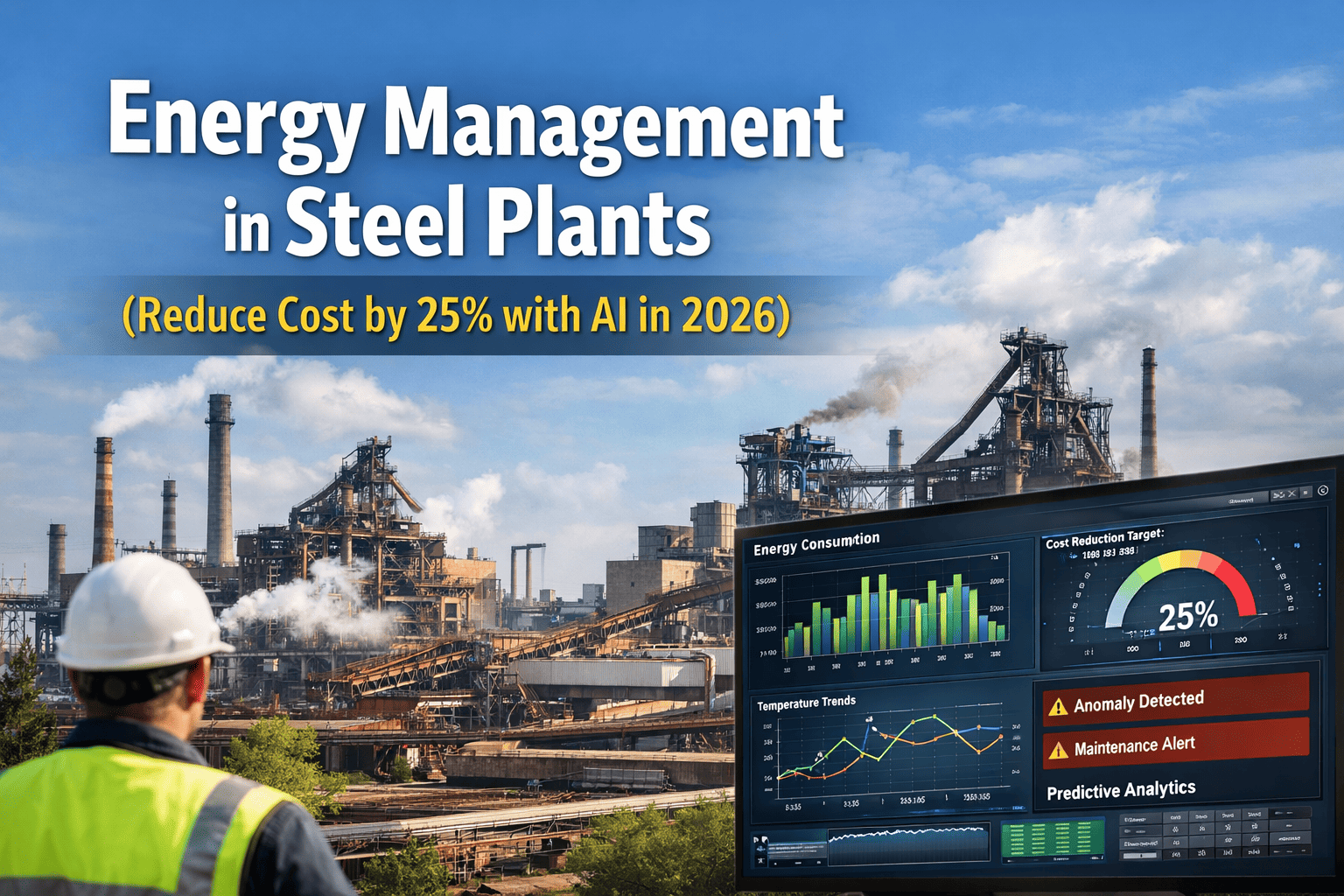
Steel is one of the most energy-intensive industries on earth — and most integrated steel plants operate 8–15% above best-available-technology energy benchmarks without a precise fix on where the overage is. Energy loss in a steel plant is not concentrated in one location: it is distributed across blast furnace gas management, reheating furnace scheduling, compressed air leaks, peak-tariff grid imports, and the 20–50% of total process energy that escapes as waste heat through exhaust stacks and cooling systems. A 1% improvement in blast furnace energy efficiency at a 500 MW facility saves approximately $3.5 million annually — but only if the monitoring system can see the deviation in real time and trigger a maintenance response before the inefficiency accumulates for another shift. OxMaint's energy management dashboard connects to existing DCS, SCADA, and sensor infrastructure without replacing them — surfacing anomalies, triggering predictive maintenance work orders, and generating the ESG energy reporting that decarbonisation commitments require.
Reduce Cost by Up to 25% with AI in 2026
| Process Area | Primary Loss Mechanism | AI Intervention | Typical Saving |
|---|---|---|---|
| Blast Furnace | BFG flaring during pressure imbalances; suboptimal hot blast temperature | Real-time BFG capture optimization; hot blast temperature anomaly alerts | 8–12% |
| BOF / Steelmaking | BOF gas uncaptured during heat transitions; oxygen lance profile drift | BOF gas capture scheduling; lance profile optimization | 15–20% |
| Reheating Furnace | Overheating during hold periods; demand spikes from poor scheduling | AI synchronizes furnace schedule with rolling mill; reduces demand peaks | 18–22% |
| Compressed Air / Steam | Leaks account for 20–30% of compressed air output | Anomaly detection on flow vs. pressure deviation; auto-generates work orders | 20–30% loss recovered |
| Captive Power & Grid Import | Grid import during peak tariff; captive plant at suboptimal load | AI balances captive generation vs. grid import in real time | 12–15% |
| Waste Heat Recovery | Only ~25% of residual heat currently recovered | ORC and heat exchanger performance monitoring; fault detection | Up to 25% of energy input |
OxMaint connects to existing DCS, SCADA, PLC, and metering systems via OPC-UA, Modbus TCP, MQTT, and REST APIs — without modification to process control systems. Deployment takes 4–6 weeks with no production disruption.
OxMaint calculates Specific Energy Consumption (SEC) per tonne produced in real time — by process area, by shift, and by equipment. Every deviation above benchmark is flagged with the contributing asset and assigned to a maintenance root cause.
AI baseline models learn normal energy consumption patterns. Deviations trigger predictive alerts — identifying the specific equipment, anomaly nature, and estimated energy cost per hour. Alerts convert directly to maintenance work orders.
OxMaint benchmarks each process area against best-available-technology reference values from EU BREF Iron & Steel and IEA Steel Technology Roadmap. Plants operating above BAT receive prioritized recommendations.
Steel production accounts for approximately 7–9% of global CO₂ emissions. Energy management is the primary lever for decarbonisation, and ESG reporting is increasingly a regulatory requirement, not a voluntary disclosure. OxMaint generates audit-ready energy reports for all major industry frameworks.
- EU ETS Monitoring Plan — verified energy consumption per tonne of crude steel
- ISO 50001 — documented energy baseline, performance trends, and corrective action records
- GRI 302-1 & 302-3 — energy consumption within the organisation and energy intensity produced
- Science Based Targets (SBTi) — year-on-year SEC improvement tracking against committed reduction pathway
- CBAM (EU Carbon Border Adjustment Mechanism) — embedded carbon reporting per product category
The issue most steel plant energy managers face is not a lack of data — modern DCS and SCADA systems generate enormous quantities of it. The issue is that the data sits in process control systems that are not connected to maintenance systems, and the maintenance systems are not connected to the financial reporting system. So when a reheating furnace burner is misfiring and consuming 18% more gas than baseline, the process engineer sees it as a combustion deviation, the maintenance team sees it as a work order backlog item, and the CFO sees it as an unexplained energy cost variance — and none of them are looking at the same screen. What AI energy management does in practice is create a single layer that translates process anomalies into cost impact, assigns them to a maintenance corrective action, and tracks the financial recovery when the fix is made. That closes the loop between the sensor reading and the business outcome, which is where the 25% energy cost reduction target actually comes from.